Blog

  • What is Form 8854, Initial & Annual Expatriation Tax Statement

    What is Form 8854, Initial & Annual Expatriation Tax Statement


    Form 8854

    Form 8854 and Expatriation

    One of the most common questions our international tax lawyers receive each year when U.S. Taxpayers get ready to renounce their U.S. citizenship or terminate their Lawful Permanent Resident status is whether or not they will have to pay an exit tax when they leave the United States. It is important to note, that not all individuals who expatriate from the United States will owe an exit tax. 

        • First, there are two categories of individuals who may be subject to an exit tax — U.S. Citizens and Long Term Lawful Permanent Residents.
        • If a Taxpayer falls into one of these two categories, he must first determine whether or not he is considered to be a covered expatriate to determine if he may even become subject to exit taxes.
        • If the Taxpayer is a covered expatriate, then he may have an exit tax — but it is important to note that the exit tax is not a wealth tax. Rather, it is a U.S. tax based on whether income or gains have accumulated while the Taxpayer was a U.S. person but has not been recognized/realized yet.

    *For all examples, please note that the Taxpayers are U.S. persons for tax purposes who have not made any treaty elections to be treated as a Non-Resident Alien (NRA). Also, these examples are for illustrative purposes only and Taxpayers should consult with a Board-Certified Tax Law Specialist if they have specific questions about their reporting requirements and not rely on this article for legal advice.

    Form 8854 is Not Only For Covered Expatriates

    One of the biggest misconceptions about IRS Form 8854 is that it is only required for covered expatriates, but that is inaccurate. An initial Form 8854 is required by U.S. citizens or Long-Term Lawful Permanent Residents whether or not they are covered expatriates. Some Taxpayers who may otherwise be covered expatriates or subject to exit tax may qualify for an exception or an exclusion — but that does not negate them having to file Form 8854.

    IRS Form 8854 is Due When the Tax Return is Filed

    Form 8854 is due with the final tax return following the expatriating act. For example, if a Taxpayer submits Form I-407 in the current year, then he will file Form 8854 in the subsequent year when he files his tax return. Some Taxpayers are being misguided into filing Form 8854 in the same actual year that they expatriate, which leads to the Taxpayer filing the incorrect form and increasing the chance of an audit.

    Before Filing Form 8854 You Need 5 Years of Tax Compliance

    Some Taxpayers are only deemed covered expatriates because they cannot certify under penalty of perjury that they have been tax-compliant for the past five years. To avoid this outcome, the Taxpayer must be in tax compliance before starting the immigration expatriation process (which precedes the expatriation tax filing process) such as renouncing U.S. citizenship or filing Form I-407 to terminate their U.S. person status. 

    As provided by the IRS:

        • Date of relinquishment of U.S. citizenship.

          • You are considered to have relinquished your U.S. citizenship (and consequently, have an expatriation date) on the earliest of the following dates.

            1. The date you renounced your U.S. citizenship before a diplomatic or consular officer of the United States (provided that the voluntary renouncement was later confirmed by the issuance of a certificate of loss of nationality).

            2. The date you furnished to the State Department a signed statement of your voluntary relinquishment of a U.S. nationality confirming the performance of an expatriating act (provided that the voluntary relinquishment was later confirmed by the issuance of a certificate of loss of nationality).

    Annual Reporting for Deferred Compensation Owners

    Even after Form 8854 is filed in the year of expatriation, some Taxpayers may have an ongoing Form 8854 filing requirement if they still maintain certain deferred compensation such as a 401K. To avoid this nuisance, some Taxpayers may withdraw their deferred compensation at the time they expatriate and pay U.S. taxes at the time.

    Failure to File Form 8854 Leads to Additional 1040 Returns

    Until a person files IRS Form 8854, the IRS is unaware that the Taxpayer has formally expatriated. That is because expatriation is a two-pronged process that includes immigration and tax. Unless the Taxpayer files Form 8854, the IRS is not aware that the Taxpayer has already completed the immigration portion. If Form 8854 was not filed, the Taxpayer may become subject to additional Form 1040 returns and still have to pay U.S. taxes on their worldwide income.

    Net Worth vs Exit Tax

    It is very important to note that when a Taxpayer is covered, it does not mean that they will have an exit tax when they leave the United States — even if they have a high net worth.  There generally has to be some type of unrealized income such as mark-to-market gain with stock (or other equities), ineligible deferred compensation that accrued while the taxpayer was a U.S. Person and is deemed distributed at exit, etc. Let’s look at two different examples to illustrate the concept:

        • Example 1: Michelle is a U.S. Citizen who owns stock worth $4M. She acquired the stock for $1M. When Michelle expatriates from the United States, she may have an exit tax based on the mark to market gain in the stock.
        • Example 2: Dylan is a U.S. Citizen who has $50M in cash. While Dylan will be considered a covered expatriate, he would not have any immediate exit tax because his assets are all cash.

    Mark-to-Market Gains

    The most common type of exit tax is based on mark-to-market gains. In an all-too-common situation, the Taxpayer may have purchased stock while they were a U.S. person, and that stock value has gone up significantly so that if the stock was sold on the day before the person expatriated there would be a gain. Noting, that there is an exit tax exclusion which may eliminate MTM exit taxes for some Taxpayers (currently, it is $821,000 and adjusts each year for inflation).

        • Example 1: Peter is a U.S. Citizen who purchased stock worth $600,000 several years ago and now the stock is worth $1.3M. If this is the only mark-to-market asset that Peter has, then the exclusion amount should cover any gain so that there would not be any exit tax when Peter expatriates.
        • Example 2: Daniel is a U.S. citizen who purchased stock worth $600,000 seven years ago and now the stock is worth $3.8M. Even if Daniel applies the exclusion amount, he will still have to pay a significant exit tax on the Long Term Capital Gain for the difference between the fair market value on the day before he expatriates and the adjusted basis.
        • Example 3: Michelle is a Lawful Permanent Resident who purchased stock before she became a Lawful Permanent Resident for $300,000. On the day she became a Lawful Permanent Resident the stock was worth $800,000 and on the day before she expatriates, it is worth $1.2M. Due to the step-up value that Michelle would receive on the day which became a Lawful Permanent Resident, if this is the only mark to market asset Michelle has she may be able to avoid MTM exit taxes on this particular asset.

    Eligible Deferred Compensation

    When it comes to Eligible Deferred Compensation (such as 401K), Taxpayers generally do not have to pay any exit tax at the time they expatriate. In the future, if they were covered, they may have to pay tax on the distributions. While no exit tax may be due when they expatriate, they may have to irrevocably waive the right to treaty benefits when they receive distributions.

    Ineligible Deferred Compensation

    When a person is covered and has ineligible deferred compensation, they may be required to pay an exit tax on the ineligible deferred compensation as if it had been distributed. This type of exit tax is especially unfair, especially in light of the fact that oftentimes ineligible deferred compensation is just a foreign retirement plan that receives tax-deferred treatment in the foreign country where the pension plan is situated — similar to a 401K in the United States. If the taxpayer has a step up, it may serve to reduce any exit taxes.

        • Example 1: Mindy is a Long Term Lawful Permanent Resident who previously earned pension while living overseas as a green card holder. She is a covered expatriate and has a $1.5M pension (with no U.S. tax basis), all of it which was received while she was a U.S. person. No taxes have been paid on the pension and therefore the full amount of the pension may become subject to exit tax.
        • Example 2: William is a U.S. Citizen who has been on different assignments throughout the globe for many years but always maintains an international pension plan overseas that is not considered qualified in the United States. It is now worth $3.2M dollars and no taxes have been paid. The full amount of the pension plan may become taxable.
        • Example 3: Jennifer is a Long-Term Resident who has $2M in foreign pension. She is a covered expatriate, but she only became a green card holder nine years ago. Before she became a green card holder from marriage, she did not have any U.S. person status. When she first came to the United States and became a green card holder the foreign pension was worth $1.6M. Therefore, Jennifer may be able to take the position that only ~$4M of the amount of pension may be taxable because of the step-up.

    Specified Tax Deferred Accounts

    Another common category of exit tax is specified tax-deferred accounts. A common example of a specified tax-deferred account may be a traditional IRA — which may be impacted based on whether the IRA is an employment IRA or an investment IRA. In general, the IRS takes the position that the IRA loses its tax-deferred status and becomes deemed distributed at the time of expatriation. However, if it is a Roth IRA and if the Taxpayer meets the requirements for longevity and age of the taxpayer, it may avoid exit tax.

        • Example 1: Frank is a U.S. citizen who has $700,000 in his IRA. It is a non-employment traditional IRA which has no tax basis since it is all pre-tax dollars. Therefore, since Frank is a covered expatriate, when he expatriates he may have to pay exit tax on that $700,000.
        • Example 2: Denise is a U.S. citizen who has $500,000 in a Roth IRA and she is also a covered expatriate. Denise is 71 years old and has had her Roth IRA for more than 20 years. Therefore, Denise may be able to avoid exit taxes on her Roth IRA.

    The Tip of the Iceberg

    This article aims to help clarify some of the basics of exit taxes. Being tax compliant when a person expatriates is very important and exit taxes in general can be very complicated, especially when it involves additional items such as foreign life insurance policies, foreign corporations, foreign partnerships, and transactions between U.S. persons and foreign companies. Taxpayers should try to stay in compliance if they are already in compliance or should consider getting into compliance if they have not properly filed the necessary reporting forms if for no other reason than the fact that the IRS has made offshore compliance a key enforcement priority and has been issuing fines and penalties for non-compliance. 

    Late Filing Penalties May be Reduced or Avoided

    For Taxpayers who did not timely file their FBAR and/or other international information-related reporting forms, the IRS has developed many different offshore amnesty programs to assist Taxpayers with safely getting into compliance. These programs may reduce or even eliminate international reporting penalties.

    Current Year vs. Prior Year Non-Compliance

    Once a Taxpayer missed the tax and reporting (such as FBAR and FATCA) requirements for prior years, they will want to be careful before submitting their information to the IRS in the current year. That is because they may risk making a quiet disclosure if they just begin filing forward in the current year and/or mass filing previous year forms without doing so under one of the approved IRS offshore submission procedures. Before filing prior untimely foreign reporting forms, Taxpayers should consider speaking with a Board-Certified Tax Law Specialist who specializes exclusively in these types of offshore disclosure matters.

    Avoid False Offshore Disclosure Submissions (Willful vs Non-Willful)

    In recent years, the IRS has increased the level of scrutiny for certain streamlined procedure submissions. When a person is non-willful, they have an excellent chance of making a successful submission to Streamlined Procedures. If they are willful, they would submit to the IRS Voluntary Disclosure Program instead. But, if a willful Taxpayer submits an intentionally false narrative under the Streamlined Procedures (and gets caught), they may become subject to significant fines and penalties

    Need Help Finding an Experienced Offshore Tax Attorney?

    When it comes to hiring an experienced international tax attorney to represent you for unreported foreign and offshore account reporting, it can become overwhelming for Taxpayers trying to trek through all the false information and nonsense they will find in their online research. There are only a handful of attorneys worldwide who are Board-Certified Tax Specialists and who specialize exclusively in offshore disclosure and international tax amnesty reporting.  *This resource may help Taxpayers seeking to hire offshore tax counsel: How to Hire an Offshore Disclosure Lawyer.

    Golding & Golding: About Our International Tax Law Firm

    Golding & Golding specializes exclusively in international tax, specifically IRS offshore disclosure

    Contact our firm today for assistance.

  • Why One Mistake Can Cost You Everything |

    Why One Mistake Can Cost You Everything |

    A recent court case didn’t just expose a weakness in one investor’s asset protection—it dismantled it. 

    The irony is that the structure involved a Limited Liability Company (LLC), the very tool most investors use to create asset protection for real estate holdings. 

    Forming an LLC for real estate is often the first step people take when they want stronger legal safeguards. 

    But true LLC asset protection depends on far more than filing formation documents.

    An LLC only protects what it’s designed to protect. 

    If your ownership records, management authority, and operating agreement don’t line up, a creditor can exploit the gaps—and that’s usually when investors learn their “protection” was mostly paperwork.

    The real dividing line is inside vs. outside liability. 

    If a tenant or property dispute arises, the claim typically stays within the LLC. But when you’re sued personally, the creditor can target your ownership interest. 

    That’s where a charging order becomes relevant—and, depending on state law, it may not be the end of the creditor’s options.

    Understanding how to protect assets from lawsuits requires more than forming a business entity. It demands clarity around control—especially the distinction between member vs. manager—and a business structure designed to withstand scrutiny when it matters most.

    What Is the Difference Between Inside & Outside Liability?

    When we talk about liability, we’re really discussing two types of protection:

    1. Inside Liability

    This is when something happens inside the legal entity.

    For example:

    • A tenant sues over an injury.
    • A contractor dispute arises.
    • A property-related lawsuit is filed.

    In these situations, the LLC prevents you from being personally liable, keeping the lawsuit confined to the company rather than exposing your personal assets.

    This protection applies in all 50 states, and that’s why real estate investors use LLCs.

    Request a free consultation with an Anderson Advisor

    At Anderson Business Advisors, we’ve helped thousands of real estate investors avoid costly mistakes and navigate the complexities of asset protection, estate planning, and tax planning. In a free 45-minute consultation, our experts will provide personalized guidance to help you protect your assets, minimize risks, and maximize your financial benefits. ($750 Value)

    2. Outside Liability

    Outside liability stems from issues tied to your personal life (and sometimes family members).

    It is more dangerous because a personal judgment can create pressure on anything tied to personal finances—cash flow, distributions, even bank accounts used for deposits or operating reserves.

    Examples:

    • Auto accident
    • Business debt
    • Personal lawsuit

    Now the creditor has a judgment against you, and they are seeking the interest you have as the owner of an LLC. That’s where charging orders come into play.

    What Is a Charging Order & Why Does It Matter?

    A charging order is a court order that allows a creditor to collect from the financial rights tied to your membership interest in an LLC—meaning they can intercept distributions you would receive, but they do not automatically become the business’s owner or take control of the company.

    Here’s how it works:

    • You owe $500,000 from a personal lawsuit.
    • Your LLC has $300,000 inside it, but they can’t take your assets.
    • They place a charging order on your interest instead and take distributions from the LLC.

    At first glance, that sounds like protection. The catch is that in some states, a charging order isn’t the end of the road. If the court allows additional remedies, a creditor may be able to push beyond intercepting distributions and seek foreclosure of the membership interest—turning a lien into a pathway to control and access.

    That is precisely what occurred in Orix Reinsurance Co. v. Collier out of California. After securing a judgment against the individual member, the creditor obtained a charging order and then pursued foreclosure when no distributions were made. 

    The creditor stepped into the member’s ownership position and gained control of the LLC interest—an outcome most investors assume cannot happen. You can see me discuss the case here.

    How Did the Investor Lose His Business?

    The individual argued that he had transferred his ownership years earlier.

    But discovery showed:

    • He never updated records with the Secretary of State.
    • He continued signing as a member-manager.
    • He held himself out as the owner.

    The court determined that he still effectively owned the single-member LLC, despite his claim that he had transferred the interest.

    After the court issued the charging order and the LLC made no distributions, the creditor moved to foreclose.

    Why Do State Laws Matter?

    Not all states treat LLCs equally. Some states allow foreclosure as a remedy after a charging order.

    Other states limit the creditor to charging-order-only protection. That distinction is critical, and why entity structure matters so much in asset protection planning.

    What Is the Proper Entity Stack for Real Estate Investors?

    If you’re serious about how to protect assets from lawsuits, you have to think in layers.

    A common structure used:

    • A state-specific LLC (where the property is located)
    • Owned 100% by a Wyoming LLC

    Why Wyoming? Because its statute limits a creditor to charging-order-only protection. That means no foreclosure and no forced takeover of the company.

    You can further reinforce the structure by:

    • Adding a second member (such as a spouse or partner)
    • Using a manager-managed design
    • Clearly separating authority between members and managers

    Each layer increases resistance. And resistance creates leverage.

    How Should an Operating Agreement Be Drafted?

    This is where most LLCs fail.

    A generic operating agreement will not hold up under pressure. Your agreement must anticipate action and limit the remedies available to creditors.

    At a minimum, it should include:

    1. Charging Order as the Sole Remedy
    The agreement should clearly state that a charging order is the exclusive remedy—no foreclosure and no forced transfer of control.

    2. Automatic Conversion to Transferee Status
    If a member becomes subject to a charging order, they automatically lose voting and management rights. This prevents a creditor from arguing for control.

    3. Buyout (“Call”) Provisions
    Other members should have the right to purchase the affected interest under pre-agreed terms. This prevents a creditor from gaining leverage.

    4. Tax Allocation Language
    Because LLCs are pass-through entities, income can be allocated to the charging order holder—even if no cash is distributed. The agreement should state that the LLC is not required to distribute funds for taxes. That means a creditor could owe tax on income they never received.

    5. Discretionary Distributions
    Distributions should be made solely at the manager’s discretion. Mandatory distributions give creditors predictable access. Discretion removes that predictability.

    Why Member vs. Manager Structure Matters

    In a member-managed LLC, owners control operations directly. In a manager-managed LLC, control is separated from ownership. Courts examine who actually runs the company, not just what the documents say.

    If someone claims they transferred ownership but continues signing as a controlling member, that inconsistency creates vulnerability.

    Always:

    • Update state filings
    • Maintain formalities
    • Clearly define authority roles

    Asset protection fails when documentation and conduct don’t match.

    Does Your LLC Actually Protect You? The California Case Says “Maybe.”

    An LLC can provide strong asset protection for real estate, but only when it’s properly structured and operated. The California case Orix Reinsurance Co. v. Collier proved what happens when those details don’t line up: A creditor used a charging order and then pushed into foreclosure, costing the owner his interest.

    Quick self-check:

    • Can a creditor in your setup go beyond a charging order?
    • Does your operating agreement limit remedies and protect control?
    • Are distributions discretionary (not automatic)?
    • Are tax allocations and roles clearly defined?
    • Is your ownership layered with the right entity stack?

    If you’re unsure about any of these, your rental properties or your business may be more vulnerable than you think. Schedule a free 45-minute Strategy Session with a Senior Advisor, and we’ll test your structure and work with you to create a corrective plan to ensure your business and assets stay where they belong–with you.

    Unlock the Secrets of Top Real Estate Investors — Save Your Free Spot Today!

    Join our FREE Virtual Tax & Asset Protection Workshop to discover how to slash your taxes, shield your assets, and secure your financial future.

    Live Q&A with Experts | Real Strategies You Can Use Immediately

  • Nonresident alien tax return guide

    Nonresident alien tax return guide

    What income goes on Form 1040NR?

    The IRS divides nonresident income into two main categories: Effectively Connected Income (ECI) and FDAP income. The difference matters because each category is taxed differently.

    Effectively Connected Income (ECI) is income that arises from working in the United States or operating a US trade or business.

    • Wages from a US employer
    • Self-employment income connected to US services
    • Business profits from US operations

    ECI is taxed at graduated rates, similar to how residents are taxed. You can usually deduct expenses that are directly connected to earning that income. In practice, this means careful tracking of business-related expenses can reduce taxable income.

    FDAP income (Fixed, Determinable, Annual, or Periodical income) is usually passive US-source income. Common examples include:

    • Dividends
    • Royalties
    • Rental income
    • Certain types of US-source interest (although some bank deposit interest may be exempt from US tax for nonresidents)

    FDAP income is typically subject to a flat 30% withholding rate at the source, unless a tax treaty reduces that rate. Unlike ECI, FDAP income is usually taxed on a gross basis, meaning you typically cannot deduct expenses against it.
    When FDAP income is involved, Schedule NEC (attached to Form 1040NR) is typically used to calculate the tax separately from effectively connected income.

  • Free CourtListener Docket Sheet and Documents for Major Tax Crimes Case (Also Major White Collar Crimes Case) (7/3/25)

    Free CourtListener Docket Sheet and Documents for Major Tax Crimes Case (Also Major White Collar Crimes Case) (7/3/25)

    I write to inform principally students and young lawyers of
    a case with documents that can educate in both tax crimes and white collar crimes. The case is United States v. Goldstein
    (D. Md. No. 8:25-cr-00006), with free access to docket entries on CourtListener, here.
    CourtListener has the docket entries but offers free access to a document only
    after the first CourtListener member retrieves the document from PACER, a paid
    service. For a case of this notoriety, most of the important documents will have
    been so retrieved and are available free.

    Although I have only looked at some of the documents that
    interest me, I think the quality of lawyering is very good. Furthermore, tax
    crimes are white-collar crimes in a tax setting. Hence, the documents (which
    are many) are often hashing out themes that will be of interest to lawyers
    and students of white -collar crimes.

    I recommend that those interested review the CourtListener
    document entries and review the documents that you find interesting. 

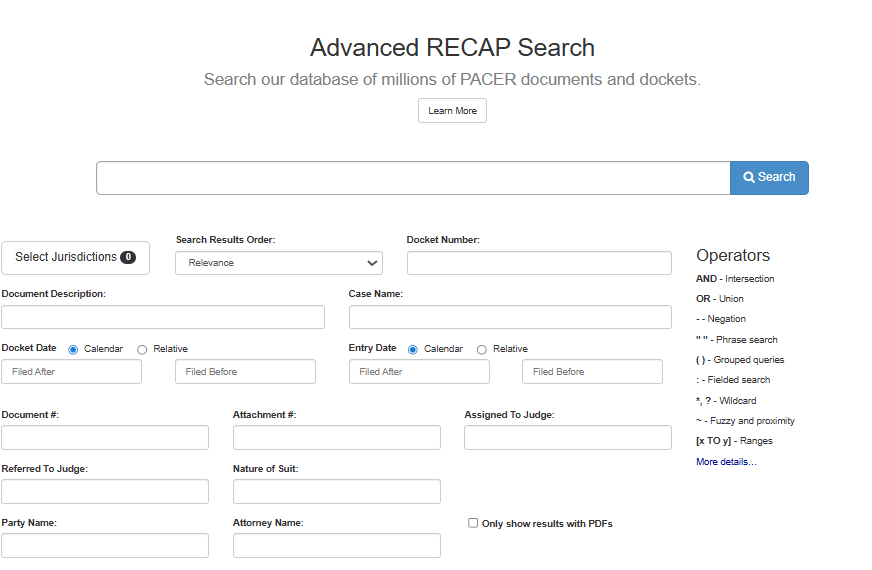
    You can also do a search of the CourtListener Recap Archive which has docket sheets and documents for all federal cases. The Recap Archive with case search features is here and looks like this:

    Finally, CourtListener is a good resource. The home page is here. It is free to join and relies
    on donations. In my practice and writing, I use CourtListener a lot.

    There are other similar free services, but this is the one I use. I’m not saying that it is the best, but it is my go-to source for court documents.

  • Austaxpolicy – ANU and Monash Collaboration

    Austaxpolicy – ANU and Monash Collaboration

    The Tax team in Monash’s Business Law and Taxation department

    We are delighted to announce that Austaxpolicy, established by TTPI, is now a collaboration between the ANU and Monash University.  The ANU looks forward to working with the Tax team in Monash’s Business Law and Taxation department (pictured above) to jointly advance our shared goal of disseminating tax and transfer research for the public benefit.

    Monash’s Tax Law Research Group undertakes qualitative and quantitative research on tax law and policy issues of national and international significance. The Tax team’s subject matter expertise spans the full taxation spectrum, including personal and corporate income tax, energy and resources taxation, value added taxes, taxpayer compliance, and international taxation. The Group is committed to developing innovative cross-disciplinary projects that produce rigorous and accessible research for policymakers, the academy, the profession and the broader community.

    Together, we will draw on our combined expertise, networks and institutional strengths to share important and pioneering research on tax and transfer policy with a global audience.


    The Tax team in Monash’s Business Law and Taxation department, from left to right in image:

    Agustinus Saputra (PhD Student), Ananda Anggara S (PhD Student), Swapna Verma, Amanda Selvarajah, Amna Shah, Helen Ping (co-editor of Austaxpolicy), John Minas (co-editor of Austaxpolicy and Director of the Taxation Law and Policy Research Group), John Bevacqua (head of Monash Department of Business Law and Taxation), Wide Putra (PhD Student)

    Citation :


    Walpola, Sonali,  Ping, Yuan,  Minas, John,  Morris, Todd,  Labanca, Claudio  & You, Jean,
    (2026)
    Austaxpolicy – ANU and Monash Collaboration
    Austaxpolicy: Tax and Transfer Policy Blog, 
    20 March 2026, Available from:

    About the Author

    Sonali Walpola

    Dr Sonali Walpola is an Associate Professor at the ANU College of Business and Economics. Sonali’s research interests broadly encompass taxation law and policy and the nature of common law developments. Her recent projects have analysed integrity measures to address tax avoidance through trusts, the interpretation of the residence article in double tax agreements, and the Australian High Court’s attitude to change in the common law. Sonali is a co-editor of Austaxpolicy, the Journal of Australian Taxation and Law&History, which is the journal of the Australia New Zealand Law History Society. Sonali is a fellow of the ANU Tax and Transfer Policy Institute, a member of The Tax Institute Higher Education Academic Board, and the Academic Lead of the ANU Tax Clinic, which she co-founded in 2019.

    Yuan Ping

    Yuan (Helen) Ping is a Lecturer in Business and Corporate Law at the Department of Business Law and Taxation of Monash University and a qualified legal practitioner. She is currently completing a PhD at the Research School of Accounting, Australian National University. Helen’s research interests are in the fields of regulatory enforcement and corporate tax behaviour, specifically examining the effects of the U.S. Securities and Exchange Commission’s tax-related comment letters on market response and firm policies. She has published papers in the Australian Tax Forum and eJournal of Tax Research. Helen is also the co-editor of Austaxpolicy.

    John Minas

    John Minas is an Associate Professor in the Department of Business Law and Taxation at Monash University, a Research Affiliate with the Tax and Transfer Policy Institute, Crawford School of Public Policy, at ANU, and an Adjunct Research Fellow in the Law Futures Centre at Griffith University.

    Todd Morris

    Todd Morris is a Lecturer in the School of Economics at the University of Queensland and an Economics Editor at AusTaxPolicy. He obtained his PhD from the University of Melbourne in 2020. After that, he was a postdoctoral researcher at the Max Planck Institute for Social Law and Social Policy from 2019 to 2021 and at HEC Montreal from 2022 to 2023. His main research interests are in public and labour economics. A unifying theme to his research is the causal evaluation of government policies (often related to retirement).

    Claudio Labanca

    Dr Claudio Labanca is a Senior Lecturer in the Department of Economics at Monash University. His research interests include Labor Economics, Public Economics and Applied Microeconomics. Claudio is a Research Affiliate at the IZA, the Tax and Transfer Policy Institute at the ANU, SoDa Labs, and is a co-editor of Austaxpolicy. 

    Jean You

    Dr Jean You is a Lecturer in Research School of Accounting of Australian National University. Jean’s research interests are in the fields of regulatory enforcement and policy setting, specifically tax transparency and tax avoidance in multinational entities. She has published papers in the Australian Tax Forum and ABACUS.

  • Tax Scams Continue to Grow; IRS Simplifies Reporting of Scams

    Tax Scams Continue to Grow; IRS Simplifies Reporting of Scams

    In February, the IRS announced a new online reporting tool for suspected tax fraud, scams, and illegal activities. Smartly, the link is on the main page (in the dark blue line):

    This month, the IRS released the 2026 Dirty Dozen list of various scams to watch out for, such as fake charities seeking your money, phishing to get you to click on links that enable the scammer to get information from you, AI-enabled robocalls impersonating an IRS employee, misleading tax advice on social media, and more.

    For a list of the dirty dozen since the IRS started this in 2001, please visit my table. You’ll see that a few have disappeared but most continue or have morphed into digital scams.

    The IRS also created two nice posters (pubs) with a QR code to encourage people to report scams. I think that while the IRS or other law enforcement agencies might not find your scammer, with more information, they do find some and can alert the public to new scams and ways to avoid them.  These pubs are 6138 and 6139.

    Something that has also changed is getting emails that clearly look suspect such as because they are poorly written with grammar and spelling errors. Well, scammers likely are using AI to write more grammatically correct, enticing looking emails and texts – we all need to be extra cautious.  When in doubt, don’t click but instead find another way to verify if the information is valid, such as logging into the online account they are talking about (using your usual link rather than the one in the email), such as your IRS online account (or one I get frequently is that my Amazon account has been suspended (!) when it has not).

    What do you think?  What more can be done to help people from being the victim of identity theft or falling for a tax scam such as claiming a bogus tax credit or giving money to scammers pretending to be the IRS or a state tax agency?

  • Ask Phil: Should I Wait 60 days to file my taxes? 

    Optima Tax Relief’s Chief Tax Officer and Lead Tax Attorney, Phil, answers another question from Reddit about getting back into tax compliance. In this case, the taxpayer hasn’t filed taxes in 10 years and was told by an enrolled agent that they likely only need to file the last six years to become current with the IRS. However, they’re wondering if they should wait 60 days until the next tax season so they won’t have to file their oldest return. 

    How the Six-Year Rule Works 

    The IRS typically requires taxpayers who are behind on filing to submit their most recent six years of tax returns. In this situation, the taxpayer estimates they owe about $30,000 in taxes, but with penalties and interest, the balance has grown to nearly $50,000. Waiting 60 days could potentially push the filing window forward and eliminate the need to file the oldest return. 

    Can You Wait? Yes. But Should You? 

    While it’s technically possible to wait, it may not always be the best move. For example, self-employed individuals may want to file older returns so their income is properly reported to the Social Security Administration, which can affect future retirement benefits. 

    The Risk of IRS Action 

    Another concern is that the IRS can file a Substitute for Return (SFR) on your behalf if you don’t file. These IRS-prepared returns exclude deductions and credits entirely, resulting in a larger tax bill. In some cases, a revenue officer may even request more than six years of returns if you had a filing requirement. 

    Waiting may seem tempting, but delaying can create more complications. Don’t wait—file your returns and start resolving the issue sooner rather than later. 

    If you need tax help, contact us today for a Free Consultation 

  • California Wealth Tax | 2026 Billionaire Tax Act

    California Wealth Tax | 2026 Billionaire Tax Act

    Proponents of a California wealth tax ballot initiative insist that the proposed wealth taxA wealth tax is imposed on an individual’s net wealth, or the market value of their total owned assets minus liabilities. A wealth tax can be narrowly or widely defined, and depending on the definition of wealth, the base for a wealth tax can vary. is temporary: a one-time 5 percent tax that can be paid upfront or over five years with deferral charges. Others are skeptical that the wealth taxA tax is a mandatory payment or charge collected by local, state, and national governments from individuals or businesses to cover the costs of general government services, goods, and activities. would be allowed to expire. Crucially, many billionaires who would be subject to the tax seem to think that it will become a long-term fixture of California’s tax code if approved by the voters this fall, which could influence decisions to depart.

    There’s good reason to believe that opponents’ policy fears are warranted—that the rationales for the wealth tax are largely inconsistent with a temporary tax, and that if the state imposes a one-time wealth tax, there will be considerable pressure to extend it or make it permanent. Concerns that the ballot measure enables the legislature to extend the tax without returning to the voters, however, appear to have less warrant.

    The ostensive purpose of the 2026 Billionaire Tax Act is to raise revenue to offset reductions in healthcare expenditures under H.R. 1. Proponents wish not only to cover the costs of the higher state funding share created by the federal law, but also to expand coverage at the state level to cover those no longer eligible at the federal level. Whether the new federal policies will remain in place is an open question, but there is certainly no guarantee that California’s costs will revert to lower levels in the coming years. Proponents have proposed a temporary tax to fund new spending that could easily become recurring.

    But efforts to impose a wealth tax in California far predate H.R. 1. The same tax law professors and economists behind this year’s wealth tax ballot measure were also the drafters and champions of California legislation in 2021 and 2023 that would have created permanent wealth taxes. These bills were part of a coordinated effort on wealth taxes and other taxes on high-net-worth households, including wealth tax proposals in Hawaii and Washington. Clearly, proponents felt a wealth tax was worth pursuing with or without H.R. 1.

    The California measure’s drafters have co-written journal articles on additional (permanent) state wealth tax designs, and most recently, the same people who drafted California’s supposedly temporary wealth tax have also been involved with Sen. Bernie Sanders’ newly proposed permanent wealth tax at the federal level. A one-time tax might have been a political concession, but there is no question that the measure’s proponents believe in wealth taxes as a permanent policy.

    The tax is, moreover, designed as an excise taxAn excise tax is a tax imposed on a specific good or activity. Excise taxes are commonly levied on cigarettes, alcoholic beverages, soda, gasoline, insurance premiums, amusement activities, and betting, and typically make up a relatively small and volatile portion of state and local and, to a lesser extent, federal tax collections. on “the activity of sustaining excessive accumulations of wealth” and is a prime example of a growing emphasis in some quarters on the erosion of wealth as a goal, rather than merely a consequence, of progressive taxA progressive tax is one where the average tax burden increases with income. High-income families pay a disproportionate share of the tax burden, while low- and middle-income taxpayers shoulder a relatively small tax burden. policy. If proponents regard “excessive accumulations of wealth” as a problem to be addressed through public policy, then the case for wealth taxation will not have changed one or five years from now.

    Temporary taxes have a way of sticking around. California’s current top rates were first adopted in 2012 as a seven-year surcharge. Voters extended the income tax increases in 2016 and will decide this year whether to make the higher rates permanent. But at least this involved going back to the voters.

    New York’s millionaire tax, adopted in 2009 as a two-year expedient to get through the Great RecessionA recession is a significant and sustained decline in the economy. Typically, a recession lasts longer than six months, but recovery from a recession can take a few years., has been extended multiple times, with the current budget proposing an extension through 2032. Since 2009, temporary individual and corporate income taxA corporate income tax (CIT) is levied by federal and state governments on business profits. Many companies are not subject to the CIT because they are taxed as pass-through businesses, with income reportable under the individual income tax. increases in Connecticut, Delaware, Illinois, New Jersey, and Wisconsin have also become permanent, with slight adjustments. Not all temporary increases become permanent, but states are often loath to give up revenue sources they’ve acquired, even if the original reason for the tax increase no longer exists.

    The economic consequences of the initial, one-time wealth tax, moreover, could make further wealth taxation more likely: by driving some billionaires, potentially along with their investments and business interests, out of state, the California wealth tax will shrink the existing tax baseThe tax base is the total amount of income, property, assets, consumption, transactions, or other economic activity subject to taxation by a tax authority. A narrow tax base is non-neutral and inefficient. A broad tax base reduces tax administration costs and allows more revenue to be raised at lower rates.. Underperformance of other taxes, particularly the individual income taxAn individual income tax (or personal income tax) is levied on the wages, salaries, investments, or other forms of income an individual or household earns. The U.S. imposes a progressive income tax where rates increase with income. The Federal Income Tax was established in 1913 with the ratification of the 16th Amendment. Though barely 100 years old, individual income taxes are the largest source, could easily become the rationale for future wealth taxation.

    The incentive, therefore, is for billionaires to leave now, and for future founders to create their startups elsewhere. No one wants to be the one holding the bag if the first exodus increases the likelihood of future wealth taxes. Despite drafters’ efforts to lock in billionaires by using a January 1, 2026, residency date, there are good reasons to believe that this date will not survive legal challenges, and that taxpayers could avoid some or all liability by moving later this year.

    Some critics of the proposed wealth tax worry that it contains the seeds of its own extension. However, it would take an unusually creative interpretation of its language for this to be the case.

    California’s constitution currently caps the taxation of intangible personal property at 0.4 percent, which would, by definition, preclude a wealth tax at a rate above 0.4 percent absent a constitutional amendment. Other existing constitutional provisions, as well as the language of ballot initiatives, which have quasi-constitutional status (the legislature cannot amend or repeal them on its own), also create impediments to a wealth tax. Previous legislative proposals have been paired with such constitutional amendments, which must be ratified by the voters. Some fear that this year’s ballot initiative, although supposedly creating a one-time tax, will permanently lift the constitutional barriers that restrain the legislature’s authority to adopt a future wealth tax on its own.

    The initiative, however, does not repeal the relevant constitutional provisions. It instead allows the 2026 California Billionaire Tax Act to supersede them. The new constitutional language appears to stipulate that (1) only this Act can supersede the 0.4 percent cap and other limitations, and (2) this Act is a one-time tax. While the legislature has the authority to amend the Act in ways that further its purposes, any amendment that turned it into a permanent tax seems facially inconsistent with its description (including in the constitutional language) as a one-time tax.

    This is not to rule out the possibility entirely. Perhaps courts would bless creative language allowing the tax to be imposed in future years on those who later become billionaires, on the theory that it is imposed one time on each taxpayer. Perhaps they would regard a retroactive rate increase spread out over additional years as still being one-time. Perhaps they would conclude that the specific supersession of the cap stands for a general principle that it is not inviolable. All these interpretations seem wildly unlikely, at odds with the text of the initiative and an affront to due process, but states have tried wilder things, and judicial deference to legislative prerogative has sometimes prevailed. These concerns cannot be dismissed out of hand, but they do seem highly improbable.

    Still, even if the legislature cannot extend the tax without returning to the voters, it is easy to imagine future budget shortfalls—exacerbated by the economic consequences of the wealth tax—prompting lawmakers to seek authorization for a permanent wealth tax. The apparatus for collecting and administering the tax would already be in place. Voters should consider the possibility that a temporary wealth tax would pave the way for a permanent one. It’s clear that the tax’s targets are already taking that possibility seriously.

    Stay informed on the tax policies impacting you.

    Subscribe to get insights from our trusted experts delivered straight to your inbox.

    Subscribe

    Share this article


  • California Wealth Tax | 2026 Billionaire Tax Act

    California Wealth Tax | 2026 Billionaire Tax Act

    Proponents of a California wealth tax ballot initiative insist that the proposed wealth taxA wealth tax is imposed on an individual’s net wealth, or the market value of their total owned assets minus liabilities. A wealth tax can be narrowly or widely defined, and depending on the definition of wealth, the base for a wealth tax can vary. is temporary: a one-time 5 percent tax that can be paid upfront or over five years with deferral charges. Others are skeptical that the wealth taxA tax is a mandatory payment or charge collected by local, state, and national governments from individuals or businesses to cover the costs of general government services, goods, and activities. would be allowed to expire. Crucially, many billionaires who would be subject to the tax seem to think that it will become a long-term fixture of California’s tax code if approved by the voters this fall, which could influence decisions to depart.

    There’s good reason to believe that opponents’ policy fears are warranted—that the rationales for the wealth tax are largely inconsistent with a temporary tax, and that if the state imposes a one-time wealth tax, there will be considerable pressure to extend it or make it permanent. Concerns that the ballot measure enables the legislature to extend the tax without returning to the voters, however, appear to have less warrant.

    The ostensive purpose of the 2026 Billionaire Tax Act is to raise revenue to offset reductions in healthcare expenditures under H.R. 1. Proponents wish not only to cover the costs of the higher state funding share created by the federal law, but also to expand coverage at the state level to cover those no longer eligible at the federal level. Whether the new federal policies will remain in place is an open question, but there is certainly no guarantee that California’s costs will revert to lower levels in the coming years. Proponents have proposed a temporary tax to fund new spending that could easily become recurring.

    But efforts to impose a wealth tax in California far predate H.R. 1. The same tax law professors and economists behind this year’s wealth tax ballot measure were also the drafters and champions of California legislation in 2021 and 2023 that would have created permanent wealth taxes. These bills were part of a coordinated effort on wealth taxes and other taxes on high-net-worth households, including wealth tax proposals in Hawaii and Washington. Clearly, proponents felt a wealth tax was worth pursuing with or without H.R. 1.

    The California measure’s drafters have co-written journal articles on additional (permanent) state wealth tax designs, and most recently, the same people who drafted California’s supposedly temporary wealth tax have also been involved with Sen. Bernie Sanders’ newly proposed permanent wealth tax at the federal level. A one-time tax might have been a political concession, but there is no question that the measure’s proponents believe in wealth taxes as a permanent policy.

    The tax is, moreover, designed as an excise taxAn excise tax is a tax imposed on a specific good or activity. Excise taxes are commonly levied on cigarettes, alcoholic beverages, soda, gasoline, insurance premiums, amusement activities, and betting, and typically make up a relatively small and volatile portion of state and local and, to a lesser extent, federal tax collections. on “the activity of sustaining excessive accumulations of wealth” and is a prime example of a growing emphasis in some quarters on the erosion of wealth as a goal, rather than merely a consequence, of progressive taxA progressive tax is one where the average tax burden increases with income. High-income families pay a disproportionate share of the tax burden, while low- and middle-income taxpayers shoulder a relatively small tax burden. policy. If proponents regard “excessive accumulations of wealth” as a problem to be addressed through public policy, then the case for wealth taxation will not have changed one or five years from now.

    Temporary taxes have a way of sticking around. California’s current top rates were first adopted in 2012 as a seven-year surcharge. Voters extended the income tax increases in 2016 and will decide this year whether to make the higher rates permanent. But at least this involved going back to the voters.

    New York’s millionaire tax, adopted in 2009 as a two-year expedient to get through the Great RecessionA recession is a significant and sustained decline in the economy. Typically, a recession lasts longer than six months, but recovery from a recession can take a few years., has been extended multiple times, with the current budget proposing an extension through 2032. Since 2009, temporary individual and corporate income taxA corporate income tax (CIT) is levied by federal and state governments on business profits. Many companies are not subject to the CIT because they are taxed as pass-through businesses, with income reportable under the individual income tax. increases in Connecticut, Delaware, Illinois, New Jersey, and Wisconsin have also become permanent, with slight adjustments. Not all temporary increases become permanent, but states are often loath to give up revenue sources they’ve acquired, even if the original reason for the tax increase no longer exists.

    The economic consequences of the initial, one-time wealth tax, moreover, could make further wealth taxation more likely: by driving some billionaires, potentially along with their investments and business interests, out of state, the California wealth tax will shrink the existing tax baseThe tax base is the total amount of income, property, assets, consumption, transactions, or other economic activity subject to taxation by a tax authority. A narrow tax base is non-neutral and inefficient. A broad tax base reduces tax administration costs and allows more revenue to be raised at lower rates.. Underperformance of other taxes, particularly the individual income taxAn individual income tax (or personal income tax) is levied on the wages, salaries, investments, or other forms of income an individual or household earns. The U.S. imposes a progressive income tax where rates increase with income. The Federal Income Tax was established in 1913 with the ratification of the 16th Amendment. Though barely 100 years old, individual income taxes are the largest source, could easily become the rationale for future wealth taxation.

    The incentive, therefore, is for billionaires to leave now, and for future founders to create their startups elsewhere. No one wants to be the one holding the bag if the first exodus increases the likelihood of future wealth taxes. Despite drafters’ efforts to lock in billionaires by using a January 1, 2026, residency date, there are good reasons to believe that this date will not survive legal challenges, and that taxpayers could avoid some or all liability by moving later this year.

    Some critics of the proposed wealth tax worry that it contains the seeds of its own extension. However, it would take an unusually creative interpretation of its language for this to be the case.

    California’s constitution currently caps the taxation of intangible personal property at 0.4 percent, which would, by definition, preclude a wealth tax at a rate above 0.4 percent absent a constitutional amendment. Other existing constitutional provisions, as well as the language of ballot initiatives, which have quasi-constitutional status (the legislature cannot amend or repeal them on its own), also create impediments to a wealth tax. Previous legislative proposals have been paired with such constitutional amendments, which must be ratified by the voters. Some fear that this year’s ballot initiative, although supposedly creating a one-time tax, will permanently lift the constitutional barriers that restrain the legislature’s authority to adopt a future wealth tax on its own.

    The initiative, however, does not repeal the relevant constitutional provisions. It instead allows the 2026 California Billionaire Tax Act to supersede them. The new constitutional language appears to stipulate that (1) only this Act can supersede the 0.4 percent cap and other limitations, and (2) this Act is a one-time tax. While the legislature has the authority to amend the Act in ways that further its purposes, any amendment that turned it into a permanent tax seems facially inconsistent with its description (including in the constitutional language) as a one-time tax.

    This is not to rule out the possibility entirely. Perhaps courts would bless creative language allowing the tax to be imposed in future years on those who later become billionaires, on the theory that it is imposed one time on each taxpayer. Perhaps they would regard a retroactive rate increase spread out over additional years as still being one-time. Perhaps they would conclude that the specific supersession of the cap stands for a general principle that it is not inviolable. All these interpretations seem wildly unlikely, at odds with the text of the initiative and an affront to due process, but states have tried wilder things, and judicial deference to legislative prerogative has sometimes prevailed. These concerns cannot be dismissed out of hand, but they do seem highly improbable.

    Still, even if the legislature cannot extend the tax without returning to the voters, it is easy to imagine future budget shortfalls—exacerbated by the economic consequences of the wealth tax—prompting lawmakers to seek authorization for a permanent wealth tax. The apparatus for collecting and administering the tax would already be in place. Voters should consider the possibility that a temporary wealth tax would pave the way for a permanent one. It’s clear that the tax’s targets are already taking that possibility seriously.

    Stay informed on the tax policies impacting you.

    Subscribe to get insights from our trusted experts delivered straight to your inbox.

    Subscribe

    Share this article