Category: Tax Planning

  • 5 years on, the Indian Point disaster is its shutdown

    5 years on, the Indian Point disaster is its shutdown

    Indian Point nuclear power plant, on the east shore of the Hudson River, in northwest Westchester County, north of New York City. Units 2 and 3, shown in photo, were permanently shut at midnight on April 30, 2020 and April 30, 2021, respectively. A smaller, prototype reactor, Unit 1, operated from 1962 to 1974. Photo: Eric Harvey for the Peekskill Herald, published Sept 24, 2024.

    Once upon a time, hearing “disaster” and “Indian Point” in the same sentence probably meant that the nuke plant had just spilled radiation into the Hudson. Or maybe a whistle-blower was postulating a meltdown scenario that could trigger a lengthy shutdown, ensuring the plant’s capacity average wouldn’t surpass 50% — the generating equivalent of a ballplayer batting .200.

    But that was last-century. Now nukes are climate-friendly, thanks to atomic fission’s sidestepping fossil fuels’ heat-trapping carbon emissions. Not only that, at century’s end Indian Point vanquished its on-line reliability problems. Starting in 2001, it racked up year after year of chart-topping generating performance right up to the plant’s forced demise that commenced five years ago tonight.

    From a climate standpoint, the true Indian Point disaster is the plant’s closure and dismantlement. Both reactors are now kaput, their reactor cores chopped up. Unsurprisingly, the effort to decarbonize the state power grid — New York’s lowest-hanging climate fruit — is in reverse. Emissions are mounting, and in New York City and other downstate areas formerly supplied by Indian Point, electricity is getting costlier and less dependable.

    Turning off Indian Point has devastated electricity decarbonization in NY State

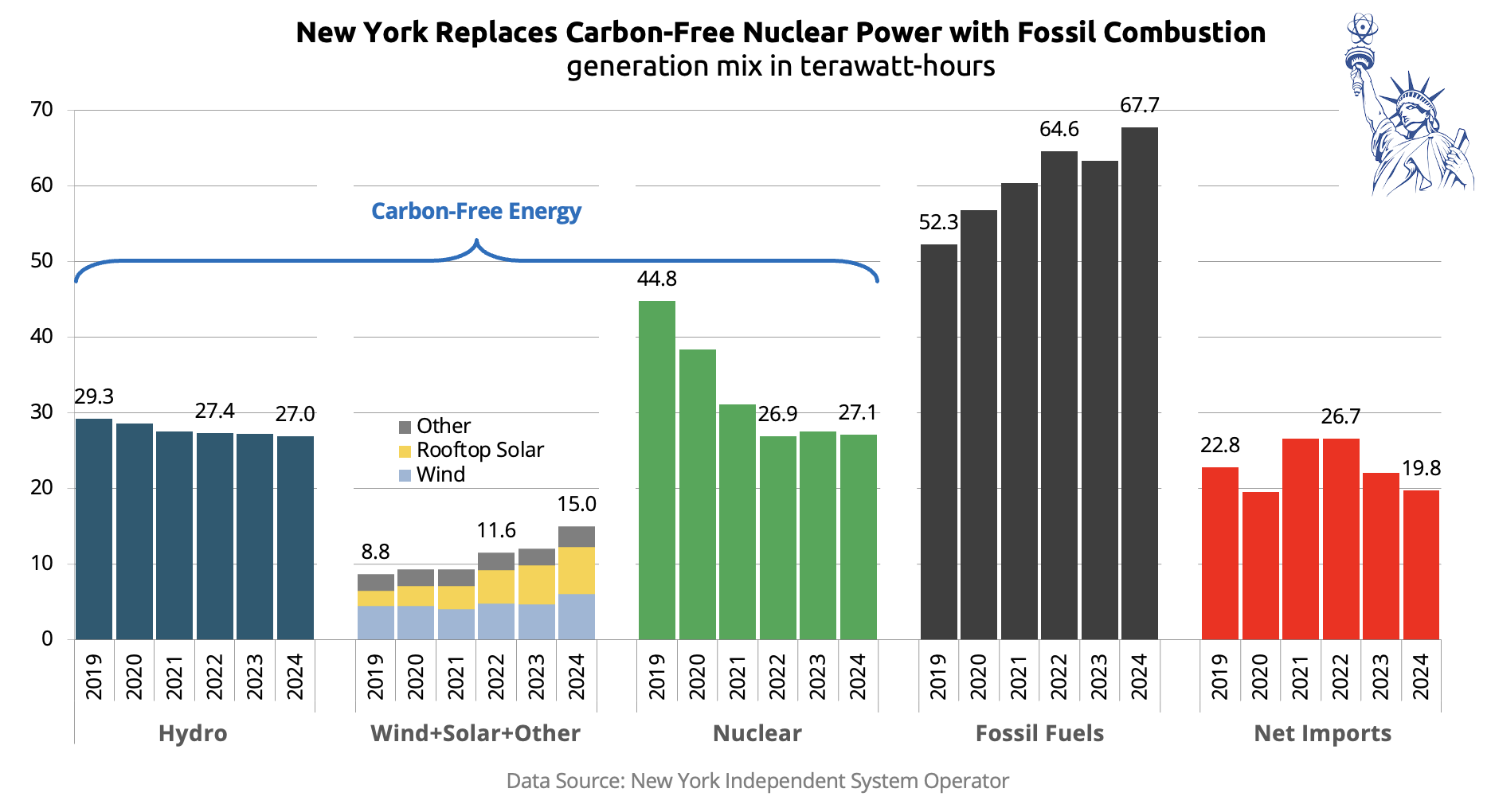
    Rarely are opposing trends as clear as the two in the chart directly below. In the five years from 2019, just before Indian Point’s closure began, the amount of electricity made by burning fossil fuels in New York State grew in tandem with the drop in nuclear generation caused by Indian Point’s absence.

    Over that 5-year term, as electricity generated statewide with nuclear power fell by 17.7 TWh, electricity generated with fossil fuels (essentially fracked methane gas) rose by 15.4 TWh a year. (A TWh, or terawatt-hour (TWh), equals a billion kWh’s.)
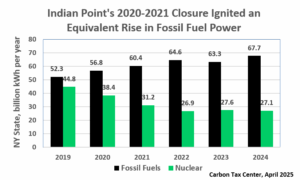
    Chart by writer, from NYISO data extracted by Isuru Seneviratne. More details in paragraph directly below.

    The loss of generation from Indian Point — 16 to 17 TWh a year, based on the 2001-2019 average — was supposed to be made up with “renewables.” Shutdown proponents, led by the advocacy group Riverkeeper, practically guaranteed it. A press release that the group issued as the hours counted down on April 30, 2020 was titled Indian Point 2 shuts down; NY’s renewable energy transition, for example. (Connoisseurs of the legendary “Dewey Defeats Truman” headline should flock to that Riverkeeper web page.) Yet increases in renewables can barely be detected in 2019-2024 statewide generation changes.

    Over those five years, electricity produced statewide from wind, solar and burning forest products did grow by a healthy 70 percent. But because the starting base was small, the increase in absolute terms was a modest 6.2 TWh. Hydro-electricity, moreover, fell by 2.3 TWh, cutting the net 2019-2024 boost from renewables to a measly 3.9 terawatt-hours. Virtually the entire slack from shutting Indian Point had to be taken up by increased burning of fossil fuels — not because of gas greedheads but because no other power source was available. (The various 2019-2024 generation changes meticulously compiled by the NY Independent System Operator have been distilled into a comprehensive chart created by Isuru Seneviratne, who monitors state electricity data for the advocacy group Nuclear NY.)

    Renewables won’t soon make up Indian Point’s lost output

    Renewable-power sources being developed for NY State can be placed in three groups.

    1. 1,200 megawatts (MW) of new hydroelectric power being brought to NY State from Quebec via a new 339-mile long transmission line known as the Champlain Hudson Power Express (CHPE).
    2. Wind farms in the Atlantic Ocean off Long Island, beginning with the 2,070-MW Empire Wind 1 and 2 arrays south of Long Beach (my hometown).
    3. New utility-scale on-shore wind and solar in various stages of permitting and construction, comprising nearly 50 ventures totaling around 7,000 MW.

    Empire Wind generation is zeroed out in “realistic” scenario due to Trump’s fear and loathing of offshore wind. Realistic scenario for solar and (onshore) wind in project pipeline assumes one-half of maximum generation.

    The raw megawatt figures above may appear imposing, but less so when we account for three crucial factors:

    (i) Only CHPE can provide reasonably consistent electricity, with a capacity factor between 70% and 75%; the wind and solar farms are weather- and astronomically-limited to much lower annual outputs: I posit 40% (offshore wind), 33% (onshore wind) and 15% (solar).

    (ii) Offshore wind is almost certainly dead in the water (sorry!), due to the U.S. president’s implacable hatred (rooted in his belief that a nearby wind-power venture would threaten the profitability of one of his Scotland golf courses). [See addendum at end of this post.]

    (iii) Not all projects in the state renewables “pipeline” will prevail through permitting obstacles, local opposition and financing problems.

    The bar chart at right adjusts for these factors by presenting the prospective the three categories of new carbon-free electricity alongside Indian Point in annual terawatt-hours. The green bars sum to 27 TWh, indicating total new carbon-free generation nearly two-thirds greater than that lost when the nuke plant was taken away. The more-realistic red bar sum, 13.8 TWh, is only around half of the maximum, and is less (by 14%) than Indian Point’s lost contribution.

    Let’s also face that having new renewables make up for the generation lost by closing Indian Point is a pathetically low bar. New wind and solar were supposed to contribute mightily to stopping climate change by pushing fossil fuels out of the grid . . . which they cannot do at present if their output must stand in for the carbon-free output that Indian Point was prevented from providing after 2020.

    Lessons learned?

    The outlook for decarbonizing the NY State power grid is grim, even if there’s a post-Trump world in which the U.S. government doesn’t throttle offshore wind as it has tried (unsuccessfully, thank goodness) to scuttle New York’s congestion pricing program. As the last bar chart shows, even bringing Empire Wind to fruition won’t make up half of Indian Point’s lost carbon-free output.

    And this post hasn’t touched on the closure’s prospective toll on downstate electricity rates and reliability. Nor has it treated the possibility that deteriorating U.S.-Canada relations will put a crimp in (or surcharges on) hydro-electricity from CHPE whose expected commencement next year is the only bright spot on the horizon, so far as large projects are concerned. (Rooftop solar has gained a solid foothold in New York State, which ranks third in the U.S. in the number of homes with solar panels, according to Solar Insure. Yet making up for Indian Point’s lost carbon-free output would require roughly one million new solar homes in the state — a 5-fold addition to the 200,000 existing solar homes in the state at the end of 2024.)

    Here are three lessons learned from the premature closure of Indian Point:

    Lesson #1. A robust carbon tax might have saved Indian Point. Based on its average 2001-2019 electricity output, a tax of $100 per ton of emitted CO2 would have conferred an annual carbon-avoidance value of three-quarters of a billion dollars on the Indian Point plant. (Calculation: 16.5 TWh/year x 10^9 kWh/TWh x 0.9 lb of CO2/kWh (per EIA, reduced slightly from that source’s 0.96 lb average to weed out peaker plants) x 1/2000 tons per lb x $100/ton.) A monetary bounty of that magnitude would have made it more difficult for Riverkeeper and then-Gov. Andrew Cuomo to engineer Indian Point’s closure. (During the decade preceding closure, the actual price under the Regional Greenhouse Gas Initiative (RGGI) to emit a ton of CO2 averaged 20 times less: around $5/ton.)

    Image from my 2020 post bemoaning the pending closure of Indian Point. (Link in text at right. Gotham Gazette ceased publication in 2023.)

    Lesson #2. Self-appointed environmental-interest groups should not be the primary arbiter of the public interest in climate-critical matters. “Climate was not at the table when Indian Point’s fate was being sealed,” I wrote in May 2020, weeks after Indian Point began to be shut down. Riverkeeper was at the table, of course, supported by several other prominent environmental organizations whose institutional biases led them, in my view, to overestimate the real-world availability of wind and solar electricity, undervalue Indian Point’s carbon-free benefit, and over-emphasize the risks of the nuclear plant’s continued operation. The result was that the “climate consequences of shutting Indian Point [were] brushed aside,” as suggested in the subhead to my 2020 post.

    Lesson #3: New Yorkers must consider adding more nuclear power capacity to the state grid. I’m starting to re-evaluate the proposition that New York State can achieve a zero-emissions electric grid without adding considerable nuclear power capacity. This widely held viewpoint (“article of faith” might be a more apt term) was critiqued in late 2023 by PhD physicist and policy analyst Leonard Rodberg, whose analytical acumen and probity I’ve admired since the 1970s, when we were colleagues in the safe energy movement, as it was then called. Len’s detailed analysis concluded that approximately 29 GW of new nuclear capacity — the equivalent of 15 Indian Point plants — will be required in addition to large amounts of offshore wind as well as solar and other “distributed” power — to reliably and affordably decarbonize the state grid by 2040 while satisfying load growth from electrifying much of the space heating and vehicular transportation now provided by combusting fossil fuels.

    Addendum

    Heatmap and other news outlets reported on May 20 that the U.S. Interior Department lifted its April 16 stop-work order indefinitely halting construction of the 810-MW Empire Wind 1 in the Atlantic Ocean south of Nassau County, NY. This hopeful development is tempered, however, not just by the Trump administration’s notorious fickleness but by the fact that if and when completed the 810-MW wind farm will offset only a sixth of the carbon benefit that was destroyed by Gov. Andrew Cuomo and Riverkeeper’s closure of Indian Point. See graph.


  • Capital Raising Mistakes Founders Make — And How to Fix Them

    Capital Raising Mistakes Founders Make — And How to Fix Them

    Founders often plan capital raising around meetings and pitch delivery. In practice, what extends the timeline is everything that follows.

    Once discussions move forward, fundraising becomes an operational process that runs together with building the business.

    As investor interest develops, requests for financial, legal, and strategic details increase.

    Each request adds coordination work, and momentum slows when information is incomplete, scattered, or prepared late. With multiple investors involved, small delays accumulate.

    When fundraising drags on, the cause is rarely market conditions. More often, it is avoidable execution gaps that appear after interest is established.

    This guide breaks down the most common process mistakes that add months to a raise and explains how founders can keep deals moving using data rooms.

    What is capital raising?

    Capital raising is securing external funding to support a company’s growth.

    Organisations raise this funding from angel investors, venture capital firms, and strategic corporate partners – each representing a different stage of the funding journey. The British Business Bank’s equity funding guide breaks down what each stage typically involves

    The process requires coordinating meetings, preparing materials, and managing investor interest efficiently.

    Capital raising includes the following steps:

    • Investor meetings and presentations — sharing the company vision and strategy
    • Financial and operational documentation — providing models, reports, and legal records
    • Due diligence coordination — answering investor questions and supplying requested materials
    • Follow-up and relationship management — keeping investors engaged while monitoring progress

    From a founder’s perspective, capital raising functions as a parallel workflow, requiring coordination, organisation, and consistent follow-up, all while the business continues to operate.

    How well this process is managed affects the speed at which a round progresses.

    Next, we explore the mistakes that slow down founders. At the same time, you can check how a data room for investors can simplify the process.

    What is a data room for investors?

    This is a secure space where users can store, manage, and share sensitive documents.

    Also called a virtual data room, the platform lets founders control access and monitor investor activity. With this functionality, the fundraising process becomes faster and more organized.

    Capital raising mistakes and how data room providers can fix them

    The following points highlight where founders often get slowed down and how structured tools can keep things on track.

    1. Treating fundraising as a pitch-only exercise

    Investors evaluate more than the story you tell. They want to see that your business runs smoothly with all relevant information.

    When teams focus only on the pitch, they may end up with weak supporting materials once investor interest appears.

    Common signs of this mistake:

    • Strong pitch deck, but incomplete documents
    • Last-minute searches for financial, legal, and operational materials

    Consequences:

    • Momentum between investor meetings slows
    • Follow-up requests stall the process and frustrate potential investors

    How a virtual data room helps: The software keeps documents updated and accessible, which ensures you can respond quickly to requests and maintain momentum. Also, it demonstrates your execution readiness.

    2. Poor document organisation and version control

    Founders often rely on email threads, shared folders with unclear names, or multiple versions of the same financial documents. While this may feel manageable, it quickly creates friction once investors begin reviewing materials.

    Common signs of this mistake:

    • Documents scattered across multiple locations
    • Confusing file names or outdated versions
    • Frequent uncertainty over which files are current

    Consequences:

    • Investors waste time clarifying which version is correct
    • Confidence in your internal processes decreases
    • Requests for the same information are repeated

    How a virtual data room helps: The solution offers clear folder structures and version tracking. Therefore, investors can always access the latest files. It reduces confusion and strengthens trust in your operational readiness.

    Extra tools: VDRs also feature a fundraising data room checklist. This is a structured list of investor-requested materials used to organize and maintain content within the data room throughout the raise.

    3. Delaying investor-ready due diligence materials

    Once interest is established, investors typically request access to financial models, cap tables, and legal or corporate records. However, delays often occur when these materials are prepared only after requests arrive.

    Common signs of this mistake:

    • Documents are assembled reactively rather than in advance
    • Key files are incomplete or spread across different locations
    • Responses to investor requests take longer than expected

    Consequences:

    • Weeks are lost gathering and organising information
    • Investor momentum fades while waiting for follow-up materials
    • Diligence conversations stall until documentation is complete

    How a virtual data room helps: An investor due diligence data room allows founders to prepare, organize, and maintain all required materials ahead of time.

    By giving investors structured access to up-to-date documents, founders can shorten review cycles, reduce friction, and keep fundraising discussions moving.

    4. Using insecure sharing methods

    Open links, email attachments, and public cloud folders are still common. However, they may raise concerns once investors begin reviewing confidential data.

    For example, it can be unclear who has access to sensitive files or whether documents have been shared beyond the intended recipients.

    Common signs of this mistake:

    • Investor materials sent as email attachments
    • Open or unrestricted access links
    • Use of public folders without clear permission controls

    Consequences:

    • Investors worry about the confidentiality of financial and intellectual property data
    • Informal sharing methods raise questions about governance and internal controls
    • Risk concerns lead investors to proceed more cautiously or pause entirely

    How a virtual data room helps: By limiting access, tracking activity, and presenting capital raising due diligence documents and other materials professionally, founders can reduce risk concerns and maintain investor confidence throughout the diligence process.

    5. Lacking visibility into investor engagement

    Once materials are shared, founders often lose sight of how investors interact with them. It is common not to know which documents are being reviewed, which investors are spending time on key materials, or whether follow-up interest is building.

    Common signs of this mistake:

    • Uncertainty about which investors have reviewed shared documents
    • Follow-ups sent without context or clear signals of interest
    • Equal time spent on engaged and disengaged investors

    Consequences:

    • Follow-up outreach is poorly timed
    • Early signs of interest are missed
    • High-intent investors may not receive the attention they expect

    How a virtual data room helps: VDRs show which documents users view and when. Thus, the tool enables founders to identify engaged investors, prioritise follow-ups, and respond to signs of interest effectively.

    Final thoughts

    Fundraising can feel like running a dozen mini-projects at the same time. Therefore, losing track of documents or sharing files the wrong way can slow everything down.

    A VDR can help you keep everything in one place and track what investors are looking at.

    Following start-up data room best practices means you’re ready when investors ask for information — and you can focus on the conversations that really matter.

    One last thing worth noting: the subscription cost of a virtual data room typically qualifies as a deductible business expense. That means you get a cleaner, faster fundraise — and a tax benefit to go with it.

  • How to Tell If Yours Is Genuine

    How to Tell If Yours Is Genuine

    A fake P800 letter is one of the most convincing frauds targeting UK taxpayers today. HMRC sends millions of genuine P800 tax calculations every year, and fraudsters exploit this by mimicking them closely.

    If you have received a P800 recently, knowing how to tell apart a fake P800 letter from the real thing could protect your bank account and personal details.

    A fake P800 letter typically arrives by email or text, though postal versions do exist. Either way, the goal is the same — to trick you into handing over bank details or clicking a link to a spoofed website.

    This guide explains what a genuine P800 looks like, lists the specific red flags that identify a fake P800 letter, and covers what to do if you suspect fraud.

    With HMRC reporting a significant rise in impersonation scams in recent years, understanding these signs has never been more important for PAYE workers and pensioners alike.

    What Is a Fake P800 Letter?

    A fake P800 letter is a fraudulent communication designed to look like an official HMRC tax calculation notice. Its purpose is to deceive you into sharing financial details or making a payment to criminals.

    HMRC genuinely issues P800 tax calculations to PAYE employees and pensioners at the end of each tax year. Fraudsters exploit this by sending fake versions during the same window, typically between June and November.

    The HMRC impersonation scam has grown significantly in recent years. Over 200,000 scam reports were made to HMRC in the tax year to January 2024 — a rise of 29% on the previous year.

    Not all fake P800 communications arrive by post. Many come by email, text message, or even automated phone call, each using slightly different tactics to extract your money or data.

    How to Tell If Your HMRC P800 Is Genuine

    The most reliable way to confirm an HMRC P800 is genuine is to log into your Personal Tax Account at gov.uk. If HMRC has issued a P800 for your records, it appears there.

    A genuine P800 arrives by post. It includes your full name, your National Insurance number, and a clear breakdown of your income and tax paid during the relevant tax year.

    What a Real P800 Contains

    The letter references your specific employer or pension provider by name. It shows the income figure HMRC holds on record, the tax paid under your PAYE code, and any difference owed to you or from you.

    If you are owed a refund, a genuine P800 may ask you to claim online via gov.uk. It does not embed a hyperlink for you to click directly from the letter.

    What a Genuine P800 Does Not Contain

    A real P800 does not ask you to call a premium-rate number. It does not contain a QR code linking to a payment page, and it does not request your full bank account details in writing.

    HMRC does not send P800 notices by email, text, or social media. Any digital message claiming to be a P800 tax calculation deserves immediate scepticism.

    Fake P800 Letter Red Flags: A Checklist

    Spotting a fake P800 letter early may prevent financial loss. Certain features appear consistently in fraudulent communications and are absent from genuine HMRC correspondence.

    Check for the following red flags when you receive any P800-related communication:

    • The message arrived by email, text, or social media rather than by post.
    • The sender address is not from an @hmrc.gov.uk domain — it may end in .com, .net, or include extra words.
    • You are directed to click a link and enter your sort code, account number, or card details to receive a refund.
    • The communication creates a deadline of 24 to 48 hours, suggesting your refund will be lost if you do not act immediately.
    • The letter or email contains spelling errors, inconsistent fonts, or an HMRC logo that looks slightly off.
    • A premium-rate telephone number is provided as the only contact route.

    A single one of these signs is enough to treat the communication as suspicious. You do not need multiple red flags before pausing and verifying.

    Why These Scams Are So Convincing

    Fraudsters invest considerable effort in making fake tax communications look authentic. They replicate HMRC branding, copy letter layouts, and time their messages to coincide with the genuine P800 mailing season.

    Some fraudulent letters arrive by post and include details such as your name, address, and even partial National Insurance digits. This personal data is often sourced from previous data breaches or phishing attacks.

    The urgency built into fake communications is deliberate. A message warning that your refund expires in 48 hours is designed to override careful thinking and prompt an immediate response.

    Deepfake audio and AI-generated voice calls impersonating HMRC have also been reported. These calls can sound remarkably official, making phone-based verification of the original letter even more important.

    P800 Tax Refund Scam: How the Fraud Actually Works

    A P800 tax refund scam typically follows a predictable sequence. Understanding each stage may help you spot where the manipulation begins.

    Stage One: Initial Contact

    You receive an email, text, or letter claiming HMRC has calculated an overpayment. The amount is usually plausible — often between £200 and £1,000 — to avoid arousing suspicion.

    The message creates a sense of entitlement and mild urgency. It feels like good news, which lowers your guard compared to a message demanding payment.

    Stage Two: The Fake Website

    You are directed to a website that mirrors the gov.uk design. The URL may be close to the real address but contains a subtle difference, such as an extra word or a different domain extension.

    Once on the fake site, you are asked to enter personal and financial details to ‘verify your identity’ before the refund can be processed. This is where the data theft occurs.

    Stage Three: Exploitation

    The details you have entered may be used immediately to access your bank account. Alternatively, they may be sold to other fraudsters or used in a follow-up scam weeks later.

    In some cases, a fake agent calls you after the initial contact, claiming to be from HMRC and offering to ‘process your refund’ directly over the phone.

    Common Mistakes That Make People Vulnerable

    Most people who fall victim to HMRC impersonation scams are not careless. They are caught out by specific patterns that fraudsters have refined over years of testing.

    Assuming personalisation means authenticity is a frequent error. A message that includes your name, employer, or partial National Insurance number feels more trustworthy — but fraudsters acquire this data routinely from leaks.

    Acting quickly under deadline pressure is another common vulnerability. The instinct to secure a refund before it expires is exactly the reaction a fake P800 letter is designed to trigger.

    Clicking the link before checking the URL is a third mistake. Even when an email looks official, hovering over or copying the link often reveals a completely unrelated web address.

    How to Verify an HMRC Letter Before Taking Any Action

    If you receive a P800 and are unsure whether it is genuine, there are straightforward steps you could take before responding in any way.

    Log into your Personal Tax Account at gov.uk by typing the address directly into your browser. This is the most reliable confirmation available — a genuine P800 issued to you may be visible there.

    You could also contact HMRC by telephone using the number listed on gov.uk — not any number printed in the letter. The general income tax enquiries line is the appropriate starting point for most queries.

    Forward suspicious emails to [email protected]. Report suspicious texts by forwarding them to 60599. Both routes feed into HMRC’s active fraud investigation process.

    If you have already clicked a link or entered financial details, contact your bank immediately and ask them to monitor your account. You could also report the incident to Action Fraud at actionfraud.police.uk.

    Fake P800 Letter by Post: What to Check on the Paper Itself

    Postal versions of a fake P800 letter require slightly different checks compared to digital messages. Physical details that are difficult or costly to forge are often the most reliable giveaways.

    Compare the print quality with any previous genuine HMRC letters you have received. Fraudulent postal letters sometimes show uneven printing, slight colour differences in the logo, or thinner paper stock.

    Check that any telephone number in the letter matches the numbers published on gov.uk. A number that cannot be found on the official site is a significant warning sign.

    Look at the postmark on the envelope. A letter claiming to come from HMRC but postmarked from an unexpected location or with a foreign postage mark deserves scrutiny.

    A genuine HMRC letter does not offer a cash reward for prompt action, and it does not include language designed to pressure you into responding within hours.

    Final Thoughts

    Knowing what a genuine P800 looks like — and recognising the specific signs of a fake P800 letter — is one of the most practical protections available to UK taxpayers.

    The core rule is simple: HMRC sends P800 notices by post and does not ask for bank details via a link.

    If anything about a P800 communication feels wrong, pause before acting. Log into gov.uk directly, contact HMRC on a verified number, and report anything suspicious.

    For more information on how a genuine P800 tax refund works, visit the HMRC P800 tax refund page on Tax Rebate Services.

    Fake P800 Letter Key Takeaways

    • HMRC sends genuine P800 tax calculations by post only — a P800 arriving by email, text, or social media is a strong sign of a fake P800 letter.
    • A real P800 includes your name, National Insurance number, and a detailed tax calculation; it does not contain a link asking for your bank details.
    • Red flags on a fake P800 include urgent deadlines, unfamiliar sender domains, premium-rate phone numbers, and website links that do not go to gov.uk.
    • You could verify any P800 by logging into your Personal Tax Account at gov.uk before taking any other action.
    • Report suspicious P800 communications to [email protected], forward scam texts to 60599, and contact Action Fraud if you have shared financial details.

    Fake P800 Tax Calculation FAQs

    Q1: How do I know if my P800 letter is a fake?

    Check whether the communication arrived by post rather than email or text — HMRC only sends genuine P800 notices by post. Log into your Personal Tax Account at gov.uk to confirm whether a P800 has been issued for your records. If the letter asks you to click a link and enter bank details, treat it as a fake P800 letter until verified.

    Q2: Does HMRC send P800 refund notices by email?

    No. HMRC does not send P800 tax calculations by email, text, or through social media. Any digital message claiming to be an HMRC P800 refund notice is likely to be a P800 tax refund scam. HMRC may send a text reminder after you have already claimed online, but it does not initiate refund contact digitally.

    Q3: What should I do if I clicked a link in a fake HMRC letter?

    Contact your bank immediately if you entered financial details on the linked site. Report the incident to Action Fraud at actionfraud.police.uk and forward the email to [email protected]. Change any passwords linked to accounts you accessed at the time, and consider checking your credit report in the following months.

    Q4: Can a fake P800 letter arrive by post rather than email?

    Yes, postal versions exist. A fraudulent postal letter may include your name and address but could show inconsistencies in print quality, logo colouring, or paper stock compared to genuine HMRC correspondence. Any telephone number in the letter should be cross-checked against gov.uk before calling.

    Q5: Where can I verify that HMRC has genuinely issued me a P800?

    Log into your Personal Tax Account at gov.uk by typing the address directly into your browser. If HMRC has issued a P800 for your tax records, it may be viewable there. You could also call HMRC on the income tax enquiries number listed on gov.uk — not any number printed in the letter itself.

  • Michael Oppenheimer, a professor of geosciences and international affairs at Princeton University, noted that solving climate change means undertaking a large number of seemingly small measures, like curbing emissions from automobiles, oil and gas wells, air travel, landfills, buildings and more. ‘Just because there are multiple contributors to a problem doesn’t mean we should excuse all but the top one,’ Dr. Oppenheimer said. ‘Just because a polluter’s emissions are decreasing doesn’t mean that they aren’t still far too high.’ “


    Michael Oppenheimer, a professor of geosciences and international affairs at Princeton University, noted that solving climate change means undertaking a large number of seemingly small measures, like curbing emissions from automobiles, oil and gas wells, air travel, landfills, buildings and more. ‘Just because there are multiple contributors to a problem doesn’t mean we should excuse all but the top one,’ Dr. Oppenheimer said. ‘Just because a polluter’s emissions are decreasing doesn’t mean that they aren’t still far too high.’ “


  • ‘Abundance’ swings but mostly misses

    ‘Abundance’ swings but mostly misses

    Since the dawn of the Bill Clinton era over 30 years ago, no journalist has more incisively illuminated the confines of U.S. liberal centrism than Daniel Lazare. In books like The Frozen Republic and The Velvet Coup as well as countless articles in Jacobin, New Left Review and other outlets, Dan has plumbed America’s deep-seated Constitutional paralysis and exposed the futility of combating carbon pollution without pricing fossil fuels’ climate damage into their market price. 

    The best-selling book Abundance was perfectly tailored for Dan’s scalpel, and his review last month for the Union of Radical Political Economists (URPE) does not disappoint. Rather than a polemic, Dan’s review gives Abundance its due — “In their effort to reduce environmental harms, greens have wound up hobbling production in such a way as to … undermine efforts to deal with the climate crisis in an effective and comprehensive way.” Yet as he points out, “The disease is intolerable, and so is the cure” of making polluters pay through carbon taxes.

    Dan’s review from URPE is reproduced below in its entirety, with permission. The graphics are ours. Dan currently publishes at Substack.

    Book Review: Ezra Klein & Derek Thompson, Abundance.

    Inside Ezra Klein and Derek Thompson’s rather pallid bestseller is a vigorous Marxist polemic trying to get out. Abundance begins with a quote from Aaron Bastani’s Fully Automated Luxury Communism (Verso, 2019) and ends with one from the Communist Manifesto: “The bourgeoisie, during its rule of scarce one hundred years, has created more massive and more colossal productive forces than have all preceding generations together.” Together, they serve to bookend the authors’ argument that in their effort to reduce environmental harms, greens have wound up hobbling production in such a way as to exacerbate inequality and homelessness and undermine efforts to deal with the climate crisis in an effective and comprehensive way.

    Dan’s books uncannily foretold today’s multiple crises.

    Despite protests from Robert Kuttner, co-founder of The American Prospect, and other outraged liberals, the argument carries weight. From a Marxist perspective, the reasons are clear. Liberal environmentalism is an ideology of just saying no, i.e. just say no to dangerous toxins in the water supply, to filling the atmosphere with noxious fumes, to scattering trash along highways and byways, and so forth. NIMBYism adds a further fillip that if you’re going to engage in such activities or do anything else that might disturb the environmental equilibrium, even if it’s for a good cause, don’t do it here. Since there is nothing that doesn’t disturb the environment in one way or another, the result is a stand-pat philosophy whose purpose is to preserve the status quo. Zeroing in on southern California, Klein and Thompson neatly sum up the prevailing ethos: “When do Angelenos want affordable housing? Now!  Where do they want it? Not here!” The problem is that anything resembling a positive program, a way of organizing production so that it doesn’t harm the environment and in fact may even improve it, is absent.

    The answer to the climate crisis is the polluter-pays principle.

    The reason for this is clear as well. The answer to the climate crisis, the environmental crisis, and all the rest is to require capitalist production to bear the full cost. If a gallon of gasoline generates amount of pollution and carbon emissions, not to mention expenditures for highway maintenance, noise abatement, and emergency services, then the simplest and most elegant solution is to incorporate the cost of x into the price of gas so that producers are forced to deal with the full consequences of their actions.

    This is what’s known as PPP – the polluter-pays principle. But it’s impractical, which is to say incompatible with capitalist production, because it would wipe out profits. What would happen to the US auto industry if society were to recognize that the true cost of gasoline is not $4 or $5 a gallon, but $15, $20, or more? What would the results be for the “drill, baby, drill” crowd in both Texas and the Middle East if structurally-induced fossil-fuel consumption were to cease? Tolerance of environmental harms is a form of subsidy since it requires the state to cover costs that producers generate. Society pays them, in effect, to pollute. The long-term consequences are proving fatal as the climate crisis accelerates. Yet the short-term consequences of de-subsidization would prove fatal to bourgeois liberalism.

    So bourgeois society dithers and dawdles, as Abundance describes. “In 2022, ninety countries and territories experienced often violent protests over the rising price of fuel,” Klein and Thompson recount. Subsidies must therefore continue. They quote a political scientist named Erik Voeten who notes that “people who bear the cost of climate policies increasingly flock to the far right.” So nothing can be done in terms of climate mitigation for fear of furthering rightwing polarization. The authors quote a pair of legal academics named J.B. Ruhl and James Salzman who note that property owners do not cotton to the prospect of oil pipelines or electric transmission lines running through their backyard. But “[g]uess what,” Ruhl and Salzman add, “they do not like the idea of wind turbines or solar panels in their backyard either.” Since they don’t like the problem or the solution, nothing can be done. The disease is intolerable, and so is the cure.

    Abundance is highly effective in depicting how this policy snarl plays out. “In much of San Francisco,” Klein and Thompson write, “you can’t walk twenty feet without seeing a multicolored sign declaring that Black Lives Matter, Kindness Is Everything, and No Human Being Is Illegal. Those signs sit in yards zoned for single families, in communities that organize against efforts to add the new homes that would bring those values closer to reality.” San Francisco’s black population has fallen steadily since 1970 due at least in part to restrictions that force poor people in general into longer and longer commutes, if not outright homelessness.

    The middle class is hypocritical, something that “progressives” would know if they ever read Flaubert, Sinclair Lewis, John Dos Passos, or Ring Lardner (which they don’t). California “is dominated by Democrats, but many of the people Democrats claim to care about most can’t afford to live there,” Abundance declares. Last year, “voters [who] were most exposed to the day-to-day realities of liberal governance” demonstrated their displeasure by casting ballots for the Republicans. “Nearly every county in California moved toward Trump, with Los Angeles County shifting eleven points toward the GOP.”

    Liberalism has sown the seeds of its own destruction. 

    It’s a case of liberalism sowing the seeds of its own destruction. Abundance is particularly scathing on California’s great misadventure with high-speed rail. This is the project that Governor Jerry Brown initiated in 1982 with visions of bullet trains whizzing back and forth between San Francisco and Los Angeles. After all, if Japan can do it, why not the United States? Fourteen years later, the state formed a high-speed rail authority, and in 2008 voters authorized $33 billion. That was more than a quarter of a century of doing zilch, but Californians were assured that the first segment would go on line by the year 2020. In 2009, Barack Obama offered a full-throated endorsement:

    “Imagine boarding a train in the center of a city. No racing to an airport and across a terminal, no delays, no sitting on the tarmac, no lost luggage, no taking off your shoes. Imagine whisking through towns at speeds over one hundred miles an hour, walking only a few steps to public transportation, and ending up just blocks from your destination. Imagine what a great project that would be to rebuild America.”

    Except that do-nothing-ism continued until the project finally collapsed. “Let’s be real,” Gavin Newsom announced in 2019. “The project, as currently planned, would cost too much and take too long. There’s been little oversight and not enough transparency. Right now, there simply isn’t a path to get from Sacramento to San Diego, let alone from San Francisco to LA. I wish there were.”

    An astonishing $33 billion had gone down the drain. But why? Klein and Thompson describe how the project immediately bogged down in innumerable negotiations over property rights. “Negotiating with courts, with funders, with business owners, with homeowners, with farm owners,” they write. “Those negotiations cost time, which costs money. Those negotiations lead to changes in the route or the build or the design, which costs money.” State officials relied on expensive consultants who made matters worse: “It was one of these consultants – WSP – that estimated the system would cost only $33 billion and take only twelve years to build. But WSP was joined by Project Finance Advisory, Cambridge Systematics, Arup, TYLin, HNTB, PGH Wong Engineering, Harris & Associates, Arcadis, STV, Sener, and Parsons Corporation.” The Los Angeles Times concluded that outsourcing “proved to be a foundational error in the project’s execution – a miscalculation that has resulted in the California High-Speed Rail Authority being overly reliant on a network of high-cost consultants who have consistently underestimated the difficulty of the task.”

    California officials who had no idea how to proceed relied on high-priced consultants who didn’t know either. It’s an example of a liberal polity that knows how to say no and nothing else. It knows what it shouldn’t do, but not what it should.

    Klein and Thompson deserve credit for bringing all this out. But Abundance suffers from numerous analytical shortcomings. The authors tiptoe around difficult political problems and take refuge in fatuous techno-optimism.  “[T]he only way for humanity to limit climate change while fighting poverty is to invent our way to clean energy that is plentiful and cheap and then spend enough to deploy it,” they assure their readers.  “…One of the most devilish challenges in energy is how to efficiently remove CO2 from the atmosphere. By 2050, the world will need to permanently remove 10 billion tons of carbon dioxide from the skies every year to avoid the most catastrophic effects of climate change.” They open with a sci-fi vision in which future Americans drink desalinated sea water, consume lab-grown chicken and beef, get packages delivered by flying drones, and dash from New York to London in just over two hours in supersonic jetliners using low-carbon “green synthetic fuels.”

    All of which is either puerile or misconceived. By itself, clean energy will do nothing to solve global warming unless counter-measures such as carbon taxes are instituted to inhibit fossil-fuel consumption. The answer to the climate crisis can’t be all carrot and no stick, but must include measures aimed at fostering conservation and energy efficiency. Carbon removal is a non-starter since it invariably requires more energy than it’s worth, while desalination is beside the point in a state like California in which there is so much waste that growers use 1,900 gallons of heavily-subsidized water to produce a pound of almonds despite a deepening drought. As for lab meat, it’s hard to imagine it being more energy efficient than raising chickens and rabbits the old-fashioned way on farms or in large-scale factories. It’s equally hard to imagine flying drones replacing delivery people on bikes in communities that are compact and car-free. Tech has its place, but real energy savings begin with such low-tech modes as walking and cycling.

    As for supersonic air transport, fuhgeddaboudit. Air France and British Airways retired the Concorde in 2003 not only because one had crashed in Gonesse, France, killing 113 people, but because it was a gas-guzzler that used 3.8 times as much fuel as a modern wide-body airliner while carrying substantially fewer people. Green synthetic fuels will do nothing to eliminate that disparity.

    Klein and Thompson are plainly on the side of more. But more of what, exactly? More CO2-spewing SUV’s?

    But there’s more. Not only is Abundance awash with meaningless techno-optimism, but it’s silent on the political issues that are the real barriers to progress. Take consumerism. Klein and Thompson are plainly on the side of more, as is any labor organizer fighting for higher wages. But more of what, exactly? More CO2-spewing SUV’s? More highways so immobilized by traffic that they turn into elongated parking lots? More strip malls and gated communities? The problem with more in a period of capitalist decay is that it often translates into less, which is to say less mobility, less attractive surroundings, and less freedom to bike, walk, or engage in other modest pleasures due to dangerous levels of traffic. In describing rail advocates engaged in painstaking negotiations over rights of way, the authors don’t consider whether car, highway, and energy subsidies are fostering a highly diffuse form of sprawl that crowds out high-density modes. America can have high-speed rail and the concentrated urban development it feeds into. Or it can have ultra-low-density development and the rising levels of congestion and fossil-fuel consumption it generates. But it can’t have both. It’s a conundrum that Klein and Thompson resolutely avoid confronting, no doubt because it would make Abundance less user-friendly.

    Then there’s the matter of class. Abundance is about middle-class consumers struggling to protect their way of life in ways that are increasingly counterproductive. But it makes no mention of the top one percent – really, the top 0.1 percent or even 0.01 – who are the real agents of destruction. Where are the oil barons who don’t care about the climate crisis as long as profits continue to grow? What about super-rich petro-sheiks – how did America wind up in alliance with such a motley crew? And what about the 40,000 US troops in and around the Persian Gulf? What are they doing there and whose interests are they serving? For anyone truly interested in American dysfunctionality, these are the places to start. Yet Klein and Thompson steer clear of such questions because they make people uncomfortable. And if there’s one thing we know about the publishing business, it’s that people don’t buy books that make them uncomfortable.

    Finally, there is no sense of America as a society in an acute political crisis. Since Abundance was released in March, it evidently went to press before Trump was elected and therefore can’t be held responsible for failing to anticipate the full nature of the breakdown that is now before us. Still, it’s not as if there weren’t plenty of warnings as gridlock intensified and politics descended into game playing and threats. Government was in decay, yet no one could think of a way out.

    Abundance reflects this growing pessimism, but never asks why. It quotes a University of Chicago economist named Chad Syverson on a construction-industry regulatory process that is complicated beyond reason. “There are a million veto points,” he complains. Yet there’s no sense that the problem involves not just economic regulation, but a legislative process that also contains a million veto points thanks to hundreds of congressional committees and subcommittees, outrageous filibuster rules, a “hold” system that allows individual senators to tie up legislation for months, and so forth. If Capitol Hill is in chaos, is it any surprise that the regulatory structure it gave rise to is in chaos too?



    Yet Klein and Thompson avert their eyes. Serious political analysis is beyond their scope. They complain about political paralysis in Los Angeles, but make no mention of the political fragmentation that is the real source of the difficulty. After all, LA is not a city as most people think of the term. Rather it’s a baroque agglomeration that consists of a city, a county, plus 87 other municipalities, 80 school districts, 51 police departments, 29 fire departments, and 142 special districts covering everything from sanitation to mosquito control. It’s an assemblage with one overriding goal: political stasis. Nothing gets done because the political structure won’t let it. It’s a form of institutionalized fragmentation designed to scatter concerted political action to the four winds before it can take flight. Yet not only do Klein and Thompson fail to mention that the problem is effectively unfixable – they fail to mention the problem at all. Instead, they dwell on side issues even though the effect is to distort the picture as a whole.

    There is a certain unity between political paralysis at the top and regulatory paralysis below, between gridlock on Capitol Hill and gridlock among thousands of local zoning boards and planning commissions. Both undermine democracy in any meaningful sense while giving corporate interests free rein. Together, they amount to an engraved invitation for a strong man to knock down barriers and overcome restraints. Today, that strong man is Donald Trump, and the way he’s going about it is dead certain to take a bad situation and make it many times worse. The result will be the opposite of abundance in every possible respect – in terms of democracy, equality, scientific advancement, and material progress. It’s a deepening descent that mindless techno-babble will do nothing to reverse.

  • Tax Scams Continue to Grow; IRS Simplifies Reporting of Scams

    Tax Scams Continue to Grow; IRS Simplifies Reporting of Scams

    In February, the IRS announced a new online reporting tool for suspected tax fraud, scams, and illegal activities. Smartly, the link is on the main page (in the dark blue line):

    This month, the IRS released the 2026 Dirty Dozen list of various scams to watch out for, such as fake charities seeking your money, phishing to get you to click on links that enable the scammer to get information from you, AI-enabled robocalls impersonating an IRS employee, misleading tax advice on social media, and more.

    For a list of the dirty dozen since the IRS started this in 2001, please visit my table. You’ll see that a few have disappeared but most continue or have morphed into digital scams.

    The IRS also created two nice posters (pubs) with a QR code to encourage people to report scams. I think that while the IRS or other law enforcement agencies might not find your scammer, with more information, they do find some and can alert the public to new scams and ways to avoid them.  These pubs are 6138 and 6139.

    Something that has also changed is getting emails that clearly look suspect such as because they are poorly written with grammar and spelling errors. Well, scammers likely are using AI to write more grammatically correct, enticing looking emails and texts – we all need to be extra cautious.  When in doubt, don’t click but instead find another way to verify if the information is valid, such as logging into the online account they are talking about (using your usual link rather than the one in the email), such as your IRS online account (or one I get frequently is that my Amazon account has been suspended (!) when it has not).

    What do you think?  What more can be done to help people from being the victim of identity theft or falling for a tax scam such as claiming a bogus tax credit or giving money to scammers pretending to be the IRS or a state tax agency?

  • New Rates, Rules and Reporting

    New Rates, Rules and Reporting

    Dividend tax rates 2026/27 have changed, and you may already be paying more as a result.

    The dividend tax rates 2026/27 rose on 6 April 2026, for the first time since 2022. The basic rate increased from 8.75% to 10.75%, and the higher rate rose from 33.75% to 35.75%.

    The dividend tax rates 2026/27 directly affect your take-home income. Working out how much dividend tax you may pay in 2026 matters.

    Your liability under the new dividend tax rates 2026/27 is only one part of the picture, though. New HMRC reporting requirements also apply, and they catch many directors off guard.

    This article covers the dividend tax rates 2026/27 and what they mean in cash terms. It explains how to report dividend income to HMRC and what directors must now disclose on their return.

    These requirements apply even when no dividend tax is due. Understanding the new rates and what they mean for your tax position is important.

    So too is knowing the new reporting rules, the new director disclosure obligations, and staying fully compliant.

    Dividend Tax Rates 2026/27: What Has Changed

    The new rates came into force on 6 April 2026, as confirmed at the Autumn Budget 2025.

    • The dividend tax basic rate rose by 2 percentage points to 10.75%.
    • The higher rate rose by the same amount to 35.75%.

    Both changes apply to income in the respective bands: £12,571–£50,270 for basic rate, and £50,271–£125,140 for higher rate.

    • The additional rate, for income above £125,140, remains unchanged at 39.35%.
    • The dividend allowance 2026/27 also stays at £500 — the first £500 of dividend income is taxed at 0%.

    That £500 still counts towards your total income when HMRC determines your band. The April 2026 dividend tax increase therefore affects all taxpayers receiving dividends above that threshold.

    For Scottish taxpayers: dividend tax in Scotland 2026 follows the UK-wide rates. Scotland sets its own rates for employment income, but dividend tax rates are the same across the whole country.

    GOV.UK has published the full legislative detail in the income tax changes document published in November 2025. The impact of the changes falls entirely on basic and higher rate taxpayers.

    How Much More Could You Actually Pay?

    The three examples below show the cash impact of the dividend tax rates 2026/27 in real terms.

    All use the 2026/27 thresholds: personal allowance £12,570, basic rate band up to £50,270.

    These figures are estimates and your own position may differ; individual tax circumstances vary significantly.

    Example A — Basic rate director

    Salary £12,570 and dividends £37,430 give total income of £50,000. The salary uses the personal allowance in full, so all dividends fall in the basic rate band.

    After the £500 allowance, £36,930 is taxable. At 8.75% in 2025/26, the bill was approximately £3,231. At 10.75% in 2026/27, it rises to approximately £3,970 — around £739 more per year.

    Example B — Higher rate director

    Salary £12,570 and dividends £75,000 give total income of £87,570. After the personal allowance, £37,700 of dividends falls in the basic rate band and £37,300 in the higher rate band.

    Estimated tax in 2025/26 was around £15,803. Under the dividend tax rates 2026/27, that rises to approximately £17,329 — around £1,526 more per year.

    Example C — Investor with no other income

    This example covers dividend tax if no other income applies. A shareholder with no salary and £20,000 in dividends sees the personal allowance cover the first £12,570.

    The remaining £7,430 falls in the basic rate band. After the £500 allowance, £6,930 is taxable: £606 in 2025/26 and £745 in 2026/27 — around £139 more per year.

    Who Needs to Report Dividend Income to HMRC

    Under the dividend tax rates 2026/27, reporting dividend income to HMRC depends on the amount received. It also depends on whether you already file a Self Assessment return.

    Three routes apply, and using the wrong one can result in penalties.

    Within the allowance — no action usually required

    If total dividend income is £500 or less, no reporting action is needed. That said, close company directors face a separate disclosure requirement regardless of the amount — covered in the next section.

    Up to £10,000 — notify HMRC or adjust your tax code

    This route covers dividend tax if not in Self Assessment already. If dividend income exceeds £500 but is no more than £10,000, notify HMRC directly.

    If you are employed or receive a pension, HMRC may adjust your tax code to collect tax through your pay. Use the Income Tax helpline or your Personal Tax Account online.

    The key date is 5 October following the end of the tax year. For 2025/26 dividend income, that deadline is 5 October 2026.

    Over £10,000 — Self Assessment required

    Do I need to do Self Assessment for dividends above £10,000? Yes — it is mandatory, even if you would not otherwise file a return.

    Not yet registered for Self Assessment? Apply to HMRC by 5 October 2026 for the 2025/26 tax year.

    Most limited company directors already file a Self Assessment return. Taking dividends from your own company is a standard HMRC filing trigger. The question is usually about completing the new close company fields correctly.

    What Directors Must Now Include on Their Self Assessment Return

    From 6 April 2025, new reporting requirements apply to directors of close companies. The new close company dividend reporting rules for 2025/26 come from the Income Tax (Additional Information in Returns) Regulations 2025.

    These rules introduced mandatory fields on the Self Assessment return for 2025/26 and all future years. A close company is broadly a UK limited company controlled by five or fewer participators.

    It also covers a company controlled by any number of participator-directors. In practice, this covers most owner-managed businesses in the UK, and around 900,000 directors are thought to be affected.

    Previously, a director declared total dividends as a single figure. There was no requirement to separate income from your own company from external shareholdings.

    From 2025/26, those two sources must be reported separately. Under the dividend tax rates 2026/27 regime, close company directors must include the following on their return:

    • The name of the close company and its Companies House registration number.
    • The dividend income received from that company during the year — even if the figure is zero.
    • The highest percentage of share capital held at any point during the tax year.
    • A mandatory confirmation of director status — previously this question was optional on the return.

    This is the point many close company directors miss when reviewing their obligations. The disclosure applies even when dividend income is zero or within the £500 allowance.

    The allowance may exempt you from paying tax, but it does not exempt you from this new disclosure.

    Under the Finance Act 2024, HMRC may charge £60 per missing item from the 2025/26 returns onwards.

    Why Frozen Thresholds Make the Dividend Tax Rates 2026/27 Worse

    The dividend tax rates 2026/27 do not operate in isolation. Frozen thresholds and dividends fiscal drag are compounding the impact.

    Income tax thresholds are frozen until April 2031. These cover the personal allowance, the basic rate limit, and the higher rate threshold. The Autumn Budget 2025 confirmed this, extending a freeze in place since April 2022.

    As salaries and profits rise with inflation, more income crosses into higher bands. That happens even when there has been no real-terms earnings increase — the defining feature of fiscal drag.

    A director comfortably within the basic rate band a few years ago may now find some dividends taxed at 35.75%. The thresholds have not moved; the income has.

    It remains at £12,570, costing a basic rate taxpayer roughly £581 per year in additional tax. The dividend rate increase comes on top of that.

    A director near the £50,270 boundary may now find modest dividends straddling two bands.

    Taken together, fiscal drag and the dividend tax rates 2026/27 rise can exceed 2 real-terms percentage points for some directors.

    Four Ways to Reduce Your Dividend Tax Legally in 2026

    Several legitimate strategies are available to reduce the impact of the dividend tax rates 2026/27 legally. Each depends on your individual position and merits careful thought before acting.

    Use your ISA allowance

    Dividends inside a Stocks and Shares ISA are free from dividend tax, regardless of the new rates. The annual ISA allowance is £20,000 per person. Moving shares into an ISA wrapper could meaningfully reduce your exposure over time.

    Make pension contributions

    Pension contributions made by a company director reduce your adjusted net income. A pension contribution can pull dividends from the higher rate band into the basic rate band.

    This is worth considering if your income sits near £50,270.

    The saving on that shift is 25 percentage points — from 35.75% down to 10.75%. A financial adviser can help you model the right contribution level for your circumstances.

    Allocate shares to a spouse or civil partner

    This must reflect a genuine transfer of ownership with proper legal documentation. HMRC scrutinises arrangements designed primarily for tax advantage.

    Time your dividend declarations

    Dividends are taxed in the year they are declared, not when they are received. A dividend declared on 5 April 2026 falls in 2025/26 at the lower rates. One declared on 6 April 2026 falls in 2026/27 at the higher rates.

    Where you have genuine flexibility, aligning planned declarations with a lower-income year may reduce the rate that applies.

    Salary vs Dividends in 2026: Does the Structure Still Work?

    Dividends are not subject to National Insurance contributions, whereas salary above the primary threshold attracts both employee and employer NI.

    That fundamental structural advantage has not changed with the 2026/27 rate increases. The dividend tax rates 2026/27 have narrowed the margin, however.

    A basic rate director now pays 10.75% on dividend income above the allowance under the dividend tax rates 2026/27.

    That compares with 8.75% the previous year, and the gap between salary and dividend tax efficiency has narrowed.

    The calculation now depends more heavily on your corporation tax position. A company paying 25% corporation tax faces a combined effective rate that deserves careful modelling.

    Relying on dividends simply being ‘lower rate’ is no longer sufficient for accurate planning. For directors earning above the basic rate threshold, the salary-dividend split merits a fresh review each year.

    The salary-dividend structure can still work well for most directors. The case for it simply needs to be made on current numbers, not on assumptions from several years ago.

    What to Check Before Filing Your 2025/26 Return

    Before you file your 2025/26 return, work through three areas. First, confirm which dividend tax rates 2026/27 apply to your income band.

    Check whether any of the four dividend tax-reduction strategies above are worth acting on given the dividend tax rates 2026/27.

    Second, if you are a close company director, gather your Companies House registration number and your highest shareholding percentage. Prepare a breakdown of dividends from your own company versus any other sources.

    Third, confirm your reporting route for 2025/26 dividend income. Dividends above £10,000 require Self Assessment registration by 5 October 2026.

    Amounts between £500 and £10,000 should be notified to HMRC or adjusted via tax code by that date.

    Reviewing your income structure at the start of the tax year gives you more options than leaving it to January.

    Summing up: dividend tax rates 2026/27 and what they mean for you

    The increases that took effect on 6 April 2026 are the most significant changes to dividend taxation in several years.

    Basic rate taxpayers now pay 10.75% and higher rate taxpayers pay 35.75% on income above the £500 allowance.

    Frozen thresholds running to April 2031 compound the impact of the new dividend tax rates 2026/27. For some directors, the real-terms increase exceeds the headline 2 percentage points.

    The new close company disclosure rules add a separate compliance obligation regardless of whether any dividend tax is due.

    For more on UK tax rules and reliefs, visit the tax guides section at taxrebateservices.co.uk.

    Key Takeaways: Dividend Tax Rates 2026/27

    • From 6 April 2026, the basic rate of dividend tax is 10.75% and the higher rate is 35.75%. Both are 2 percentage points higher than in 2025/26.
    • The £500 dividend allowance and the additional rate of 39.35% remain unchanged for 2026/27.
    • Income tax thresholds are frozen until April 2031. Fiscal drag may push more of your income into higher bands without any change in real earnings.
    • From 6 April 2025, close company directors must report their shareholding percentage, company number, and dividend amount on their return. This is required even when no dividend tax is owed.
    • Dividends above £10,000 require a Self Assessment return. Amounts between £500 and £10,000 should be notified to HMRC or adjusted via tax code by 5 October 2026.
    • Options to reduce dividend tax legally include ISA contributions, pension contributions, spousal share allocation, and careful timing of declarations.

    Dividend Tax Rates for 2026/27 FAQs

    What Are the Dividend Tax Rates for 2026/27?

    From 6 April 2026, the basic rate of dividend tax is 10.75% and the higher rate is 35.75%. Both are 2 percentage points higher than in 2025/26. The additional rate, for income above £125,140, remains unchanged at 39.35%. The £500 dividend allowance also remains in place.

    How Much Dividend Tax Will I Pay in 2026?

    If your total income stays within the basic rate band — up to £50,270 — you pay 10.75% on dividend income above the £500 allowance. A director drawing a salary of £12,570 and dividends of £37,430 may pay approximately £3,970 in dividend tax in 2026/27. That is around £739 more than in 2025/26.

    Do I Need to Register for Self Assessment Because of Dividends?

    If your dividend income for the 2025/26 tax year exceeds £10,000, you must register for Self Assessment by 5 October 2026. For amounts between £500 and £10,000, notify HMRC or request a tax code adjustment before that date. If your dividends are within the £500 allowance and you are not a close company director, no action is typically required.

    What Must Close Company Directors Now Report on Their Tax Return?

    From 6 April 2025, directors of close companies must report additional information on their Self Assessment return: the company name and Companies House registration number, the amount of dividend income received from that company (even if zero), and the highest percentage shareholding held during the year. This disclosure is mandatory even when no dividend tax is owed. A £60 penalty applies for each missing item under the Finance Act 2024.

    How Can I Legally Reduce My Dividend Tax Bill in 2026?

    Four approaches may help. Dividends received inside a Stocks and Shares ISA are completely tax-free, and the annual allowance is £20,000. Pension contributions reduce your adjusted net income and could pull dividends from the higher rate band into the basic rate band. Allocating shares to a lower-earning spouse or civil partner may reduce the rate applied to some dividends. Careful timing of dividend declarations — since dividends are taxed in the year declared — may also allow you to align payments with a lower-income year.

  • What is Form 8854, Initial & Annual Expatriation Tax Statement

    What is Form 8854, Initial & Annual Expatriation Tax Statement


    Form 8854

    Form 8854 and Expatriation

    One of the most common questions our international tax lawyers receive each year when U.S. Taxpayers get ready to renounce their U.S. citizenship or terminate their Lawful Permanent Resident status is whether or not they will have to pay an exit tax when they leave the United States. It is important to note, that not all individuals who expatriate from the United States will owe an exit tax. 

        • First, there are two categories of individuals who may be subject to an exit tax — U.S. Citizens and Long Term Lawful Permanent Residents.
        • If a Taxpayer falls into one of these two categories, he must first determine whether or not he is considered to be a covered expatriate to determine if he may even become subject to exit taxes.
        • If the Taxpayer is a covered expatriate, then he may have an exit tax — but it is important to note that the exit tax is not a wealth tax. Rather, it is a U.S. tax based on whether income or gains have accumulated while the Taxpayer was a U.S. person but has not been recognized/realized yet.

    *For all examples, please note that the Taxpayers are U.S. persons for tax purposes who have not made any treaty elections to be treated as a Non-Resident Alien (NRA). Also, these examples are for illustrative purposes only and Taxpayers should consult with a Board-Certified Tax Law Specialist if they have specific questions about their reporting requirements and not rely on this article for legal advice.

    Form 8854 is Not Only For Covered Expatriates

    One of the biggest misconceptions about IRS Form 8854 is that it is only required for covered expatriates, but that is inaccurate. An initial Form 8854 is required by U.S. citizens or Long-Term Lawful Permanent Residents whether or not they are covered expatriates. Some Taxpayers who may otherwise be covered expatriates or subject to exit tax may qualify for an exception or an exclusion — but that does not negate them having to file Form 8854.

    IRS Form 8854 is Due When the Tax Return is Filed

    Form 8854 is due with the final tax return following the expatriating act. For example, if a Taxpayer submits Form I-407 in the current year, then he will file Form 8854 in the subsequent year when he files his tax return. Some Taxpayers are being misguided into filing Form 8854 in the same actual year that they expatriate, which leads to the Taxpayer filing the incorrect form and increasing the chance of an audit.

    Before Filing Form 8854 You Need 5 Years of Tax Compliance

    Some Taxpayers are only deemed covered expatriates because they cannot certify under penalty of perjury that they have been tax-compliant for the past five years. To avoid this outcome, the Taxpayer must be in tax compliance before starting the immigration expatriation process (which precedes the expatriation tax filing process) such as renouncing U.S. citizenship or filing Form I-407 to terminate their U.S. person status. 

    As provided by the IRS:

        • Date of relinquishment of U.S. citizenship.

          • You are considered to have relinquished your U.S. citizenship (and consequently, have an expatriation date) on the earliest of the following dates.

            1. The date you renounced your U.S. citizenship before a diplomatic or consular officer of the United States (provided that the voluntary renouncement was later confirmed by the issuance of a certificate of loss of nationality).

            2. The date you furnished to the State Department a signed statement of your voluntary relinquishment of a U.S. nationality confirming the performance of an expatriating act (provided that the voluntary relinquishment was later confirmed by the issuance of a certificate of loss of nationality).

    Annual Reporting for Deferred Compensation Owners

    Even after Form 8854 is filed in the year of expatriation, some Taxpayers may have an ongoing Form 8854 filing requirement if they still maintain certain deferred compensation such as a 401K. To avoid this nuisance, some Taxpayers may withdraw their deferred compensation at the time they expatriate and pay U.S. taxes at the time.

    Failure to File Form 8854 Leads to Additional 1040 Returns

    Until a person files IRS Form 8854, the IRS is unaware that the Taxpayer has formally expatriated. That is because expatriation is a two-pronged process that includes immigration and tax. Unless the Taxpayer files Form 8854, the IRS is not aware that the Taxpayer has already completed the immigration portion. If Form 8854 was not filed, the Taxpayer may become subject to additional Form 1040 returns and still have to pay U.S. taxes on their worldwide income.

    Net Worth vs Exit Tax

    It is very important to note that when a Taxpayer is covered, it does not mean that they will have an exit tax when they leave the United States — even if they have a high net worth.  There generally has to be some type of unrealized income such as mark-to-market gain with stock (or other equities), ineligible deferred compensation that accrued while the taxpayer was a U.S. Person and is deemed distributed at exit, etc. Let’s look at two different examples to illustrate the concept:

        • Example 1: Michelle is a U.S. Citizen who owns stock worth $4M. She acquired the stock for $1M. When Michelle expatriates from the United States, she may have an exit tax based on the mark to market gain in the stock.
        • Example 2: Dylan is a U.S. Citizen who has $50M in cash. While Dylan will be considered a covered expatriate, he would not have any immediate exit tax because his assets are all cash.

    Mark-to-Market Gains

    The most common type of exit tax is based on mark-to-market gains. In an all-too-common situation, the Taxpayer may have purchased stock while they were a U.S. person, and that stock value has gone up significantly so that if the stock was sold on the day before the person expatriated there would be a gain. Noting, that there is an exit tax exclusion which may eliminate MTM exit taxes for some Taxpayers (currently, it is $821,000 and adjusts each year for inflation).

        • Example 1: Peter is a U.S. Citizen who purchased stock worth $600,000 several years ago and now the stock is worth $1.3M. If this is the only mark-to-market asset that Peter has, then the exclusion amount should cover any gain so that there would not be any exit tax when Peter expatriates.
        • Example 2: Daniel is a U.S. citizen who purchased stock worth $600,000 seven years ago and now the stock is worth $3.8M. Even if Daniel applies the exclusion amount, he will still have to pay a significant exit tax on the Long Term Capital Gain for the difference between the fair market value on the day before he expatriates and the adjusted basis.
        • Example 3: Michelle is a Lawful Permanent Resident who purchased stock before she became a Lawful Permanent Resident for $300,000. On the day she became a Lawful Permanent Resident the stock was worth $800,000 and on the day before she expatriates, it is worth $1.2M. Due to the step-up value that Michelle would receive on the day which became a Lawful Permanent Resident, if this is the only mark to market asset Michelle has she may be able to avoid MTM exit taxes on this particular asset.

    Eligible Deferred Compensation

    When it comes to Eligible Deferred Compensation (such as 401K), Taxpayers generally do not have to pay any exit tax at the time they expatriate. In the future, if they were covered, they may have to pay tax on the distributions. While no exit tax may be due when they expatriate, they may have to irrevocably waive the right to treaty benefits when they receive distributions.

    Ineligible Deferred Compensation

    When a person is covered and has ineligible deferred compensation, they may be required to pay an exit tax on the ineligible deferred compensation as if it had been distributed. This type of exit tax is especially unfair, especially in light of the fact that oftentimes ineligible deferred compensation is just a foreign retirement plan that receives tax-deferred treatment in the foreign country where the pension plan is situated — similar to a 401K in the United States. If the taxpayer has a step up, it may serve to reduce any exit taxes.

        • Example 1: Mindy is a Long Term Lawful Permanent Resident who previously earned pension while living overseas as a green card holder. She is a covered expatriate and has a $1.5M pension (with no U.S. tax basis), all of it which was received while she was a U.S. person. No taxes have been paid on the pension and therefore the full amount of the pension may become subject to exit tax.
        • Example 2: William is a U.S. Citizen who has been on different assignments throughout the globe for many years but always maintains an international pension plan overseas that is not considered qualified in the United States. It is now worth $3.2M dollars and no taxes have been paid. The full amount of the pension plan may become taxable.
        • Example 3: Jennifer is a Long-Term Resident who has $2M in foreign pension. She is a covered expatriate, but she only became a green card holder nine years ago. Before she became a green card holder from marriage, she did not have any U.S. person status. When she first came to the United States and became a green card holder the foreign pension was worth $1.6M. Therefore, Jennifer may be able to take the position that only ~$4M of the amount of pension may be taxable because of the step-up.

    Specified Tax Deferred Accounts

    Another common category of exit tax is specified tax-deferred accounts. A common example of a specified tax-deferred account may be a traditional IRA — which may be impacted based on whether the IRA is an employment IRA or an investment IRA. In general, the IRS takes the position that the IRA loses its tax-deferred status and becomes deemed distributed at the time of expatriation. However, if it is a Roth IRA and if the Taxpayer meets the requirements for longevity and age of the taxpayer, it may avoid exit tax.

        • Example 1: Frank is a U.S. citizen who has $700,000 in his IRA. It is a non-employment traditional IRA which has no tax basis since it is all pre-tax dollars. Therefore, since Frank is a covered expatriate, when he expatriates he may have to pay exit tax on that $700,000.
        • Example 2: Denise is a U.S. citizen who has $500,000 in a Roth IRA and she is also a covered expatriate. Denise is 71 years old and has had her Roth IRA for more than 20 years. Therefore, Denise may be able to avoid exit taxes on her Roth IRA.

    The Tip of the Iceberg

    This article aims to help clarify some of the basics of exit taxes. Being tax compliant when a person expatriates is very important and exit taxes in general can be very complicated, especially when it involves additional items such as foreign life insurance policies, foreign corporations, foreign partnerships, and transactions between U.S. persons and foreign companies. Taxpayers should try to stay in compliance if they are already in compliance or should consider getting into compliance if they have not properly filed the necessary reporting forms if for no other reason than the fact that the IRS has made offshore compliance a key enforcement priority and has been issuing fines and penalties for non-compliance. 

    Late Filing Penalties May be Reduced or Avoided

    For Taxpayers who did not timely file their FBAR and/or other international information-related reporting forms, the IRS has developed many different offshore amnesty programs to assist Taxpayers with safely getting into compliance. These programs may reduce or even eliminate international reporting penalties.

    Current Year vs. Prior Year Non-Compliance

    Once a Taxpayer missed the tax and reporting (such as FBAR and FATCA) requirements for prior years, they will want to be careful before submitting their information to the IRS in the current year. That is because they may risk making a quiet disclosure if they just begin filing forward in the current year and/or mass filing previous year forms without doing so under one of the approved IRS offshore submission procedures. Before filing prior untimely foreign reporting forms, Taxpayers should consider speaking with a Board-Certified Tax Law Specialist who specializes exclusively in these types of offshore disclosure matters.

    Avoid False Offshore Disclosure Submissions (Willful vs Non-Willful)

    In recent years, the IRS has increased the level of scrutiny for certain streamlined procedure submissions. When a person is non-willful, they have an excellent chance of making a successful submission to Streamlined Procedures. If they are willful, they would submit to the IRS Voluntary Disclosure Program instead. But, if a willful Taxpayer submits an intentionally false narrative under the Streamlined Procedures (and gets caught), they may become subject to significant fines and penalties

    Need Help Finding an Experienced Offshore Tax Attorney?

    When it comes to hiring an experienced international tax attorney to represent you for unreported foreign and offshore account reporting, it can become overwhelming for Taxpayers trying to trek through all the false information and nonsense they will find in their online research. There are only a handful of attorneys worldwide who are Board-Certified Tax Specialists and who specialize exclusively in offshore disclosure and international tax amnesty reporting.  *This resource may help Taxpayers seeking to hire offshore tax counsel: How to Hire an Offshore Disclosure Lawyer.

    Golding & Golding: About Our International Tax Law Firm

    Golding & Golding specializes exclusively in international tax, specifically IRS offshore disclosure

    Contact our firm today for assistance.

  • energy conservation and efficiency. Targeted subsidies don’t always reach underdog alternatives, known and unknown. A carbon tax would.”


    A broad, briskly rising tax on climate pollution would claw back the implicit subsidy that fossil fuels now enjoy, seeing as their pollutants are dumped freely. It would simultaneously provide across-the-board incentives for climate-friendly energy, spurring the lowest-carbon alternatives: energy conservation and efficiency. Targeted subsidies don’t always reach underdog alternatives, known and unknown. A carbon tax would.”