Category: Expat Tax

  • What is Form 8854, Initial & Annual Expatriation Tax Statement

    What is Form 8854, Initial & Annual Expatriation Tax Statement


    Form 8854

    Form 8854 and Expatriation

    One of the most common questions our international tax lawyers receive each year when U.S. Taxpayers get ready to renounce their U.S. citizenship or terminate their Lawful Permanent Resident status is whether or not they will have to pay an exit tax when they leave the United States. It is important to note, that not all individuals who expatriate from the United States will owe an exit tax. 

        • First, there are two categories of individuals who may be subject to an exit tax — U.S. Citizens and Long Term Lawful Permanent Residents.
        • If a Taxpayer falls into one of these two categories, he must first determine whether or not he is considered to be a covered expatriate to determine if he may even become subject to exit taxes.
        • If the Taxpayer is a covered expatriate, then he may have an exit tax — but it is important to note that the exit tax is not a wealth tax. Rather, it is a U.S. tax based on whether income or gains have accumulated while the Taxpayer was a U.S. person but has not been recognized/realized yet.

    *For all examples, please note that the Taxpayers are U.S. persons for tax purposes who have not made any treaty elections to be treated as a Non-Resident Alien (NRA). Also, these examples are for illustrative purposes only and Taxpayers should consult with a Board-Certified Tax Law Specialist if they have specific questions about their reporting requirements and not rely on this article for legal advice.

    Form 8854 is Not Only For Covered Expatriates

    One of the biggest misconceptions about IRS Form 8854 is that it is only required for covered expatriates, but that is inaccurate. An initial Form 8854 is required by U.S. citizens or Long-Term Lawful Permanent Residents whether or not they are covered expatriates. Some Taxpayers who may otherwise be covered expatriates or subject to exit tax may qualify for an exception or an exclusion — but that does not negate them having to file Form 8854.

    IRS Form 8854 is Due When the Tax Return is Filed

    Form 8854 is due with the final tax return following the expatriating act. For example, if a Taxpayer submits Form I-407 in the current year, then he will file Form 8854 in the subsequent year when he files his tax return. Some Taxpayers are being misguided into filing Form 8854 in the same actual year that they expatriate, which leads to the Taxpayer filing the incorrect form and increasing the chance of an audit.

    Before Filing Form 8854 You Need 5 Years of Tax Compliance

    Some Taxpayers are only deemed covered expatriates because they cannot certify under penalty of perjury that they have been tax-compliant for the past five years. To avoid this outcome, the Taxpayer must be in tax compliance before starting the immigration expatriation process (which precedes the expatriation tax filing process) such as renouncing U.S. citizenship or filing Form I-407 to terminate their U.S. person status. 

    As provided by the IRS:

        • Date of relinquishment of U.S. citizenship.

          • You are considered to have relinquished your U.S. citizenship (and consequently, have an expatriation date) on the earliest of the following dates.

            1. The date you renounced your U.S. citizenship before a diplomatic or consular officer of the United States (provided that the voluntary renouncement was later confirmed by the issuance of a certificate of loss of nationality).

            2. The date you furnished to the State Department a signed statement of your voluntary relinquishment of a U.S. nationality confirming the performance of an expatriating act (provided that the voluntary relinquishment was later confirmed by the issuance of a certificate of loss of nationality).

    Annual Reporting for Deferred Compensation Owners

    Even after Form 8854 is filed in the year of expatriation, some Taxpayers may have an ongoing Form 8854 filing requirement if they still maintain certain deferred compensation such as a 401K. To avoid this nuisance, some Taxpayers may withdraw their deferred compensation at the time they expatriate and pay U.S. taxes at the time.

    Failure to File Form 8854 Leads to Additional 1040 Returns

    Until a person files IRS Form 8854, the IRS is unaware that the Taxpayer has formally expatriated. That is because expatriation is a two-pronged process that includes immigration and tax. Unless the Taxpayer files Form 8854, the IRS is not aware that the Taxpayer has already completed the immigration portion. If Form 8854 was not filed, the Taxpayer may become subject to additional Form 1040 returns and still have to pay U.S. taxes on their worldwide income.

    Net Worth vs Exit Tax

    It is very important to note that when a Taxpayer is covered, it does not mean that they will have an exit tax when they leave the United States — even if they have a high net worth.  There generally has to be some type of unrealized income such as mark-to-market gain with stock (or other equities), ineligible deferred compensation that accrued while the taxpayer was a U.S. Person and is deemed distributed at exit, etc. Let’s look at two different examples to illustrate the concept:

        • Example 1: Michelle is a U.S. Citizen who owns stock worth $4M. She acquired the stock for $1M. When Michelle expatriates from the United States, she may have an exit tax based on the mark to market gain in the stock.
        • Example 2: Dylan is a U.S. Citizen who has $50M in cash. While Dylan will be considered a covered expatriate, he would not have any immediate exit tax because his assets are all cash.

    Mark-to-Market Gains

    The most common type of exit tax is based on mark-to-market gains. In an all-too-common situation, the Taxpayer may have purchased stock while they were a U.S. person, and that stock value has gone up significantly so that if the stock was sold on the day before the person expatriated there would be a gain. Noting, that there is an exit tax exclusion which may eliminate MTM exit taxes for some Taxpayers (currently, it is $821,000 and adjusts each year for inflation).

        • Example 1: Peter is a U.S. Citizen who purchased stock worth $600,000 several years ago and now the stock is worth $1.3M. If this is the only mark-to-market asset that Peter has, then the exclusion amount should cover any gain so that there would not be any exit tax when Peter expatriates.
        • Example 2: Daniel is a U.S. citizen who purchased stock worth $600,000 seven years ago and now the stock is worth $3.8M. Even if Daniel applies the exclusion amount, he will still have to pay a significant exit tax on the Long Term Capital Gain for the difference between the fair market value on the day before he expatriates and the adjusted basis.
        • Example 3: Michelle is a Lawful Permanent Resident who purchased stock before she became a Lawful Permanent Resident for $300,000. On the day she became a Lawful Permanent Resident the stock was worth $800,000 and on the day before she expatriates, it is worth $1.2M. Due to the step-up value that Michelle would receive on the day which became a Lawful Permanent Resident, if this is the only mark to market asset Michelle has she may be able to avoid MTM exit taxes on this particular asset.

    Eligible Deferred Compensation

    When it comes to Eligible Deferred Compensation (such as 401K), Taxpayers generally do not have to pay any exit tax at the time they expatriate. In the future, if they were covered, they may have to pay tax on the distributions. While no exit tax may be due when they expatriate, they may have to irrevocably waive the right to treaty benefits when they receive distributions.

    Ineligible Deferred Compensation

    When a person is covered and has ineligible deferred compensation, they may be required to pay an exit tax on the ineligible deferred compensation as if it had been distributed. This type of exit tax is especially unfair, especially in light of the fact that oftentimes ineligible deferred compensation is just a foreign retirement plan that receives tax-deferred treatment in the foreign country where the pension plan is situated — similar to a 401K in the United States. If the taxpayer has a step up, it may serve to reduce any exit taxes.

        • Example 1: Mindy is a Long Term Lawful Permanent Resident who previously earned pension while living overseas as a green card holder. She is a covered expatriate and has a $1.5M pension (with no U.S. tax basis), all of it which was received while she was a U.S. person. No taxes have been paid on the pension and therefore the full amount of the pension may become subject to exit tax.
        • Example 2: William is a U.S. Citizen who has been on different assignments throughout the globe for many years but always maintains an international pension plan overseas that is not considered qualified in the United States. It is now worth $3.2M dollars and no taxes have been paid. The full amount of the pension plan may become taxable.
        • Example 3: Jennifer is a Long-Term Resident who has $2M in foreign pension. She is a covered expatriate, but she only became a green card holder nine years ago. Before she became a green card holder from marriage, she did not have any U.S. person status. When she first came to the United States and became a green card holder the foreign pension was worth $1.6M. Therefore, Jennifer may be able to take the position that only ~$4M of the amount of pension may be taxable because of the step-up.

    Specified Tax Deferred Accounts

    Another common category of exit tax is specified tax-deferred accounts. A common example of a specified tax-deferred account may be a traditional IRA — which may be impacted based on whether the IRA is an employment IRA or an investment IRA. In general, the IRS takes the position that the IRA loses its tax-deferred status and becomes deemed distributed at the time of expatriation. However, if it is a Roth IRA and if the Taxpayer meets the requirements for longevity and age of the taxpayer, it may avoid exit tax.

        • Example 1: Frank is a U.S. citizen who has $700,000 in his IRA. It is a non-employment traditional IRA which has no tax basis since it is all pre-tax dollars. Therefore, since Frank is a covered expatriate, when he expatriates he may have to pay exit tax on that $700,000.
        • Example 2: Denise is a U.S. citizen who has $500,000 in a Roth IRA and she is also a covered expatriate. Denise is 71 years old and has had her Roth IRA for more than 20 years. Therefore, Denise may be able to avoid exit taxes on her Roth IRA.

    The Tip of the Iceberg

    This article aims to help clarify some of the basics of exit taxes. Being tax compliant when a person expatriates is very important and exit taxes in general can be very complicated, especially when it involves additional items such as foreign life insurance policies, foreign corporations, foreign partnerships, and transactions between U.S. persons and foreign companies. Taxpayers should try to stay in compliance if they are already in compliance or should consider getting into compliance if they have not properly filed the necessary reporting forms if for no other reason than the fact that the IRS has made offshore compliance a key enforcement priority and has been issuing fines and penalties for non-compliance. 

    Late Filing Penalties May be Reduced or Avoided

    For Taxpayers who did not timely file their FBAR and/or other international information-related reporting forms, the IRS has developed many different offshore amnesty programs to assist Taxpayers with safely getting into compliance. These programs may reduce or even eliminate international reporting penalties.

    Current Year vs. Prior Year Non-Compliance

    Once a Taxpayer missed the tax and reporting (such as FBAR and FATCA) requirements for prior years, they will want to be careful before submitting their information to the IRS in the current year. That is because they may risk making a quiet disclosure if they just begin filing forward in the current year and/or mass filing previous year forms without doing so under one of the approved IRS offshore submission procedures. Before filing prior untimely foreign reporting forms, Taxpayers should consider speaking with a Board-Certified Tax Law Specialist who specializes exclusively in these types of offshore disclosure matters.

    Avoid False Offshore Disclosure Submissions (Willful vs Non-Willful)

    In recent years, the IRS has increased the level of scrutiny for certain streamlined procedure submissions. When a person is non-willful, they have an excellent chance of making a successful submission to Streamlined Procedures. If they are willful, they would submit to the IRS Voluntary Disclosure Program instead. But, if a willful Taxpayer submits an intentionally false narrative under the Streamlined Procedures (and gets caught), they may become subject to significant fines and penalties

    Need Help Finding an Experienced Offshore Tax Attorney?

    When it comes to hiring an experienced international tax attorney to represent you for unreported foreign and offshore account reporting, it can become overwhelming for Taxpayers trying to trek through all the false information and nonsense they will find in their online research. There are only a handful of attorneys worldwide who are Board-Certified Tax Specialists and who specialize exclusively in offshore disclosure and international tax amnesty reporting.  *This resource may help Taxpayers seeking to hire offshore tax counsel: How to Hire an Offshore Disclosure Lawyer.

    Golding & Golding: About Our International Tax Law Firm

    Golding & Golding specializes exclusively in international tax, specifically IRS offshore disclosure

    Contact our firm today for assistance.
  • Free CourtListener Docket Sheet and Documents for Major Tax Crimes Case (Also Major White Collar Crimes Case) (7/3/25)

    Free CourtListener Docket Sheet and Documents for Major Tax Crimes Case (Also Major White Collar Crimes Case) (7/3/25)

    I write to inform principally students and young lawyers of
    a case with documents that can educate in both tax crimes and white collar crimes. The case is United States v. Goldstein
    (D. Md. No. 8:25-cr-00006), with free access to docket entries on CourtListener, here.
    CourtListener has the docket entries but offers free access to a document only
    after the first CourtListener member retrieves the document from PACER, a paid
    service. For a case of this notoriety, most of the important documents will have
    been so retrieved and are available free.

    Although I have only looked at some of the documents that
    interest me, I think the quality of lawyering is very good. Furthermore, tax
    crimes are white-collar crimes in a tax setting. Hence, the documents (which
    are many) are often hashing out themes that will be of interest to lawyers
    and students of white -collar crimes.

    I recommend that those interested review the CourtListener
    document entries and review the documents that you find interesting. 

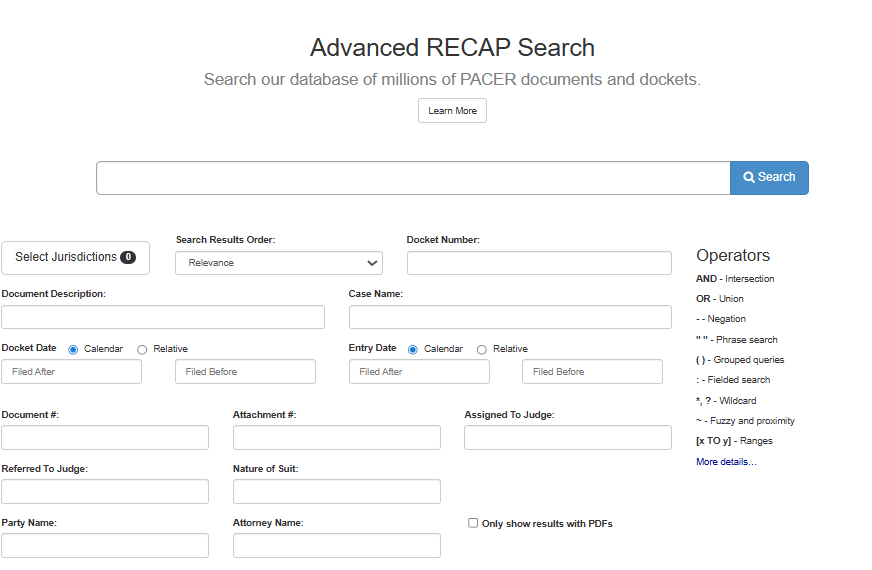
    You can also do a search of the CourtListener Recap Archive which has docket sheets and documents for all federal cases. The Recap Archive with case search features is here and looks like this:

    Finally, CourtListener is a good resource. The home page is here. It is free to join and relies
    on donations. In my practice and writing, I use CourtListener a lot.

    There are other similar free services, but this is the one I use. I’m not saying that it is the best, but it is my go-to source for court documents.

  • Austaxpolicy – ANU and Monash Collaboration

    Austaxpolicy – ANU and Monash Collaboration

    The Tax team in Monash’s Business Law and Taxation department

    We are delighted to announce that Austaxpolicy, established by TTPI, is now a collaboration between the ANU and Monash University.  The ANU looks forward to working with the Tax team in Monash’s Business Law and Taxation department (pictured above) to jointly advance our shared goal of disseminating tax and transfer research for the public benefit.

    Monash’s Tax Law Research Group undertakes qualitative and quantitative research on tax law and policy issues of national and international significance. The Tax team’s subject matter expertise spans the full taxation spectrum, including personal and corporate income tax, energy and resources taxation, value added taxes, taxpayer compliance, and international taxation. The Group is committed to developing innovative cross-disciplinary projects that produce rigorous and accessible research for policymakers, the academy, the profession and the broader community.

    Together, we will draw on our combined expertise, networks and institutional strengths to share important and pioneering research on tax and transfer policy with a global audience.


    The Tax team in Monash’s Business Law and Taxation department, from left to right in image:

    Agustinus Saputra (PhD Student), Ananda Anggara S (PhD Student), Swapna Verma, Amanda Selvarajah, Amna Shah, Helen Ping (co-editor of Austaxpolicy), John Minas (co-editor of Austaxpolicy and Director of the Taxation Law and Policy Research Group), John Bevacqua (head of Monash Department of Business Law and Taxation), Wide Putra (PhD Student)

    Citation :


    Walpola, Sonali,  Ping, Yuan,  Minas, John,  Morris, Todd,  Labanca, Claudio  & You, Jean,
    (2026)
    Austaxpolicy – ANU and Monash Collaboration
    Austaxpolicy: Tax and Transfer Policy Blog, 
    20 March 2026, Available from:

    About the Author

    Sonali Walpola

    Dr Sonali Walpola is an Associate Professor at the ANU College of Business and Economics. Sonali’s research interests broadly encompass taxation law and policy and the nature of common law developments. Her recent projects have analysed integrity measures to address tax avoidance through trusts, the interpretation of the residence article in double tax agreements, and the Australian High Court’s attitude to change in the common law. Sonali is a co-editor of Austaxpolicy, the Journal of Australian Taxation and Law&History, which is the journal of the Australia New Zealand Law History Society. Sonali is a fellow of the ANU Tax and Transfer Policy Institute, a member of The Tax Institute Higher Education Academic Board, and the Academic Lead of the ANU Tax Clinic, which she co-founded in 2019.

    Yuan Ping

    Yuan (Helen) Ping is a Lecturer in Business and Corporate Law at the Department of Business Law and Taxation of Monash University and a qualified legal practitioner. She is currently completing a PhD at the Research School of Accounting, Australian National University. Helen’s research interests are in the fields of regulatory enforcement and corporate tax behaviour, specifically examining the effects of the U.S. Securities and Exchange Commission’s tax-related comment letters on market response and firm policies. She has published papers in the Australian Tax Forum and eJournal of Tax Research. Helen is also the co-editor of Austaxpolicy.

    John Minas

    John Minas is an Associate Professor in the Department of Business Law and Taxation at Monash University, a Research Affiliate with the Tax and Transfer Policy Institute, Crawford School of Public Policy, at ANU, and an Adjunct Research Fellow in the Law Futures Centre at Griffith University.

    Todd Morris

    Todd Morris is a Lecturer in the School of Economics at the University of Queensland and an Economics Editor at AusTaxPolicy. He obtained his PhD from the University of Melbourne in 2020. After that, he was a postdoctoral researcher at the Max Planck Institute for Social Law and Social Policy from 2019 to 2021 and at HEC Montreal from 2022 to 2023. His main research interests are in public and labour economics. A unifying theme to his research is the causal evaluation of government policies (often related to retirement).

    Claudio Labanca

    Dr Claudio Labanca is a Senior Lecturer in the Department of Economics at Monash University. His research interests include Labor Economics, Public Economics and Applied Microeconomics. Claudio is a Research Affiliate at the IZA, the Tax and Transfer Policy Institute at the ANU, SoDa Labs, and is a co-editor of Austaxpolicy. 

    Jean You

    Dr Jean You is a Lecturer in Research School of Accounting of Australian National University. Jean’s research interests are in the fields of regulatory enforcement and policy setting, specifically tax transparency and tax avoidance in multinational entities. She has published papers in the Australian Tax Forum and ABACUS.

  • Tax Scams Continue to Grow; IRS Simplifies Reporting of Scams

    Tax Scams Continue to Grow; IRS Simplifies Reporting of Scams

    In February, the IRS announced a new online reporting tool for suspected tax fraud, scams, and illegal activities. Smartly, the link is on the main page (in the dark blue line):

    This month, the IRS released the 2026 Dirty Dozen list of various scams to watch out for, such as fake charities seeking your money, phishing to get you to click on links that enable the scammer to get information from you, AI-enabled robocalls impersonating an IRS employee, misleading tax advice on social media, and more.

    For a list of the dirty dozen since the IRS started this in 2001, please visit my table. You’ll see that a few have disappeared but most continue or have morphed into digital scams.

    The IRS also created two nice posters (pubs) with a QR code to encourage people to report scams. I think that while the IRS or other law enforcement agencies might not find your scammer, with more information, they do find some and can alert the public to new scams and ways to avoid them.  These pubs are 6138 and 6139.

    Something that has also changed is getting emails that clearly look suspect such as because they are poorly written with grammar and spelling errors. Well, scammers likely are using AI to write more grammatically correct, enticing looking emails and texts – we all need to be extra cautious.  When in doubt, don’t click but instead find another way to verify if the information is valid, such as logging into the online account they are talking about (using your usual link rather than the one in the email), such as your IRS online account (or one I get frequently is that my Amazon account has been suspended (!) when it has not).

    What do you think?  What more can be done to help people from being the victim of identity theft or falling for a tax scam such as claiming a bogus tax credit or giving money to scammers pretending to be the IRS or a state tax agency?

  • “A Signal Was Sent”: BC Still Reeling From Budget 2026, Housing To Take A Hit

    “A Signal Was Sent”: BC Still Reeling From Budget 2026, Housing To Take A Hit

    The dust is yet to settle from the release of BC’s Budget 2026.

    Weeks later, developers are still reeling, and say that it does nothing to encourage the housing development that the province badly needs. Even worse, they worry that tax measures introduced are actively discouraging it.

    “A signal was sent to individual industries and for housing — it really was,” says Michael Drummond, who is the interim vice president and CEO of the Urban Development Institute (UDI) in BC. “We have been raising the cost-of-delivery crisis for a number of years, and there was nothing in the budget to help address that.”

    UDI is one of 19 signatories on a February 24 statement urging the Province to walk back on one of the particularly contentious measures introduced in the budget: the expansion of the 7% PST burden to accounting services, architectural services, engineering and geoscience services, security services, and commercial real estate services, effective October 1, 2026. These services have not generally been subject to PST in BC.

    “BC cannot afford policies that raise input costs, discourage investment, and weaken our competitive position,” says the joint statement, which represents the opinion of not just housing market stakeholders, but business organizations across the board. “BC’s PST is already the most uncompetitive sales tax in Canada, and Budget 2026 doubles down. This expansion creates a massive new administrative burden and a ‘tax on a tax’ for every project.”

    In one pro forma provided to STOREYS by Drummond, the consultancy spend on a 21-storey, 330-unit concrete rental would jump by about $275,000 (about $800 per unit), while operating expenses would rise by about $20,000 per year (about $60 per unit, per year).

    “It doesn’t sound like that much until you look at what that would do to the cap rate. And basically, you take [a $470,000] loss in the value of the asset,” Drummond explains. He also gives a second example of a five-storey, 150-unit wood-frame rental that would see consultancy costs and yearly operating expenses rise increase by $150,000 and $10,000 respectively, resulting in an asset value loss of $250,000.

    “But it’s less about that, and it’s more about the signal that government chose to put on an additional tax on development at a time when very few projects are penciling, the presale market has collapsed, rental margins are tightening, and the market is not signalling a near true recovery,” he adds.

    While the PST expansion has gotten a lot of attention, it’s not the only tax measure included in Budget 2026 that will exacerbate pain-points in BC’s housing market.

    The Province has also opted to bump the Speculation and Vacancy Tax rate for the 2027 tax year up to 4% (from 3%), and, effective January 1, 2027, the additional school tax rate for properties with a residential component is set to be 0.3% (up from from 0.2%) on the portion of value between $3 million and $4 million, and 0.6% (up from 0.4%) on the portion of value over $4 million.

    “We basically have shut investors down. Like, why would you invest in BC?,” says Wesbild President and CEO Kevin Layden. “And this just isn’t the speculation tax that’s discouraging investment, it’s the overall taxation environment and the lack of being able to get projects moving forward.”

    “The bigger issue for me is the school tax, which is an asset tax. And for us, we’re a land developer, we own a lot of land that we’re now going to have to pay additional school taxes on, that we can’t bring to market because of how long it takes to bring it to market,” Layden adds. “It’s just ridiculous… and it’s going to lead to more people leaving BC.”

    And the implications stand to run even deeper than that. Layden reveals that Wesbild has already started to park a number of their projects, including its plans for the Poco Place Shopping Centre in Port Coquitlam, which it acquired back in April 2024.

    “We have a very strong development permit application in place, but the math doesn’t work. […] It’ll stay as a shopping centre unless there’s some kind of significant change to the expectations of bonus density or DCCs, because the rents have dropped,” he says. “And I’m all for rents dropping, I think it’s good for the market, but the Province and municipalities need to adjust to the market realities that we’re all faced with. What I’ve said to city councillors is that you can raise taxes and the DCCs, but you’ll get 100% of nothing, because the project won’t go forward.”

    While Layden feels that BC could take a page out of Ontario’s book by introducing a GST rebate for first-time homebuyers, he also underscores that the province has a lot more to worry about than its lacklustre housing output. Budget 2026 revealed a 39% increase in operating expenses, but just 18% increase in revenue — and the Province is projecting a record-breaking $13.3 billion deficit for the 2026-2027 fiscal year.

    With everything that BC’s latest budget has revealed and introduced, Layden says he’s “worried for British Columbia” and what this is all going to mean for future generations. And he’s certainly not alone.

  • Toronto Could Face Higher Property Taxes As Feds Cut Refugee Support

    Toronto Could Face Higher Property Taxes As Feds Cut Refugee Support

    Despite the fact that Toronto’s unhoused population has more than doubled since 2021, the City is set to receive a fraction of the Canada-Ontario Housing Benefit (COHB) funding in its sixth year that it did in both its fourth- and fifth-year allocations.

    Toronto Mayor Olivia Chow wrote in a letter that went to the Executive Committee on Monday that the Province allocated $38 million to Toronto from the COHB between April 2024 and March 2025, and $19.75 million from April 2025 to March 2026 — but between April 2026 and March 2027, the City will receive only $7.95 million, representing an almost 60% decrease year over year.

    Launched in April 2020, the COHB pays the difference between 30% of eligible households’ income and the average market rent in the area, and is supported by provincial and federal funding. Chow said in her letter that the program “is the single most effective tool we have for freeing up beds in our shelter system so that more people can come indoors from streets and parks.”

    She also describes “provincial delays and uncertainty” that led to the City fronting $4.815 million of the COHB funding earlier this year — a move that helped 570 households move from the streets and shelters into housing.

    “Now, the Province has said we can only allow for 40 more households to move into housing between now and March 2026 within the funding they’ve provided,” said Chow. “That means all funds will be spent by the end of October, just when the weather turns cold and we need to bring homeless people on the street into shelters or homes.”

    Chow’s letter also speaks to a pullback in funding for the Interim Housing Assistance Program (IHAP), which is a federal grant program created to help provincial and municipal governments manage the cost burden of housing asylum claimants. Toronto is set to receive funding for only 26% of what it’s projected to spend on shelter refugees and asylum seekers this year.

    “We’ve been providing shelter to people who arrived to Toronto fleeing violence, war and persecution, but now the federal government won’t pay their bills for the service, and the City is short by $107 million,” Chow said to media on Monday. “We can either stop sheltering refugee claimers, leave them on the street, which will make homelessness worse, reversing the progress we made on reducing the number of encampments — or Torontonians will have to pay for it through their property taxes. Neither is fair.”

    Chow is calling on the the federal government to provide transitional funding of $107 million for refugee claimants and asylum seekers in the City’s emergency shelter system, and in addition, is requesting Toronto’s COHB allocation be increased to $54 million for the program’s fifth year “to allow 300 households to continue to secure permanent housing each month.” Her requests will be discussed at Toronto City Council’s October session, scheduled to begin on Wednesday, October 8.

  • Brampton Reduces Development Charges By Up To 100% For Rental Apartments

    Brampton Reduces Development Charges By Up To 100% For Rental Apartments

    On Wednesday, the City of Brampton announced it is reducing development charges (DCs) by up to 100% on purpose-built rental units in order to encourage their construction and “address the city’s growing housing needs.”

    DCs are taxes that builders pay to a city in order to help fund increased infrastructure needs that may be required as a result of growth, including services like roads, transit, water, and sewer systems. But over the last 15 years, DCs across the GTA have skyrocketed, placing additional strain on already struggling development pipelines.

    “Brampton is taking a bold step to address one of the biggest challenges facing our residents: the shortage of safe and affordable rental housing,” said Mayor of Brampton, Patrick Brown, in a press release. “This new incentive program will attract investment, support family-friendly rentals and help us build the strong, vibrant communities our residents deserve.”

    As of August 1, the municipal DC for a large apartment (over 750 sq. ft) in Brampton is $38,395 and $23,628 for a small apartment (less than 750 sq. ft). But on top of that, builders pay a DC to the Region of Peel, to GO Transit, and to the region’s education boards, totalling $100,659 in DCs for a large apartment and $59,084 for a small apartment. In 2018, Brampton developers would have been charged just $54,197 and $36,738 in DCs for these unit sizes, respectively.

    Brampton’s new Development Charges (DC) Incentive Program reduces the financial burden on builders by lowering municipal DCs based on unit size, effective immediately until November 14, 2026. Under the new program, reductions would be tiered, with one-bedroom units seeing a 50% discount, a 75% discount for one-bedroom+den and two-bedroom units, and a 100% discount for both three-bedrooms and two+bedroom units with mixed use.

    Additionally, in June, Peel Region passed their own DC reforms, reducing regional residential development charges by 50% from July 10, 2025 to November 13, 2026, further reducing costs for Brampton developers.

    Brampton’s announcement follows a handful of other GTHA municipalities that have taken action to lower DCs in some capacity. Last May, Burlington lowered their DCs by $1,500, Vaughan returned their DCs to September 2018 levels in November, Mississauga reduced all residential DCs by 50% and by 100% for three-bedroom units in purpose-built rentals in January of this year, and Hamilton lowered all residential DCs by 20% in August.

    In addition to the DC reductions, Brampton City Council passed a motion Wednesday asking the Province to reconsider its “one-size-fits-all” Additional Residential Units (ARU) legislation. An ARU could be any additional dwelling on an existing residential property, such as a basement apartment or garden suite. According to the press release, the legislation has allowed more than 26,000 registered ARUs in Brampton, which makes up more 60% of all new residential units in 2025. The City is asking that the Province allow Brampton to pause new ARUs in concentrated areas, “so the City can address property standards and safety issues, while incentivizing better, safer alternatives through purpose-built rentals.”

  • GTA Rental Supply Deficit To Hit 235,000 Units Over Next Decade

    GTA Rental Supply Deficit To Hit 235,000 Units Over Next Decade

    A report released Wednesday finds that the GTA is on track to amass a roughly 235,000-unit deficit in purpose-built rental (PBR) housing supply over the next 10 years, made up of the current and projected shortfall in units. Using comparative pro forma analysis, the report also shows how far targeted policy changes can go towards making projects more viable moving forward.

    The report was assembled by the Building Industry and Land Development Association (BILD) in conjunction with real estate consulting firm Urbanation and cost consulting company Finnegan Marshall, and it shares sobering insights into current PBR housing needs in the GTA, how project feasibility has changed since 2022, and policy changes they say need to be implemented by all three levels of government in order to meet housing needs over the next decade.

    Titled The Pathway For Rental Housing Stock, the report builds upon a previous study released in February 2023 by providing updated information and outlooks following a number of policy and market changes that have impacted PBR development in the region.

    Decoding The Current Market

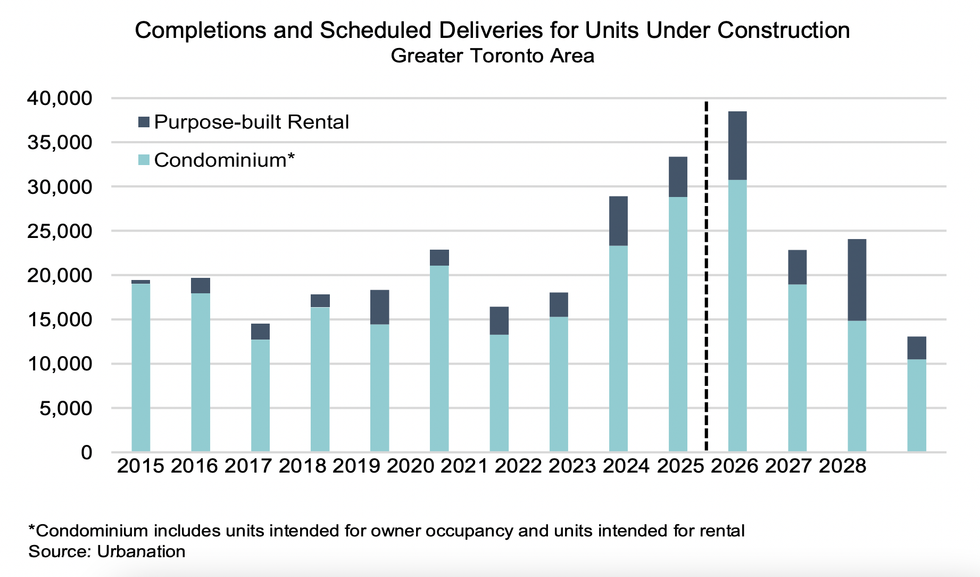
    A whitepaper prepared by Urbanation provides an updated view of the GTA’s PBR market as well as rental needs and the forces that are shaping those needs. The report highlights that the GTA saw a significant rise in rental demand over the past two years as the population surged by 550,000 people over 2023 and 2024. This historic demand was met by an historic wave of new purpose-built and condo rental completions that saw nearly 35,000 units added over the course of 2024 — more than double the 10-year average.

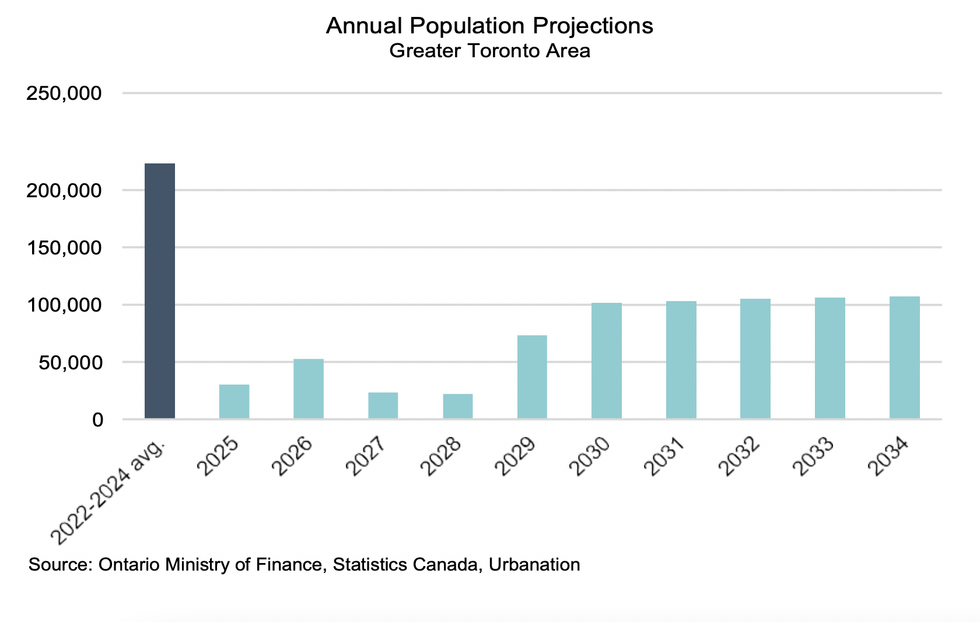
    Since the Feds lowered immigration targets in October 2024, the region has started to see the flow of permanent and temporary residents dwindle, bringing down rents as completions continue to arrive in record numbers. But while the GTA population is expected to grow by 726,884 residents over the next 10 years — 38% less than the previous 10 years (1,177,497 residents) — plummeting condo completions and slowing PBR growth will also “substantially” pull down supply.

    For context, the current downturn in condo presales has contributed to a 50% year-over-year drop in condo starts between 2023 and 2024, when it hit a 25-year low of 8,792 units. Meanwhile, despite rising 7% in 2024 to 6,637 units, PBR starts remain below the recent 2021 high of 7,061 units. Looking ahead, condo and PBR completions combined are expected to total 38,528 units in 2025, before moderating to 22,860 and 24,065 units in 2026 and 2027, respectively. Then by 2028, completions will fall to a 20-year low of 13,076 units.

    But with investors fleeing the condo market, the report says PBRs will be expected to fill the rental gap by delivering 16,000 to 19,000 rental units per year for the next ten years — something it is not currently on track to do, due in part to red tape at various levels of government. More on that later.

    “While the GTA could previously rely on condo investors to supply the market with the majority of new rental units, the downturn in new condo market activity underway suggests that won’t be the case going forward and there will be a greater need for PBR construction. However, relative to the other large markets in Canada, the GTA ranks lowest in terms of per capita for rental construction,” reads the report.

    On top of falling construction, declining homeownership rates are exacerbating the looming supply deficit as more would-be-homeowners turn instead to renting. According to Urbanation, the GTA’s homeownership rate fell from 68% in 2011 to 65% in 2021 and rates are expected to continue falling due to “ongoing, long-term ownership affordability challenges.”

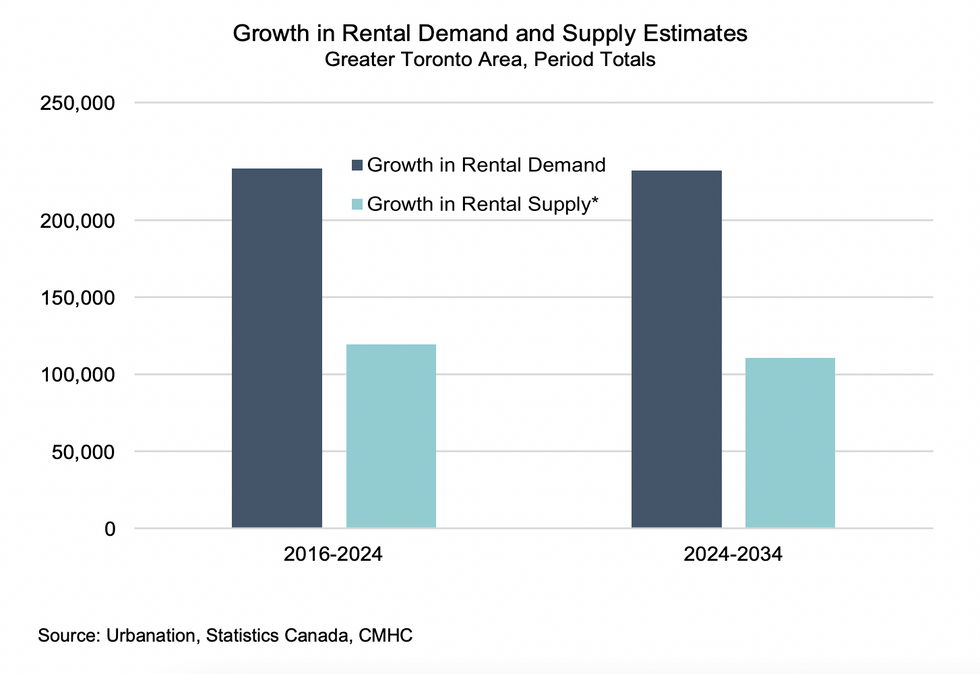
    Considering projected population growth, falling homeownership rates, and dwindling supply, Urbanation estimates the GTA will have a rental deficit of 235,000 units in ten years, made up of 121,000 units needed in the future and the 114,000-unit deficit that grew between 2016 and 2024.

    Feasibility Stronger Where DCs Are Lower

    Pro formas, pro formas, pro formas. While PBR demand may be headed fora major increase and while developers may be eager to build these rental types, Urbanation highlights that current conditions just aren’t conducive for development.

    “The deterioration in economic feasibility for new development and often lengthly application timelines has left a large supply of units waiting in the pipeline,” reads the report. “As of Q1 2025, the GTA had a total of 200,586 PBR units in the proposed stage that had not started construction. […] This is in addition to hundreds of thousands of units in the planning stages proposed as condominium or have an undetermined tenure.”

    To help explain how these conditions hold development back, the second portion of the report consists of two April 2025 pro forma analyses from Finnegan Marshall for condo and PBR projects proposed in both downtown Toronto and Mississauga. According to the analysis, both municipalities saw feasibility for PBRs improve over the last two years thanks to federal, provincial, and municipal changes, such as the feds waiving HST on new PBRs in fall 2023, the matching of that incentive by the province, and the two cities implementing various incentives to spur development.

    However, in Mississauga, where municipal incentives for development were more impactful, the analysis found that pro formas for both building types had improved by a greater amount than in Toronto. In January of this year, Mississauga voted to lower development charges (DCs) for residential projects by 50%, to eliminate the fees for three-bedroom PBR units, and to defer the collection of DCs until occupancy permits are issued for all residential developments.

    For Toronto’s part, the City has done things like freeze DCs at current rates and waive DCs for certain housing types like sixplexes, but the report says more needs to be done.

    “The lack of support from the City of Toronto remains a key impediment. While the city has adopted some measures, they are time-bound and have very restricted eligibility,” it reads. “The lack of broad-based relief in Toronto, where the need for more housing is notably the greatest, as evidenced by the pro formas in this document, means new PBR and condo remain non-viable.”

    According to the analysis, for a hypothetical 400-unit condo development in Mississauga, including year-one operating costs, the net revenue would now be $28,333,469. In Toronto, that same condo project would deliver just $11,478,175 in profits, making it unviable. For comparison, the profit on a 400-unit Toronto condo proposed in late-2022 would have been $39,772,225.

    If the same development was proposed as a PBR in Toronto, the project would now cost $251,850,000 and the net annual cash flow would be $974,246. In Mississauga, where average rent is around $383 lower than Toronto, the cost would be a more affordable $226,715, while annual income would be $820,460.

    Recommendations From BILD

    In the final portion of the report, BILD lays out a to-do list of policy changes for the municipal, provincial, and federal governments aimed at spurring rental development.

    At the municipal level, BILD recommends things like eliminating or lowering DCs for rental and mixed-use projects and lowering property tax rates for PBRs via Tax Increment Financing and the New Multi-Residential Subclass discount of 35% on property taxes. At the provincial level, they recommend unlocking existing DC reserves for ready-to-go projects, and federally, recommendations include expanding CMHC programs, lifting the foreign buyer ban, and establishing a housing task force that includes all three levels of government, among other suggestions.

    BILD’s SVP of Communications, Research & Stakeholder Relations, Justin Sherwood, emphasizes just how important it is that these recommendations be adopted in order to avoid a “tremendous economic hit,” ensure housing is delivered, and keep the industry on two feet.

    “The industry is facing massive amounts of layoffs. You’re looking at starts dropping tremendously — somewhere in the order of magnitude of 60% in the GTA — and you’re actually seeing the drying up of investment going into residential construction, whether it be for sale or for rent,” Sherwood tells STOREYS, adding that the number one goal is to ensure people are housed. “[…] We need to be able to put roofs over heads. Population is going to continue to grow. Whether it’s going to grow by 400,000 people a year in Canada or 500,000 people, it’s still growing, right? That need is not going away.”

    But spurring housing, Sherwood points out, not only benefits developers but all three levels of government as well. “There’s an economic benefit that the housing sector brings to the domestic economy,” he says. “It’s one of the largest sectors in the Canadian economy, it’s one of the largest employers in the Canadian economy, and it sources about 90% of its raw materials domestically. If all of a sudden that starts declining, there’s a tremendous negative impact to governments.”

  • "Self-Defeating": With DCs Out Of Control, Homeowners Are Paying The Price

    "Self-Defeating": With DCs Out Of Control, Homeowners Are Paying The Price

    British statesman Winston Churchill once said, “We contend that for a nation to try to tax itself into prosperity is like a man standing in a bucket and trying to lift himself up by the handle.”

    In many ways, that characterizes what we are doing with development charges (DCs) on new housing. Municipalities are unilaterally imposing the levies on new development to foot the bill for capital costs of infrastructure like roads, water, sewage and power services to support growth.

    In the end, it is self-defeating as new homeowners end up paying exorbitant fees that raise the cost of housing.

    Over the years, there’s been tremendous mission creep with these charges. The funds are being used to pay for everything from subways to animal shelters and, in one instance, a cricket pitch.

    In some municipal jurisdictions, such as in central Ontario, the GTA and Ottawa, DCs have become a runaway train. In Toronto, DCs on a two-bedroom condo increased to $88,000 from $8,000 over a 10-year period. Hikes like this put housing out of reach of most homebuyers.

    And make no mistake. It is homebuyers that are footing the bill. While developers are the ones who initially pay the DCs when they obtain building permits, they are passed on to the buyers of new homes as part of the purchase price.

    DCs are traditionally adjusted annually by municipalities to cover inflation and the increasing costs of infrastructure projects. However, these fees account for a large chunk of the tax burden on new housing.

    A report for RESCON done by the Canadian Centre for Economic Analysis found that taxes, fees and levies on new housing has jumped to almost 36% in Ontario, up from 31% three years ago.

    DCs are a main reason housing has become unaffordable. They are discretionary fees that municipalities can apply to developments to help pay for infrastructure to support new growth. However, there aren’t enough guardrails to stop municipalities from using DCs to fund items not related to housing.

    The original idea behind DCs was noble, but they’ve have ballooned out of control. Municipal governments are adding items to the wish list. The levies have become a way of raising money without increasing taxes.

    The result?

    Prices for new homes and for renters in new properties have risen. It’s a form of hidden taxation.

    As mentioned, a big problem has been that builders have had to pay for development charges upfront rather than on closing, which means they must finance the charges while projects are being built. Projects can take years, so it can be a hefty bill. The cost is then added to the price tag.

    The math is simple. The higher the development charges are, the harder it is for people to buy housing. This results in fewer projects being started, which restricts housing and pushes up prices.

    We’re now seeing that scenario play out in housing starts and sales figures. We are at the point where builders can’t build homes that people can afford to buy.

    The provincial government recently introduced legislation called Bill 17, or the Protect Ontario by Building Faster and Smarter Act, 2025, that enables developers and builders to defer the payment of DCs until the property has been transferred to the ultimate buyer. This will save developers money both on payments and financing charges as well as reduce red tape.

    It’s certainly a good start, but to really spur the market DCs ultimately need to be reduced. To fix the problem, the Province must get DCs under control and stop the abuse by municipal governments.

    A few municipalities have stepped up and done the right thing. DCs in the City of Vaughan, for example, were cut in half because Mayor Steven Del Duca took action as nothing was being sold. The City of Mississauga followed suit, substantially cutting its DCs in January of this year.

    Presently, Ontario’s municipalities are sitting on substantial DC reserve funds. Data shared by the provincial government indicates that the municipalities have $10 billion in the bank. Toronto has $2.8 billion of that figure, Durham Region has $1.1 billion and Ottawa has $800 million.

    The Ford government has recommended that the money be used quickly to reduce the cost of building homes. Meanwhile, we are waiting to see what the federal government will do on DCs.

    Prime Minister Mark Carney says Ottawa will be supporting municipalities that reduce DCs and we are hopeful significant measures will be introduced to support homebuilding in the budget this fall.

    To alleviate the housing crunch, we must get DCs under control. The Province got the ball rolling with Bill 17. The Feds must now answer the bell.