Author: yd4jx

  • 5 years on, the Indian Point disaster is its shutdown

    5 years on, the Indian Point disaster is its shutdown

    Indian Point nuclear power plant, on the east shore of the Hudson River, in northwest Westchester County, north of New York City. Units 2 and 3, shown in photo, were permanently shut at midnight on April 30, 2020 and April 30, 2021, respectively. A smaller, prototype reactor, Unit 1, operated from 1962 to 1974. Photo: Eric Harvey for the Peekskill Herald, published Sept 24, 2024.

    Once upon a time, hearing “disaster” and “Indian Point” in the same sentence probably meant that the nuke plant had just spilled radiation into the Hudson. Or maybe a whistle-blower was postulating a meltdown scenario that could trigger a lengthy shutdown, ensuring the plant’s capacity average wouldn’t surpass 50% — the generating equivalent of a ballplayer batting .200.

    But that was last-century. Now nukes are climate-friendly, thanks to atomic fission’s sidestepping fossil fuels’ heat-trapping carbon emissions. Not only that, at century’s end Indian Point vanquished its on-line reliability problems. Starting in 2001, it racked up year after year of chart-topping generating performance right up to the plant’s forced demise that commenced five years ago tonight.

    From a climate standpoint, the true Indian Point disaster is the plant’s closure and dismantlement. Both reactors are now kaput, their reactor cores chopped up. Unsurprisingly, the effort to decarbonize the state power grid — New York’s lowest-hanging climate fruit — is in reverse. Emissions are mounting, and in New York City and other downstate areas formerly supplied by Indian Point, electricity is getting costlier and less dependable.

    Turning off Indian Point has devastated electricity decarbonization in NY State

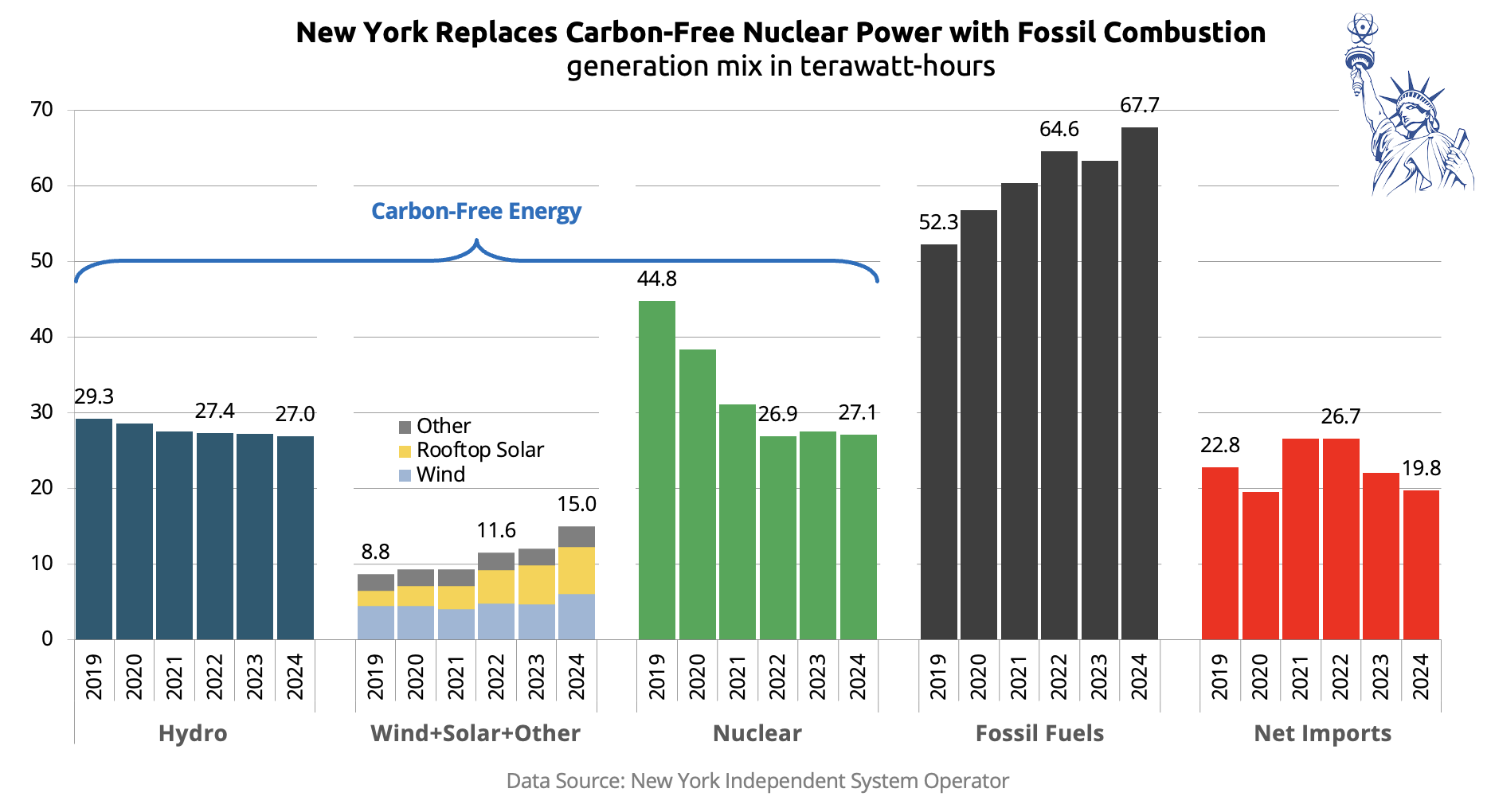
    Rarely are opposing trends as clear as the two in the chart directly below. In the five years from 2019, just before Indian Point’s closure began, the amount of electricity made by burning fossil fuels in New York State grew in tandem with the drop in nuclear generation caused by Indian Point’s absence.

    Over that 5-year term, as electricity generated statewide with nuclear power fell by 17.7 TWh, electricity generated with fossil fuels (essentially fracked methane gas) rose by 15.4 TWh a year. (A TWh, or terawatt-hour (TWh), equals a billion kWh’s.)

    Chart by writer, from NYISO data extracted by Isuru Seneviratne. More details in paragraph directly below.

    The loss of generation from Indian Point — 16 to 17 TWh a year, based on the 2001-2019 average — was supposed to be made up with “renewables.” Shutdown proponents, led by the advocacy group Riverkeeper, practically guaranteed it. A press release that the group issued as the hours counted down on April 30, 2020 was titled Indian Point 2 shuts down; NY’s renewable energy transition, for example. (Connoisseurs of the legendary “Dewey Defeats Truman” headline should flock to that Riverkeeper web page.) Yet increases in renewables can barely be detected in 2019-2024 statewide generation changes.

    Over those five years, electricity produced statewide from wind, solar and burning forest products did grow by a healthy 70 percent. But because the starting base was small, the increase in absolute terms was a modest 6.2 TWh. Hydro-electricity, moreover, fell by 2.3 TWh, cutting the net 2019-2024 boost from renewables to a measly 3.9 terawatt-hours. Virtually the entire slack from shutting Indian Point had to be taken up by increased burning of fossil fuels — not because of gas greedheads but because no other power source was available. (The various 2019-2024 generation changes meticulously compiled by the NY Independent System Operator have been distilled into a comprehensive chart created by Isuru Seneviratne, who monitors state electricity data for the advocacy group Nuclear NY.)

    Renewables won’t soon make up Indian Point’s lost output

    Renewable-power sources being developed for NY State can be placed in three groups.

    1. 1,200 megawatts (MW) of new hydroelectric power being brought to NY State from Quebec via a new 339-mile long transmission line known as the Champlain Hudson Power Express (CHPE).
    2. Wind farms in the Atlantic Ocean off Long Island, beginning with the 2,070-MW Empire Wind 1 and 2 arrays south of Long Beach (my hometown).
    3. New utility-scale on-shore wind and solar in various stages of permitting and construction, comprising nearly 50 ventures totaling around 7,000 MW.

    Empire Wind generation is zeroed out in “realistic” scenario due to Trump’s fear and loathing of offshore wind. Realistic scenario for solar and (onshore) wind in project pipeline assumes one-half of maximum generation.

    The raw megawatt figures above may appear imposing, but less so when we account for three crucial factors:

    (i) Only CHPE can provide reasonably consistent electricity, with a capacity factor between 70% and 75%; the wind and solar farms are weather- and astronomically-limited to much lower annual outputs: I posit 40% (offshore wind), 33% (onshore wind) and 15% (solar).

    (ii) Offshore wind is almost certainly dead in the water (sorry!), due to the U.S. president’s implacable hatred (rooted in his belief that a nearby wind-power venture would threaten the profitability of one of his Scotland golf courses). [See addendum at end of this post.]

    (iii) Not all projects in the state renewables “pipeline” will prevail through permitting obstacles, local opposition and financing problems.

    The bar chart at right adjusts for these factors by presenting the prospective the three categories of new carbon-free electricity alongside Indian Point in annual terawatt-hours. The green bars sum to 27 TWh, indicating total new carbon-free generation nearly two-thirds greater than that lost when the nuke plant was taken away. The more-realistic red bar sum, 13.8 TWh, is only around half of the maximum, and is less (by 14%) than Indian Point’s lost contribution.

    Let’s also face that having new renewables make up for the generation lost by closing Indian Point is a pathetically low bar. New wind and solar were supposed to contribute mightily to stopping climate change by pushing fossil fuels out of the grid . . . which they cannot do at present if their output must stand in for the carbon-free output that Indian Point was prevented from providing after 2020.

    Lessons learned?

    The outlook for decarbonizing the NY State power grid is grim, even if there’s a post-Trump world in which the U.S. government doesn’t throttle offshore wind as it has tried (unsuccessfully, thank goodness) to scuttle New York’s congestion pricing program. As the last bar chart shows, even bringing Empire Wind to fruition won’t make up half of Indian Point’s lost carbon-free output.

    And this post hasn’t touched on the closure’s prospective toll on downstate electricity rates and reliability. Nor has it treated the possibility that deteriorating U.S.-Canada relations will put a crimp in (or surcharges on) hydro-electricity from CHPE whose expected commencement next year is the only bright spot on the horizon, so far as large projects are concerned. (Rooftop solar has gained a solid foothold in New York State, which ranks third in the U.S. in the number of homes with solar panels, according to Solar Insure. Yet making up for Indian Point’s lost carbon-free output would require roughly one million new solar homes in the state — a 5-fold addition to the 200,000 existing solar homes in the state at the end of 2024.)

    Here are three lessons learned from the premature closure of Indian Point:

    Lesson #1. A robust carbon tax might have saved Indian Point. Based on its average 2001-2019 electricity output, a tax of $100 per ton of emitted CO2 would have conferred an annual carbon-avoidance value of three-quarters of a billion dollars on the Indian Point plant. (Calculation: 16.5 TWh/year x 10^9 kWh/TWh x 0.9 lb of CO2/kWh (per EIA, reduced slightly from that source’s 0.96 lb average to weed out peaker plants) x 1/2000 tons per lb x $100/ton.) A monetary bounty of that magnitude would have made it more difficult for Riverkeeper and then-Gov. Andrew Cuomo to engineer Indian Point’s closure. (During the decade preceding closure, the actual price under the Regional Greenhouse Gas Initiative (RGGI) to emit a ton of CO2 averaged 20 times less: around $5/ton.)

    Image from my 2020 post bemoaning the pending closure of Indian Point. (Link in text at right. Gotham Gazette ceased publication in 2023.)

    Lesson #2. Self-appointed environmental-interest groups should not be the primary arbiter of the public interest in climate-critical matters. “Climate was not at the table when Indian Point’s fate was being sealed,” I wrote in May 2020, weeks after Indian Point began to be shut down. Riverkeeper was at the table, of course, supported by several other prominent environmental organizations whose institutional biases led them, in my view, to overestimate the real-world availability of wind and solar electricity, undervalue Indian Point’s carbon-free benefit, and over-emphasize the risks of the nuclear plant’s continued operation. The result was that the “climate consequences of shutting Indian Point [were] brushed aside,” as suggested in the subhead to my 2020 post.

    Lesson #3: New Yorkers must consider adding more nuclear power capacity to the state grid. I’m starting to re-evaluate the proposition that New York State can achieve a zero-emissions electric grid without adding considerable nuclear power capacity. This widely held viewpoint (“article of faith” might be a more apt term) was critiqued in late 2023 by PhD physicist and policy analyst Leonard Rodberg, whose analytical acumen and probity I’ve admired since the 1970s, when we were colleagues in the safe energy movement, as it was then called. Len’s detailed analysis concluded that approximately 29 GW of new nuclear capacity — the equivalent of 15 Indian Point plants — will be required in addition to large amounts of offshore wind as well as solar and other “distributed” power — to reliably and affordably decarbonize the state grid by 2040 while satisfying load growth from electrifying much of the space heating and vehicular transportation now provided by combusting fossil fuels.

    Addendum

    Heatmap and other news outlets reported on May 20 that the U.S. Interior Department lifted its April 16 stop-work order indefinitely halting construction of the 810-MW Empire Wind 1 in the Atlantic Ocean south of Nassau County, NY. This hopeful development is tempered, however, not just by the Trump administration’s notorious fickleness but by the fact that if and when completed the 810-MW wind farm will offset only a sixth of the carbon benefit that was destroyed by Gov. Andrew Cuomo and Riverkeeper’s closure of Indian Point. See graph.


  • Threadline Wealth Spins Out of Baker Tilly as Independent RIA

    Threadline Wealth Spins Out of Baker Tilly as Independent RIA

    Moss Adams Wealth Advisors, the wealth division of accounting firm Moss Adams that last year combined with Baker Tilly, has spun out to become an independent registered investment advisor with $5.8 billion in assets under management.

    The new firm, called Threadline Wealth, made the move with backing from co-owner The Cynosure Group and a group of employee owners that “more than doubles” the wealth division’s previous number of employee stakeholders, according to CEO and co-founder Justin Fisher.

    Eric Miles, who had been CEO of Moss Adams before the merger with Baker Tilly, remains CEO of Baker Tilly. As part of the merger of those two firms, private equity firms Hellman & Friedman and Valeas Capital, existing Baker Tilly stakeholders made additional investments, according to an announcement at the time.

    Fisher, formerly the private client group leader at Moss Adams, said the Seattle-based Threadline will maintain its current custodial and wealth technology platform in the liftoff, along with its tax strategy focus for high-net-worth families and business owners that includes a large client base in Silicon Valley.

    Related:Deals & Moves: $1B Maridea Lures LPL Team; $30B Waverly Expands in Washington

    “We’re working with owners, executives—folks that are going to need expertise from a large accounting and consulting firm,” he said. “We really recognized that we’ve got to be all in on wealth management from an operating model and from a technology standpoint in order to really serve those clients differently in three, four years from now and going forward.” 

    The wealth division of Moss Adams had been discussing the breakaway with Baker Tilly leadership for over a year, Fisher said. He said there was a mutual understanding that the wealth team’s work to provide clients with private investment options, as well as invest aggressively in technology and talent, would not do as well if it remained in the accounting firm. 

    “For us, it’s really about being free from the requirements so we don’t cause a safety problem with the accounting firm and still invest in the entire universe of private investments,” he said. “You’ll have Baker Tilly want to audit a company that we may want to invest client funds in—from an allocation standpoint, why have that friction there? How does that serve the clients better?” 

    Threadeline launches with 60 employees, about half of whom are advisors. The firm custodies with Charles Schwab and Fidelity Investments’ National Financial Services, according to its most recent Form ADV.

    New CEO Fisher sees Threadline as building on its accounting and tax roots. He said upper-high-net-worth clients, particularly business owners, founders and executives, have a growing need to combine their investing, tax strategy, liquidity planning and estate design under one roof.

    Related:$34B Allworth Launches Women’s Initiative

    “When you look at the balance sheet of executives, owners and high-net-worth families that have balance sheets that are in the federally taxable range and above, they have a whole lot of financial complexity that they’re trying to navigate,” he said. “I probably don’t go a day without talking to an owner about a tax strategy.” 

    Cynosure will hold seats on Threadline’s board and be a partner in shaping the business, Fisher said. 

    The wealth management industry investor, which also has its own RIA, has investments in large RIA platforms, including Steward Partners and Savant Wealth.

    In February, there was a similar tax-focused advisory breakout with a new firm called Aerodigm Wealth. That RIA launched in Portland, Ore., via a management buyout of accounting firm Delap LLP’s wealth division.

    In addition, large RIAs have been bulking up their tax strategy expertise in recent years, sometimes adding full tax accounting practices through acquisitions or partnering through various models. 

    In January, Merit Financial Advisors acquired SSC Wealth, the $260 million financial advice team of SSC CPAs + Advisors, while keeping a relationship with the parent firm. In late 2025, Moneco Advisors, a Fairfield, Conn.-based registered investment advisor with about $2 billion in client assets, completed a merger with Lichtenstein Financial and its affiliated tax firm, Lichtenstein Tax Consultants, which it acquired in 2023. 

    Related:Younger, Affluent Self-Directed Investors Are Warming Up to Working with Advisors

  • S Corp vs. LLC Taxes: Which Saves You More in 2026? 

    S Corp vs. LLC Taxes: Which Saves You More in 2026? 

    Key Takeaways 

    • LLCs and S corps both provide liability protection and pass-through taxation, but they differ in payroll tax treatment, owner compensation, and administrative requirements. Choosing the right structure can influence overall tax efficiency. 
    •  LLCs are easy to set up, require minimal filings, and allow owners to claim standard business deductions. They are often the default choice for new entrepreneurs, freelancers, and small business owners. 
    •  By splitting income into a reasonable salary and distributions, S Corp owners may lower self-employment tax exposure, making this election attractive for businesses with higher profits. 
    • Compliance and administrative costs are higher for S Corps. S corporations require payroll processing, Form 1120-S filings, and detailed recordkeeping, which can offset potential tax savings if not managed carefully. 
    •  LLCs and S corps allow deductions for ordinary business expenses, while S corps may also deduct shareholder-employee benefits like health insurance and retirement contributions. 
    • Businesses should regularly evaluate profits, administrative capacity, and long-term goals to determine whether an LLC should remain as-is or elect S corporation status to optimize taxes in 2026. 

    Choosing the right business structure can have a significant impact on how much you pay in taxes each year. For many entrepreneurs, freelancers, and small business owners, the decision often comes down to S Corp vs LLC. Both structures provide liability protection and pass-through taxation, but they differ in how owners are compensated, how payroll taxes are handled, and how complex the administrative requirements can be. 

    Understanding the benefits of S Corp vs LLC is particularly important as businesses grow and profits increase. While LLCs are widely used because of their simplicity and flexibility, electing S corporation tax treatment may provide tax savings in certain situations. However, those savings typically come with additional filing obligations and stricter IRS rules regarding owner compensation. 

    This guide explores the pros and cons of LLC vs S Corp, explains how each structure is taxed, and highlights when one option may provide greater tax advantages in 2026. By understanding how these entities work, business owners can make more informed decisions about structuring their companies for both tax efficiency and long-term growth. 

    What Is an LLC? Understanding the Default Business Structure 

    Many businesses begin as Limited Liability Companies because they offer a combination of legal protection and relatively straightforward tax treatment. LLCs are particularly popular among freelancers, consultants, and small business owners who want to separate personal and business liability without dealing with the complexities of corporate structures. 

    Understanding how LLC taxation works is essential when comparing S Corp vs LLC, since LLCs are often the starting point before businesses consider making an S corporation election. 

    How LLCs Are Taxed by Default 

    An LLC is typically treated as a pass-through entity for federal tax purposes. This means the business itself does not pay federal income tax directly. Instead, profits and losses pass through to the owners, who report the income on their personal tax returns. 

    For a single-member LLC, the IRS generally treats the business as a disregarded entity. In this case, the owner reports business income and expenses on Schedule C of their personal tax return. Multi-member LLCs, on the other hand, are usually taxed as partnerships and file an informational partnership return while allocating income to members. 

    One of the key considerations with LLC taxation is self-employment tax. In most situations, LLC owners must pay self-employment tax on the entire net profit of the business. This tax covers Social Security and Medicare contributions. For 2026, the combined self-employment tax rate is 15.3 percent — broken down as 12.4 percent for Social Security and 2.9 percent for Medicare. However, the tax is calculated on 92.35 percent of net earnings (not the full amount), which accounts for the deductible employer-equivalent portion. The Social Security portion applies only to the first $184,500 of net earnings, while the Medicare portion applies to all net earnings with no cap. Higher earners may also owe an additional 0.9 percent Medicare surtax on income above $200,000 (or $250,000 for married couples filing jointly). 

    For example, if an LLC generates $120,000 in net profit during the year, the owner typically pays both income tax and self-employment tax on that full amount. This is one reason many growing businesses begin exploring whether an S corporation election could reduce their overall tax burden. 

    Note that there is no IRS-approved formula or ratio for determining a reasonable salary. The figures above are for illustration only. Each business owner’s appropriate salary depends on their specific role, industry, location, and experience. 

    Flexibility of LLC Tax Treatment 

    One of the most appealing aspects of an LLC is its flexibility in how it can be taxed. While LLCs default to sole proprietorship or partnership taxation, they can elect to be taxed differently depending on the owner’s goals and financial situation. 

    This flexibility leads many business owners to ask an important question: can an LLC be an S Corp? The answer is yes. An LLC can elect to be taxed as an S corporation by filing IRS Form 2553, allowing it to maintain its legal structure while changing how profits and compensation are taxed. 

    This option allows business owners to start with a simple structure and later adjust their tax classification as their income grows. For many entrepreneurs, this flexibility makes the LLC a practical starting point that can evolve alongside the business. 

    Key Advantages of an LLC 

    LLCs remain one of the most widely used business structures in the United States because they balance protection with simplicity. Owners receive liability protection, meaning their personal assets are generally separated from business liabilities and debts. This protection can be particularly valuable in industries where financial or legal risks may arise. 

    Another advantage is the relatively low administrative burden. LLCs typically have fewer formal requirements than corporations, and many states allow owners to operate with minimal reporting obligations. This simplicity makes LLCs attractive for solo entrepreneurs or small teams who want to focus on running their businesses rather than managing corporate paperwork. 

    LLC owners can also benefit from a variety of LLC tax deductions, which reduce the overall taxable income of the business. These deductions may include ordinary and necessary business expenses such as office equipment, marketing costs, software subscriptions, and professional services. Taking advantage of these deductions can significantly reduce the amount of taxable profit reported each year. 

    LLC owners who pay self-employment tax can deduct half of that tax as an above-the-line deduction on their federal return, which reduces their adjusted gross income and may affect eligibility for other tax benefits. 

    What Is an S Corp? The Tax Election Explained 

    Before comparing S Corp vs LLC, it is important to understand that an S corporation is not actually a type of business entity. Instead, it is a tax classification that eligible businesses can elect through the IRS. 

    Understanding what an S Corp is helps clarify why many LLC owners eventually choose this tax status as their businesses grow and become more profitable. 

    S Corp Is a Tax Status, Not a Business Entity 

    An S corporation is created when a qualifying business elects to be taxed under Subchapter S of the Internal Revenue Code. This election changes how business income is treated for tax purposes but does not alter the company’s underlying legal structure. 

    Several types of entities can elect S Corporation status, including LLCs and traditional corporations. This is why the question “can an LLC be an S Corp” arises so frequently among entrepreneurs evaluating their tax options. 

    To qualify for S Corporation treatment, a business must meet certain IRS requirements. These include a limit of no more than 100 shareholders, a restriction that all shareholders must be U.S. citizens or resident aliens (partnerships and corporations cannot hold shares), and a requirement that the company issue only one class of stock. The business must also be a domestic entity. 

    Once the election is approved, the business files a separate informational tax return each year. However, income generally continues to pass through to shareholders rather than being taxed at the corporate level. 

    How S Corp Taxes Work 

    Like an LLC, an S corporation benefits from pass-through taxation, meaning the business itself typically does not pay federal income tax on its profits. Instead, income is allocated to shareholders and reported on their individual tax returns. 

    The major difference in the S Corp vs LLC comparison involves how owners receive compensation. S corporation owners must pay themselves a reasonable salary for the work they perform in the business. That salary is subject to payroll taxes, including Social Security and Medicare contributions. 

    Any additional profits remaining after salaries and expenses may be distributed to shareholders as distributions. Unlike salary payments, these distributions are generally not subject to self-employment tax. This structure can potentially reduce the overall payroll tax burden for business owners whose companies generate significant profits. 

    S Corp vs LLC Taxes: The Key Differences in 2026 

    When evaluating S Corp vs LLC, the most important differences involve payroll taxes, compensation structure, compliance requirements, and overall tax complexity. While both structures offer pass-through taxation, the way profits are treated can produce different financial outcomes. 

    Understanding these differences is essential for determining whether an S corporation election might provide meaningful tax savings. 

    Self-Employment Taxes 

    One of the most significant distinctions between LLCs and S corporations involves how self-employment taxes are applied. LLC owners typically pay self-employment tax on the entire net profit of the business. This means all earnings are subject to both income tax and the Social Security and Medicare contributions included in self-employment tax. 

    S corporation owners, however, divide their income into two categories: salary and distributions. Only the salary portion is subject to payroll taxes, while distributions are generally exempt from self-employment tax. This difference can result in tax savings when the business generates profits above the owner’s reasonable salary. 

    For example, a business owner earning $150,000 in profit might take a $90,000 salary and $60,000 in distributions. Payroll taxes would apply only to the salary portion, potentially reducing the total tax liability compared to an LLC structure. 

    Owner Compensation Rules 

    Although S corporations can offer payroll tax advantages, they also come with stricter rules regarding owner compensation. The IRS requires shareholder-employees to receive a reasonable salary based on their role and the services they provide to the business. 

    Determining reasonable compensation often involves analyzing industry salary benchmarks, job responsibilities, and the financial performance of the company. If the IRS determines that a shareholder-employee’s salary is unreasonably low, it can reclassify distributions as wages, resulting in back payroll taxes, interest, and potential penalties — making proper salary documentation an important part of S Corp compliance. 

    Because of these requirements, many business owners work with accountants or tax professionals to determine an appropriate salary level that satisfies IRS guidelines while still optimizing tax efficiency. 

    Payroll and Administrative Costs 

    Running an S corporation generally involves more administrative work than operating a standard LLC. Because owners must be treated as employees, the business must establish payroll systems, withhold taxes, and submit regular payroll filings. 

    This additional complexity often requires payroll software or professional payroll services. Businesses must also maintain more detailed financial records to ensure accurate reporting of salaries, distributions, and shareholder allocations. 

    While these administrative tasks are manageable for many companies, they do add ongoing costs that should be considered when evaluating the benefits of S Corp vs LLC. 

    Business Loss Treatment 

    Both LLCs and S corporations allow business losses to pass through to owners, potentially offsetting other taxable income. However, the ability to deduct these losses may be limited by several tax rules. 

    For example, owners must have sufficient basis in the business to claim losses, and deductions may be limited by passive activity or at-risk rules. These limitations apply regardless of whether the business is taxed as an LLC or an S corporation. 

    Tax Filing Complexity 

    Another difference in the pros and cons of LLC vs. S Corp involves tax filing requirements. Single-member LLCs often file taxes directly on the owner’s personal return using Schedule C, making the process relatively straightforward. 

    S corporations must file a separate corporate tax return using Form 1120-S. The company then provides each shareholder with a Schedule K-1, which reports their share of income, deductions, and credits. 

    This additional filing requirement typically increases the complexity of tax preparation and may require professional accounting assistance. 

    Tax Deductions for S Corp Owners vs LLC Tax Deductions 

    Tax deductions play a critical role in reducing a business’s taxable income regardless of its structure. Both LLCs and S corporations allow owners to deduct ordinary and necessary business expenses, though some deductions are handled differently depending on the entity type. 

    Understanding the available deductions can help maximize tax efficiency while remaining compliant with IRS guidelines. 

    Common LLC Tax Deductions 

    Many business expenses qualify as LLC tax deductions, allowing owners to reduce their overall taxable income. These deductions typically include costs that are considered ordinary and necessary for operating the business. 

    Examples of deductible expenses may include office supplies, business-related travel, marketing costs, professional services, and technology subscriptions used to support daily operations. Home office expenses may also qualify if the workspace is used exclusively and regularly for business activities. 

    These deductions reduce the net profit reported on the owner’s tax return, which in turn lowers both income tax and self-employment tax obligations. 

    Tax Deductions for S Corp Owners 

    Many of the same deductions available to LLC owners also apply to S corporations. However, S Corp structures sometimes offer additional opportunities for tax planning, particularly when it comes to employee-related benefits. 

    Common tax deductions for S Corp owners may include health insurance premiums for shareholder-employees, retirement contributions made through company-sponsored plans, and reimbursed business expenses under accountable plans. These benefits can provide both tax savings and improved financial planning opportunities for business owners. 

    Because S corporations involve both salary and distribution income, tax professionals often use strategic deduction planning to help ensure the business remains tax-efficient while meeting compliance requirements. 

    How Optima Tax Relief Can Help 

    Choosing the right business structure is only one part of managing your tax obligations. Mistakes involving payroll taxes, S Corp elections, or improper deductions can lead to serious issues with the IRS. 

    If tax liabilities accumulate due to business structure errors or compliance problems, professional assistance may be necessary. Optima Tax Relief helps taxpayers address complex tax challenges, resolve outstanding tax debt, and navigate IRS processes. Their team works with individuals and business owners to explore potential relief options and develop solutions for resolving tax issues. 

    Frequently Asked Questions 

    Can an LLC be an S Corp? 

    Yes, an LLC can elect to be taxed as an S corporation by filing IRS Form 2553 if it meets eligibility requirements. This allows the business to keep its LLC legal structure while changing how it is taxed. 

    What is the difference between an S Corp vs LLC? 

    The main difference is how owners are taxed and compensated. LLC owners typically pay self-employment tax on all profits, while S Corp owners split income between salary and distributions, which can reduce payroll tax exposure. 

    When does it make sense to switch from an LLC to an S Corp? 

    Many businesses consider switching once profits grow large enough that payroll tax savings could outweigh the additional administrative costs. This often occurs when annual profits exceed the amount needed to pay the owner a reasonable salary. 

    Does an S Corp always save more taxes than an LLC? 

    No, an S corporation does not always result in lower taxes. If business profits are relatively low or inconsistent, the cost of payroll services, accounting, and additional filings may offset any potential tax savings. 

    Tax Help for People Who Owe 

    The choice between S Corp vs LLC ultimately depends on a variety of factors, including business profitability, administrative capacity, and long-term financial goals. LLCs provide a simple and flexible structure that works well for many entrepreneurs, particularly during the early stages of business development. Their straightforward tax treatment and minimal administrative requirements make them a practical option for freelancers and small businesses. 

    S corporations, on the other hand, may offer tax advantages for businesses generating higher profits. By separating salary from distributions, owners may be able to reduce the portion of income subject to payroll taxes. However, these potential savings come with additional compliance responsibilities, including payroll management and corporate tax filings. 

    Understanding the benefits of S Corp vs LLC, evaluating the pros and cons of LLC vs S Corp, and regularly reviewing your business structure as profits grow can help ensure your company remains both compliant and tax-efficient in 2026 and beyond. Optima Tax Relief is the nation’s leading tax resolution firm with over a decade of experience helping taxpayers.     

    If You Need Tax Help, Contact Us Today for a Free Consultation 

  • Capital Raising Mistakes Founders Make — And How to Fix Them

    Capital Raising Mistakes Founders Make — And How to Fix Them

    Founders often plan capital raising around meetings and pitch delivery. In practice, what extends the timeline is everything that follows.

    Once discussions move forward, fundraising becomes an operational process that runs together with building the business.

    As investor interest develops, requests for financial, legal, and strategic details increase.

    Each request adds coordination work, and momentum slows when information is incomplete, scattered, or prepared late. With multiple investors involved, small delays accumulate.

    When fundraising drags on, the cause is rarely market conditions. More often, it is avoidable execution gaps that appear after interest is established.

    This guide breaks down the most common process mistakes that add months to a raise and explains how founders can keep deals moving using data rooms.

    What is capital raising?

    Capital raising is securing external funding to support a company’s growth.

    Organisations raise this funding from angel investors, venture capital firms, and strategic corporate partners – each representing a different stage of the funding journey. The British Business Bank’s equity funding guide breaks down what each stage typically involves

    The process requires coordinating meetings, preparing materials, and managing investor interest efficiently.

    Capital raising includes the following steps:

    • Investor meetings and presentations — sharing the company vision and strategy
    • Financial and operational documentation — providing models, reports, and legal records
    • Due diligence coordination — answering investor questions and supplying requested materials
    • Follow-up and relationship management — keeping investors engaged while monitoring progress

    From a founder’s perspective, capital raising functions as a parallel workflow, requiring coordination, organisation, and consistent follow-up, all while the business continues to operate.

    How well this process is managed affects the speed at which a round progresses.

    Next, we explore the mistakes that slow down founders. At the same time, you can check how a data room for investors can simplify the process.

    What is a data room for investors?

    This is a secure space where users can store, manage, and share sensitive documents.

    Also called a virtual data room, the platform lets founders control access and monitor investor activity. With this functionality, the fundraising process becomes faster and more organized.

    Capital raising mistakes and how data room providers can fix them

    The following points highlight where founders often get slowed down and how structured tools can keep things on track.

    1. Treating fundraising as a pitch-only exercise

    Investors evaluate more than the story you tell. They want to see that your business runs smoothly with all relevant information.

    When teams focus only on the pitch, they may end up with weak supporting materials once investor interest appears.

    Common signs of this mistake:

    • Strong pitch deck, but incomplete documents
    • Last-minute searches for financial, legal, and operational materials

    Consequences:

    • Momentum between investor meetings slows
    • Follow-up requests stall the process and frustrate potential investors

    How a virtual data room helps: The software keeps documents updated and accessible, which ensures you can respond quickly to requests and maintain momentum. Also, it demonstrates your execution readiness.

    2. Poor document organisation and version control

    Founders often rely on email threads, shared folders with unclear names, or multiple versions of the same financial documents. While this may feel manageable, it quickly creates friction once investors begin reviewing materials.

    Common signs of this mistake:

    • Documents scattered across multiple locations
    • Confusing file names or outdated versions
    • Frequent uncertainty over which files are current

    Consequences:

    • Investors waste time clarifying which version is correct
    • Confidence in your internal processes decreases
    • Requests for the same information are repeated

    How a virtual data room helps: The solution offers clear folder structures and version tracking. Therefore, investors can always access the latest files. It reduces confusion and strengthens trust in your operational readiness.

    Extra tools: VDRs also feature a fundraising data room checklist. This is a structured list of investor-requested materials used to organize and maintain content within the data room throughout the raise.

    3. Delaying investor-ready due diligence materials

    Once interest is established, investors typically request access to financial models, cap tables, and legal or corporate records. However, delays often occur when these materials are prepared only after requests arrive.

    Common signs of this mistake:

    • Documents are assembled reactively rather than in advance
    • Key files are incomplete or spread across different locations
    • Responses to investor requests take longer than expected

    Consequences:

    • Weeks are lost gathering and organising information
    • Investor momentum fades while waiting for follow-up materials
    • Diligence conversations stall until documentation is complete

    How a virtual data room helps: An investor due diligence data room allows founders to prepare, organize, and maintain all required materials ahead of time.

    By giving investors structured access to up-to-date documents, founders can shorten review cycles, reduce friction, and keep fundraising discussions moving.

    4. Using insecure sharing methods

    Open links, email attachments, and public cloud folders are still common. However, they may raise concerns once investors begin reviewing confidential data.

    For example, it can be unclear who has access to sensitive files or whether documents have been shared beyond the intended recipients.

    Common signs of this mistake:

    • Investor materials sent as email attachments
    • Open or unrestricted access links
    • Use of public folders without clear permission controls

    Consequences:

    • Investors worry about the confidentiality of financial and intellectual property data
    • Informal sharing methods raise questions about governance and internal controls
    • Risk concerns lead investors to proceed more cautiously or pause entirely

    How a virtual data room helps: By limiting access, tracking activity, and presenting capital raising due diligence documents and other materials professionally, founders can reduce risk concerns and maintain investor confidence throughout the diligence process.

    5. Lacking visibility into investor engagement

    Once materials are shared, founders often lose sight of how investors interact with them. It is common not to know which documents are being reviewed, which investors are spending time on key materials, or whether follow-up interest is building.

    Common signs of this mistake:

    • Uncertainty about which investors have reviewed shared documents
    • Follow-ups sent without context or clear signals of interest
    • Equal time spent on engaged and disengaged investors

    Consequences:

    • Follow-up outreach is poorly timed
    • Early signs of interest are missed
    • High-intent investors may not receive the attention they expect

    How a virtual data room helps: VDRs show which documents users view and when. Thus, the tool enables founders to identify engaged investors, prioritise follow-ups, and respond to signs of interest effectively.

    Final thoughts

    Fundraising can feel like running a dozen mini-projects at the same time. Therefore, losing track of documents or sharing files the wrong way can slow everything down.

    A VDR can help you keep everything in one place and track what investors are looking at.

    Following start-up data room best practices means you’re ready when investors ask for information — and you can focus on the conversations that really matter.

    One last thing worth noting: the subscription cost of a virtual data room typically qualifies as a deductible business expense. That means you get a cleaner, faster fundraise — and a tax benefit to go with it.

  • What’s in My Wealthstack: Caprock

    What’s in My Wealthstack: Caprock

    The most important thing about how we think about our technology stack is that we orient toward the advisor. It’s true that the person whose capital we are managing is the client, but the primary audience and most important user in my world is the advisor. They are part of why the client is here, and they are the force multiplier for the business. 

    We need to help create leverage for those advisors so that they can do what they do best for the client. There aren’t many people on earth who can stand in front of a family with $100 million in assets and get them to trust them with all of it. We’re making sure those people can spend as much time doing that work to give the best advice they can while feeling great about the tools they are using to do it.

    CRM: Microsoft Dynamics 365

    We use Microsoft Dynamics because it syncs with all our systems. We use it to help manage new business development, but have evolved our thinking when it comes to CRM.

    Related:Modern Wealth Management: A Tech Stack Built for M&A

    In the past, a CRM used to be a lot more about the client record, name, birth dates, mailing address and all that. Then it became a tool for marketing automation, meeting notes and document storage. When it came to working with the client, the CRM was always an extra step: after a meeting, you had to stop and enter notes so they could be appended to the record.

    Now, these features and functions are being used by various AI tools and agents. Instead of putting data into the CRM, it’s more automated. Because of AI, our entire Microsoft 365 tenant replaces a dedicated CRM system. It’s scraping Outlook, Teams messages, emails, meeting transcripts and client documents. It interacts with our Office 365 tools to gather all information about the client relationship, and then AI surfaces the next best steps or tasks for the advisor to evaluate. 

    Reporting & Portfolio Management: Addepar

    Addepar is still very much the category leader. That’s particularly true for alternatives and private investing. 

    It’s not inexpensive. And I’m a little surprised they have not built in some simple commodity functionality, such as a document library or vault for client documents. When it comes to alternative investments data management, Addepar is also expensive. But when you look at some of the other platforms in that category, the pricing model consistently makes it difficult for a multi-family office because they charge per position rather than per fund. Platforms like Canoe, Arch and others assume you are working as a single-family office. Though I do think with the help of AI, that it will get sorted out over time and they’ll evolve their pricing to where it makes more sense.

    Related:Private Advisor Group: An Open-Architecture Approach

    Trading & Rebalancing: Addepar

    It’s still relatively early in the product life for trading and rebalancing with Addepar, but things are going well so far, and it means one less provider for us, and the integration is valuable. 

    Financial Planning: Proprietary Tools, Envestnet | MoneyGuidePro

    We have built our own financial planning tools and have had various iterations over time. We also give advisors the option to use MoneyGuidePro. We’ve been trying to move away from our own proprietary tools, but most of what’s in this category is focused on retirement planning, which is not our primary use case. 

    We’ve looked at other options, but it’s just not the right fit yet. The Venn diagram is just a bit off for us in terms of the functions we need. Some parts we really like, and some just aren’t a fit. The biggest thing for us tends to be serving the UHNW clients with their life events. That’s not necessarily about saving for retirement, but more about managing 25% to 30% of the portfolio being in private investments. There are unique business logistics you need for that, especially around liquidity management, that are not built into those [other] financial planning tools. 

    Related:Summit Financial: A Wealthstack For All

    Document Management: Microsoft 365

    Copilot continues to evolve and help us leverage what we have in our Microsoft environment.

    Primary/Secondary Custodians: Fidelity, Schwab

    We are not pleased by recent changes that Fidelity made when it comes to long-short SMA strategies. Fortunately, we have options.

    AI Services: Microsoft Copilot

    We are using Copilot because it fits with our system. But we are very interested in Anthropic/Claude and their financial services offering, and what they are doing there. We’re also interested in the note-taking category. We love the functionality of Jump, Firefly and those other notetakers. But the gap between what already exists and what Microsoft is offering seems small, particularly as Microsoft is constantly rolling out new functionality. This is also a highly regulated industry, so we want to be comfortable about where the data is going to live. We are reluctant to add a new platform and a new place where data lives. 

    Direct Indexing and/or Tax-loss harvesting services: Canvas, Canopy, Quantinno

    We’ve been using Quantinno for a little over two years, and it’s incredibly useful. The biggest obstacle is how it interacts with our custodians to build the portfolio. Caprock was an early adopter in this category and we were disappointed when Fidelity changed its policy. The tools are great and unlock useful strategies we continue to use for Caprock clients. We’re just doing it elsewhere. 

    Trust & Estate Planning: Luminary, Vanilla

    We are using estate planning more and more with overall financial planning. The next layer for each client is not just what you own and the performance, but how you own it. Understanding the relationship (what is in the portfolio and what is in the trust, or the marital trust, and how to think about gifting) is critical. We love Luminary and so do our clients. The lines are starting to blur between what an estate planning tool is versus a financial planning tool. 

    As told to senior reporter Alex Ortolani and edited for length and clarity. The views and opinions are not representative of the views of Wealth Management.

    Want to tell us what’s in your wealthstack? Contact Alex Ortolani at [email protected].

  • Why Everyone Is Talking About Bigger Refunds

    Why Everyone Is Talking About Bigger Refunds

    IRS data shows average refunds are up, but that doesn’t mean everyone will see the same result.

    Key takeaways

    • Average tax refunds are trending higher this filing season and filers are expected to see up to $1,000 increase in refund this year. 
    • A higher national average doesn’t guarantee your refund will be bigger. Your outcome depends on your income, withholding, and credits.
    • Changes to income, withholding, and credits can all affect your final refund.

    The news is all abuzz about receiving bigger tax refunds.

    Refund headlines are everywhere this year. But there’s an important catch if you’re already mentally spending money you haven’t received yet.

    In general filers could see up to $1,000 increase in refunds or lower balance due this season related to the new tax law changes.

    Here’s what’s driving the buzz, what people often misunderstand about “bigger refunds,” and how to figure out what your own refund might look like before you file.

    Are tax refunds bigger this year?

    So far, yes, on average related to the new tax law changes. The IRS reports average refund figures based on returns processed to date, and those numbers change throughout the filing season as more people submit returns.

    That’s why bigger refunds this year aren’t guaranteed. Your refund ultimately depends on your own tax situation — including income, withholding, credits, and deductions.

    Why your refund might be bigger this year

    Refunds go up for a few common reasons, and they’re usually personal, not universal. For example:

    • Your withholding changed. If more tax was withheld from your paychecks, your refund could be larger, even if nothing else changed.
    • Your life changed. Marriage, a new baby, a home purchase, or childcare costs can shift your credits and deductions.
    • Your income mix changed. Side income, bonuses, or new investments can change what you owe or get back.

    Some taxpayers may also see differences tied to new provisions associated with the One Big Beautiful Bill Act that the IRS has outlined in its guidance (for example, the car loan interest deduction, as well as deductions tied to tips and overtime for eligible filers).

    The important part: these changes only matter if they apply to you.

    Common misconceptions about ‘bigger refunds’

    A few ideas show up every year when refund headlines start circulating. Here’s what’s worth keeping in mind.

    A bigger refund isn’t always “extra money.”

    A refund is often a sign that you paid more tax during the year than you ultimately owed. If you got a very large refund and would rather have more money in each paycheck, you may want to review your withholding for next year.

    A bigger refund this year doesn’t mean a bigger refund next year.

    Refunds can change quickly if your income changes, credits phase in or out, withholding shifts, or tax rules change. One year’s refund isn’t a forecast.

    The number you expect isn’t always the number you receive.

    The IRS may adjust returns for errors or missing information, which can change the refund amount and affect timing. If that happens, you’ll typically receive a notice explaining the change.

    There are exceptions.

    Some people can still receive a refund even if they didn’t have taxes withheld or aren’t required to file. That’s often because of refundable credits like the Earned Income Tax Credit, which can result in a refund even if you don’t owe taxes.

    If you’re seeing refund headlines and thinking, “Okay, but what about me?” you’re asking the right question.Get clarity on your refund before you file using the TurboTax Tax Calculator.

  • How to Tell If Yours Is Genuine

    How to Tell If Yours Is Genuine

    A fake P800 letter is one of the most convincing frauds targeting UK taxpayers today. HMRC sends millions of genuine P800 tax calculations every year, and fraudsters exploit this by mimicking them closely.

    If you have received a P800 recently, knowing how to tell apart a fake P800 letter from the real thing could protect your bank account and personal details.

    A fake P800 letter typically arrives by email or text, though postal versions do exist. Either way, the goal is the same — to trick you into handing over bank details or clicking a link to a spoofed website.

    This guide explains what a genuine P800 looks like, lists the specific red flags that identify a fake P800 letter, and covers what to do if you suspect fraud.

    With HMRC reporting a significant rise in impersonation scams in recent years, understanding these signs has never been more important for PAYE workers and pensioners alike.

    What Is a Fake P800 Letter?

    A fake P800 letter is a fraudulent communication designed to look like an official HMRC tax calculation notice. Its purpose is to deceive you into sharing financial details or making a payment to criminals.

    HMRC genuinely issues P800 tax calculations to PAYE employees and pensioners at the end of each tax year. Fraudsters exploit this by sending fake versions during the same window, typically between June and November.

    The HMRC impersonation scam has grown significantly in recent years. Over 200,000 scam reports were made to HMRC in the tax year to January 2024 — a rise of 29% on the previous year.

    Not all fake P800 communications arrive by post. Many come by email, text message, or even automated phone call, each using slightly different tactics to extract your money or data.

    How to Tell If Your HMRC P800 Is Genuine

    The most reliable way to confirm an HMRC P800 is genuine is to log into your Personal Tax Account at gov.uk. If HMRC has issued a P800 for your records, it appears there.

    A genuine P800 arrives by post. It includes your full name, your National Insurance number, and a clear breakdown of your income and tax paid during the relevant tax year.

    What a Real P800 Contains

    The letter references your specific employer or pension provider by name. It shows the income figure HMRC holds on record, the tax paid under your PAYE code, and any difference owed to you or from you.

    If you are owed a refund, a genuine P800 may ask you to claim online via gov.uk. It does not embed a hyperlink for you to click directly from the letter.

    What a Genuine P800 Does Not Contain

    A real P800 does not ask you to call a premium-rate number. It does not contain a QR code linking to a payment page, and it does not request your full bank account details in writing.

    HMRC does not send P800 notices by email, text, or social media. Any digital message claiming to be a P800 tax calculation deserves immediate scepticism.

    Fake P800 Letter Red Flags: A Checklist

    Spotting a fake P800 letter early may prevent financial loss. Certain features appear consistently in fraudulent communications and are absent from genuine HMRC correspondence.

    Check for the following red flags when you receive any P800-related communication:

    • The message arrived by email, text, or social media rather than by post.
    • The sender address is not from an @hmrc.gov.uk domain — it may end in .com, .net, or include extra words.
    • You are directed to click a link and enter your sort code, account number, or card details to receive a refund.
    • The communication creates a deadline of 24 to 48 hours, suggesting your refund will be lost if you do not act immediately.
    • The letter or email contains spelling errors, inconsistent fonts, or an HMRC logo that looks slightly off.
    • A premium-rate telephone number is provided as the only contact route.

    A single one of these signs is enough to treat the communication as suspicious. You do not need multiple red flags before pausing and verifying.

    Why These Scams Are So Convincing

    Fraudsters invest considerable effort in making fake tax communications look authentic. They replicate HMRC branding, copy letter layouts, and time their messages to coincide with the genuine P800 mailing season.

    Some fraudulent letters arrive by post and include details such as your name, address, and even partial National Insurance digits. This personal data is often sourced from previous data breaches or phishing attacks.

    The urgency built into fake communications is deliberate. A message warning that your refund expires in 48 hours is designed to override careful thinking and prompt an immediate response.

    Deepfake audio and AI-generated voice calls impersonating HMRC have also been reported. These calls can sound remarkably official, making phone-based verification of the original letter even more important.

    P800 Tax Refund Scam: How the Fraud Actually Works

    A P800 tax refund scam typically follows a predictable sequence. Understanding each stage may help you spot where the manipulation begins.

    Stage One: Initial Contact

    You receive an email, text, or letter claiming HMRC has calculated an overpayment. The amount is usually plausible — often between £200 and £1,000 — to avoid arousing suspicion.

    The message creates a sense of entitlement and mild urgency. It feels like good news, which lowers your guard compared to a message demanding payment.

    Stage Two: The Fake Website

    You are directed to a website that mirrors the gov.uk design. The URL may be close to the real address but contains a subtle difference, such as an extra word or a different domain extension.

    Once on the fake site, you are asked to enter personal and financial details to ‘verify your identity’ before the refund can be processed. This is where the data theft occurs.

    Stage Three: Exploitation

    The details you have entered may be used immediately to access your bank account. Alternatively, they may be sold to other fraudsters or used in a follow-up scam weeks later.

    In some cases, a fake agent calls you after the initial contact, claiming to be from HMRC and offering to ‘process your refund’ directly over the phone.

    Common Mistakes That Make People Vulnerable

    Most people who fall victim to HMRC impersonation scams are not careless. They are caught out by specific patterns that fraudsters have refined over years of testing.

    Assuming personalisation means authenticity is a frequent error. A message that includes your name, employer, or partial National Insurance number feels more trustworthy — but fraudsters acquire this data routinely from leaks.

    Acting quickly under deadline pressure is another common vulnerability. The instinct to secure a refund before it expires is exactly the reaction a fake P800 letter is designed to trigger.

    Clicking the link before checking the URL is a third mistake. Even when an email looks official, hovering over or copying the link often reveals a completely unrelated web address.

    How to Verify an HMRC Letter Before Taking Any Action

    If you receive a P800 and are unsure whether it is genuine, there are straightforward steps you could take before responding in any way.

    Log into your Personal Tax Account at gov.uk by typing the address directly into your browser. This is the most reliable confirmation available — a genuine P800 issued to you may be visible there.

    You could also contact HMRC by telephone using the number listed on gov.uk — not any number printed in the letter. The general income tax enquiries line is the appropriate starting point for most queries.

    Forward suspicious emails to [email protected]. Report suspicious texts by forwarding them to 60599. Both routes feed into HMRC’s active fraud investigation process.

    If you have already clicked a link or entered financial details, contact your bank immediately and ask them to monitor your account. You could also report the incident to Action Fraud at actionfraud.police.uk.

    Fake P800 Letter by Post: What to Check on the Paper Itself

    Postal versions of a fake P800 letter require slightly different checks compared to digital messages. Physical details that are difficult or costly to forge are often the most reliable giveaways.

    Compare the print quality with any previous genuine HMRC letters you have received. Fraudulent postal letters sometimes show uneven printing, slight colour differences in the logo, or thinner paper stock.

    Check that any telephone number in the letter matches the numbers published on gov.uk. A number that cannot be found on the official site is a significant warning sign.

    Look at the postmark on the envelope. A letter claiming to come from HMRC but postmarked from an unexpected location or with a foreign postage mark deserves scrutiny.

    A genuine HMRC letter does not offer a cash reward for prompt action, and it does not include language designed to pressure you into responding within hours.

    Final Thoughts

    Knowing what a genuine P800 looks like — and recognising the specific signs of a fake P800 letter — is one of the most practical protections available to UK taxpayers.

    The core rule is simple: HMRC sends P800 notices by post and does not ask for bank details via a link.

    If anything about a P800 communication feels wrong, pause before acting. Log into gov.uk directly, contact HMRC on a verified number, and report anything suspicious.

    For more information on how a genuine P800 tax refund works, visit the HMRC P800 tax refund page on Tax Rebate Services.

    Fake P800 Letter Key Takeaways

    • HMRC sends genuine P800 tax calculations by post only — a P800 arriving by email, text, or social media is a strong sign of a fake P800 letter.
    • A real P800 includes your name, National Insurance number, and a detailed tax calculation; it does not contain a link asking for your bank details.
    • Red flags on a fake P800 include urgent deadlines, unfamiliar sender domains, premium-rate phone numbers, and website links that do not go to gov.uk.
    • You could verify any P800 by logging into your Personal Tax Account at gov.uk before taking any other action.
    • Report suspicious P800 communications to [email protected], forward scam texts to 60599, and contact Action Fraud if you have shared financial details.

    Fake P800 Tax Calculation FAQs

    Q1: How do I know if my P800 letter is a fake?

    Check whether the communication arrived by post rather than email or text — HMRC only sends genuine P800 notices by post. Log into your Personal Tax Account at gov.uk to confirm whether a P800 has been issued for your records. If the letter asks you to click a link and enter bank details, treat it as a fake P800 letter until verified.

    Q2: Does HMRC send P800 refund notices by email?

    No. HMRC does not send P800 tax calculations by email, text, or through social media. Any digital message claiming to be an HMRC P800 refund notice is likely to be a P800 tax refund scam. HMRC may send a text reminder after you have already claimed online, but it does not initiate refund contact digitally.

    Q3: What should I do if I clicked a link in a fake HMRC letter?

    Contact your bank immediately if you entered financial details on the linked site. Report the incident to Action Fraud at actionfraud.police.uk and forward the email to [email protected]. Change any passwords linked to accounts you accessed at the time, and consider checking your credit report in the following months.

    Q4: Can a fake P800 letter arrive by post rather than email?

    Yes, postal versions exist. A fraudulent postal letter may include your name and address but could show inconsistencies in print quality, logo colouring, or paper stock compared to genuine HMRC correspondence. Any telephone number in the letter should be cross-checked against gov.uk before calling.

    Q5: Where can I verify that HMRC has genuinely issued me a P800?

    Log into your Personal Tax Account at gov.uk by typing the address directly into your browser. If HMRC has issued a P800 for your tax records, it may be viewable there. You could also call HMRC on the income tax enquiries number listed on gov.uk — not any number printed in the letter itself.

  • Dan Zitting on Elevating Client Meetings

    Dan Zitting on Elevating Client Meetings

    Client meetings remain the heartbeat of the advisory relationship, but the expectations around them have never been higher. Advisors are under pressure to show up prepared, deliver deeply personalized guidance and answer increasingly complex questions on the spot, all while navigating a fragmented tech stack and rising client expectations shaped by artificial intelligence.

    In this episode of The WealthStack Podcast, host Shannon Rosic sits down with Nitrogen CEO Dan Zitting to unpack how technology is reshaping the before, during and after of client engagement. Fresh off Nitrogen’s Fearless Investing Summit, Zitting shares why the real opportunity in wealthtech isn’t replacing advisors with automation, but amplifying their expertise through connected workflows, compelling visuals and agentic AI.

    Key takeaways:

    • Why the client meeting is becoming the most important battleground for advisor value

    • How Nitrogen rebuilt its platform around its Nucleus AI engine to automate advisor workflows

    • Why tax conversations may spark the next generation of “catalyst moments” for clients

    • Why persuasive visuals can transform client understanding and engagement

    • How AI tools could help advisors manage larger client books while offering deeper planning insights

    Related:The WealthStack Podcast: Beyond the Model & Scaling Personalized Portfolios with Joshua Allen

    Resources:

    Connect with Shannon Rosic:

    Connect with Dan Zitting:

    About Our Guest:

    Nitrogen CEO Dan Zitting is a SaaS entrepreneur & operator, with a passion for software that enables a bold vision, especially one as bold as empowering the world to invest fearlessly. Prior to Nitrogen, Dan spent 13 years in enterprise SaaS for governance, risk management, and compliance (GRC). That journey started with founding Workpapers.com, the first true cloud software for audit & compliance management, which was acquired by Galvanize (then ACL) in late 2011. Then, leading Galvanize, Dan oversaw growth into the industry-recognized leader globally in GRC as recognized by analysts, investors, and (most importantly) customers alike. Galvanize was ultimately acquired by Diligent in a $1B transaction that created by far the world’s largest company in GRC software, a $650m+ revenue SaaS business serving 25,000 customers in 130+ countries. Dan’s lessons along the way have been published in Forbes, The Wall Street Journal, Bloomberg, Business Week, Reuters, The Street, CNBC, etc., as well as from the stage at hundreds of professional speaking events.

    Related:The WealthStack Podcast: Portfolio Personalization Without the Ops Headache with Wes Caywood

    Dan graduated with a BSBA in Information Systems and Finance from Colorado State University and received a Master of Accountancy from the University of Notre Dame. Dan believes his purpose is to challenge the planet’s organizations to maximize impact by operating with a conscience, and he’s found cloud software to be his best contribution to that personal mission.

  • New Tax Season Tips: Avoiding Penalties and Maximizing Deductions – Optima Tax Relief

    Mar 10, 2026

    Wondering what you need to know for this tax season? CEO David King and Chief Tax Officer & Lead Tax Attorney Philip Hwang explain why filing isn’t voluntary, how to avoid a Substitute for Return, and how to request an extension to prevent failure-to-file penalties.

    If You Need Tax Help, Contact Us Today for a Free Consultation 

    Categories:
    Tax Help Videos

  • Michael Oppenheimer, a professor of geosciences and international affairs at Princeton University, noted that solving climate change means undertaking a large number of seemingly small measures, like curbing emissions from automobiles, oil and gas wells, air travel, landfills, buildings and more. ‘Just because there are multiple contributors to a problem doesn’t mean we should excuse all but the top one,’ Dr. Oppenheimer said. ‘Just because a polluter’s emissions are decreasing doesn’t mean that they aren’t still far too high.’ “


    Michael Oppenheimer, a professor of geosciences and international affairs at Princeton University, noted that solving climate change means undertaking a large number of seemingly small measures, like curbing emissions from automobiles, oil and gas wells, air travel, landfills, buildings and more. ‘Just because there are multiple contributors to a problem doesn’t mean we should excuse all but the top one,’ Dr. Oppenheimer said. ‘Just because a polluter’s emissions are decreasing doesn’t mean that they aren’t still far too high.’ “