Author: admin

  • Tips for Paying Estimated Taxes to Avoid Underpayment Penalties

    Tips for Paying Estimated Taxes to Avoid Underpayment Penalties

    For many taxpayers, especially freelancers, self-employed individuals, and small business owners, managing taxes can seem overwhelming. Regularly setting aside income for estimated tax payments helps ensure that you are not caught off-guard when tax season arrives. Making these payments throughout the year can prevent underpayment penalties and provide peace of mind. This discussion explores effective strategies and practical tips for paying estimated taxes on time, managing cash flow, and staying compliant with tax regulations.

    Understanding Estimated Taxes and Penalties

    Estimated taxes are periodic tax payments made throughout the year, rather than a single annual lump sum. They are designed for individuals whose income is not subject to withholding. When you earn income that is not automatically deducted for tax purposes, you must estimate and pay your tax liability in quarterly installments. Missing these payments or underpaying can result in penalties and interest charges, making it crucial to maintain accurate records and timely payments.

    Why Underpayment Penalties Occur

    Underpayment penalties may occur when you do not pay enough tax by the deadline on the annual tax return. The Internal Revenue Service (IRS) calculates these penalties based on the amount that is underpaid and the period during which the underpayment occurs. Essentially, if your estimated tax payments fall short of certain thresholds during the year, you could face additional costs that will only increase your overall tax burden.

    How to Calculate Your Estimated Taxes

    Calculating estimated taxes might seem complicated, but breaking the process into simple steps can help simplify your planning:

    1. Review your prior year’s tax return. Use last year’s income, deductions, and credits as a foundation, adjusting for any significant changes in your financial situation.

    2. Estimate your current year’s income. Be realistic about potential increases or decreases in revenue, and consider seasonal variations, contract completions, or new business lines.

    3. Estimate your deductions and credits. Include business expenses, health insurance premiums, home office deductions, and any other qualifying deductions.

    4. Determine your tax liability. Utilize tax tables and official IRS guidance to calculate the expected tax based on your income and deductions.

    5. Divide your estimated tax liability by four. The IRS typically expects quarterly payments, so this division will give you the approximate amount due each quarter.

    Top Tips for Paying Estimated Taxes On Time

    Timely and accurate payments of estimated taxes are essential to avoid penalties. The following tips can help you streamline the process:

    • Set Up a Dedicated Account: Establish a separate savings or checking account specifically for tax payments. This separation helps ensure that you have sufficient funds when tax deadlines approach.

    • Automate Your Payments: Where possible, use your bank’s automatic transfer feature to make quarterly payments. Automation reduces the risk of forgetting a deadline.

    • Keep a Detailed Calendar: Mark all tax payment due dates and set reminders ahead of time. Many digital calendar applications will allow you to add recurring events and notifications.

    • Monitor Cash Flow Regularly: Regularly review your monthly income and expenses to ensure that you have enough funds available to meet your quarterly obligations.

    • Consult with a Tax Professional: A qualified tax advisor can help estimate your tax liability more accurately and provide customized suggestions to keep you compliant.

    Strategies to Avoid Underpayment Penalties

    Implementing strategic measures can help you steer clear of underpayment penalties and avoid unnecessary costs. Consider the following approaches:

    • Safe Harbor Rules: The IRS provides safe harbor provisions which help taxpayers avoid penalties if their cumulative estimated payments meet or exceed certain thresholds. Familiarize yourself with these rules to see if you qualify.

    • Annualized Income Method: This method is beneficial if your income is not consistent throughout the year. Rather than making equal quarterly payments, you can adjust your payments based on the income earned during each period.

    • Regular Review and Adjustments: Your financial situation may change over the course of the year. Reassess and adjust your estimated tax calculations periodically so that your payments remain aligned with your actual income.

    • Underpayment Calculators: Utilize online tools and IRS calculators to determine if your quarterly payments sufficiently cover your expected tax liability. These calculators can help identify potential underpayment issues early on.

    • Maintain a Cushion: Always consider a buffer in your estimated tax payments. Overpaying a little might be less concerning than facing harsh IRS penalties or interest charges.

    Managing Cash Flow and Record Keeping

    Beyond simply calculating your taxes, maintaining organized records and managing your cash flow are essential practices for smooth tax payments. Clear record keeping not only aids in providing accurate tax estimates but also simplifies the filing process at year’s end.

    Implement these best practices for effective record management:

    • Maintain Organized Financial Records: Regularly update records of all income and expenses. Using accounting software or spreadsheets can help maintain clarity and accuracy.

    • Retain Receipts and Invoices: Keep digital or physical copies of all receipts, invoices, and other financial documents. This practice makes it easier to verify deductions and adjustments if needed.

    • Review Bank Statements: Verify that funds have been transferred to your dedicated tax account and that no payment discrepancies occur.

    • Seek Professional Assistance: If organizing these records is overwhelming, consider working with a bookkeeper or financial advisor who specializes in taxes.

    Planning Ahead and Staying Informed

    Tax laws can change, and staying informed about these changes is necessary to ensure that your estimated tax payments remain accurate. Consider these strategies to stay ahead:

    • Subscribe to IRS Updates: The IRS regularly publishes updates and changes to tax laws. Signing up for newsletters or checking the IRS website can help you stay current.

    • Attend Tax Seminars and Workshops: Various community groups and professional organizations offer seminars that can help you better understand tax regulations and planning strategies.

    • Network with Other Professionals: Sharing experiences with other self-employed individuals or business owners can provide insights and practical tips for managing taxes.

    • Regularly Consult with a Tax Professional: Ongoing consultations ensure that your tax strategy is adjusted for changes in your financial situation or tax law refinements.

    Conclusion

    Paying estimated taxes on time is a critical strategy for avoiding penalties and managing your annual tax liability efficiently. By understanding how estimated taxes work, calculating your payments accurately, and leveraging practical tips like automating payments and maintaining thorough records, you can ease the burden of tax season. Staying proactive and informed about changes in tax laws, while utilizing professional advice when necessary, further solidifies your financial stability. With proper planning and disciplined execution, estimated tax payments become a manageable and predictable part of running a business or managing freelance income.

    Frequently Asked Questions

    How can I determine if I need to pay estimated taxes?
    If you expect to owe at least $1,000 in tax for the year (after subtracting withholding and refundable credits), you are typically required to make estimated tax payments. Self-employed individuals and freelancers often fall into this category. It is best to consult IRS guidelines or a tax professional to determine your specific situation.

    What happens if I overpay my estimated taxes?
    If you overpay your estimated taxes during the year, you generally have the option to request a refund or apply the excess amount to the following year’s tax liability. Overpayments may happen if you’re uncertain about your exact tax liability; it is often a safer route to avoid penalties, assuming you have cash flow flexibility.

    Can automated systems help with making estimated payments?
    Yes, many banks and financial institutions offer automated payment options that can help ensure your estimated tax payments are made on time. Automation simplifies the process and reduces the risk of missing a payment deadline, which can ultimately help you avoid underpayment penalties.

    Is the annualized income method suitable for everyone?
    The annualized income method is often useful for individuals whose income fluctuates throughout the year. It allows you to adjust your estimated tax payments based on the actual income earned during each period rather than making equal quarterly payments. However, if your income is relatively stable, the standard quarterly estimation might be more straightforward.
  • Toronto Could Face Higher Property Taxes As Feds Cut Refugee Support

    Toronto Could Face Higher Property Taxes As Feds Cut Refugee Support

    Despite the fact that Toronto’s unhoused population has more than doubled since 2021, the City is set to receive a fraction of the Canada-Ontario Housing Benefit (COHB) funding in its sixth year that it did in both its fourth- and fifth-year allocations.

    Toronto Mayor Olivia Chow wrote in a letter that went to the Executive Committee on Monday that the Province allocated $38 million to Toronto from the COHB between April 2024 and March 2025, and $19.75 million from April 2025 to March 2026 — but between April 2026 and March 2027, the City will receive only $7.95 million, representing an almost 60% decrease year over year.

    Launched in April 2020, the COHB pays the difference between 30% of eligible households’ income and the average market rent in the area, and is supported by provincial and federal funding. Chow said in her letter that the program “is the single most effective tool we have for freeing up beds in our shelter system so that more people can come indoors from streets and parks.”

    She also describes “provincial delays and uncertainty” that led to the City fronting $4.815 million of the COHB funding earlier this year — a move that helped 570 households move from the streets and shelters into housing.

    “Now, the Province has said we can only allow for 40 more households to move into housing between now and March 2026 within the funding they’ve provided,” said Chow. “That means all funds will be spent by the end of October, just when the weather turns cold and we need to bring homeless people on the street into shelters or homes.”

    Chow’s letter also speaks to a pullback in funding for the Interim Housing Assistance Program (IHAP), which is a federal grant program created to help provincial and municipal governments manage the cost burden of housing asylum claimants. Toronto is set to receive funding for only 26% of what it’s projected to spend on shelter refugees and asylum seekers this year.

    “We’ve been providing shelter to people who arrived to Toronto fleeing violence, war and persecution, but now the federal government won’t pay their bills for the service, and the City is short by $107 million,” Chow said to media on Monday. “We can either stop sheltering refugee claimers, leave them on the street, which will make homelessness worse, reversing the progress we made on reducing the number of encampments — or Torontonians will have to pay for it through their property taxes. Neither is fair.”

    Chow is calling on the the federal government to provide transitional funding of $107 million for refugee claimants and asylum seekers in the City’s emergency shelter system, and in addition, is requesting Toronto’s COHB allocation be increased to $54 million for the program’s fifth year “to allow 300 households to continue to secure permanent housing each month.” Her requests will be discussed at Toronto City Council’s October session, scheduled to begin on Wednesday, October 8.

  • Brampton Reduces Development Charges By Up To 100% For Rental Apartments

    Brampton Reduces Development Charges By Up To 100% For Rental Apartments

    On Wednesday, the City of Brampton announced it is reducing development charges (DCs) by up to 100% on purpose-built rental units in order to encourage their construction and “address the city’s growing housing needs.”

    DCs are taxes that builders pay to a city in order to help fund increased infrastructure needs that may be required as a result of growth, including services like roads, transit, water, and sewer systems. But over the last 15 years, DCs across the GTA have skyrocketed, placing additional strain on already struggling development pipelines.

    “Brampton is taking a bold step to address one of the biggest challenges facing our residents: the shortage of safe and affordable rental housing,” said Mayor of Brampton, Patrick Brown, in a press release. “This new incentive program will attract investment, support family-friendly rentals and help us build the strong, vibrant communities our residents deserve.”

    As of August 1, the municipal DC for a large apartment (over 750 sq. ft) in Brampton is $38,395 and $23,628 for a small apartment (less than 750 sq. ft). But on top of that, builders pay a DC to the Region of Peel, to GO Transit, and to the region’s education boards, totalling $100,659 in DCs for a large apartment and $59,084 for a small apartment. In 2018, Brampton developers would have been charged just $54,197 and $36,738 in DCs for these unit sizes, respectively.

    Brampton’s new Development Charges (DC) Incentive Program reduces the financial burden on builders by lowering municipal DCs based on unit size, effective immediately until November 14, 2026. Under the new program, reductions would be tiered, with one-bedroom units seeing a 50% discount, a 75% discount for one-bedroom+den and two-bedroom units, and a 100% discount for both three-bedrooms and two+bedroom units with mixed use.

    Additionally, in June, Peel Region passed their own DC reforms, reducing regional residential development charges by 50% from July 10, 2025 to November 13, 2026, further reducing costs for Brampton developers.

    Brampton’s announcement follows a handful of other GTHA municipalities that have taken action to lower DCs in some capacity. Last May, Burlington lowered their DCs by $1,500, Vaughan returned their DCs to September 2018 levels in November, Mississauga reduced all residential DCs by 50% and by 100% for three-bedroom units in purpose-built rentals in January of this year, and Hamilton lowered all residential DCs by 20% in August.

    In addition to the DC reductions, Brampton City Council passed a motion Wednesday asking the Province to reconsider its “one-size-fits-all” Additional Residential Units (ARU) legislation. An ARU could be any additional dwelling on an existing residential property, such as a basement apartment or garden suite. According to the press release, the legislation has allowed more than 26,000 registered ARUs in Brampton, which makes up more 60% of all new residential units in 2025. The City is asking that the Province allow Brampton to pause new ARUs in concentrated areas, “so the City can address property standards and safety issues, while incentivizing better, safer alternatives through purpose-built rentals.”

  • GTA Rental Supply Deficit To Hit 235,000 Units Over Next Decade

    GTA Rental Supply Deficit To Hit 235,000 Units Over Next Decade

    A report released Wednesday finds that the GTA is on track to amass a roughly 235,000-unit deficit in purpose-built rental (PBR) housing supply over the next 10 years, made up of the current and projected shortfall in units. Using comparative pro forma analysis, the report also shows how far targeted policy changes can go towards making projects more viable moving forward.

    The report was assembled by the Building Industry and Land Development Association (BILD) in conjunction with real estate consulting firm Urbanation and cost consulting company Finnegan Marshall, and it shares sobering insights into current PBR housing needs in the GTA, how project feasibility has changed since 2022, and policy changes they say need to be implemented by all three levels of government in order to meet housing needs over the next decade.

    Titled The Pathway For Rental Housing Stock, the report builds upon a previous study released in February 2023 by providing updated information and outlooks following a number of policy and market changes that have impacted PBR development in the region.

    Decoding The Current Market

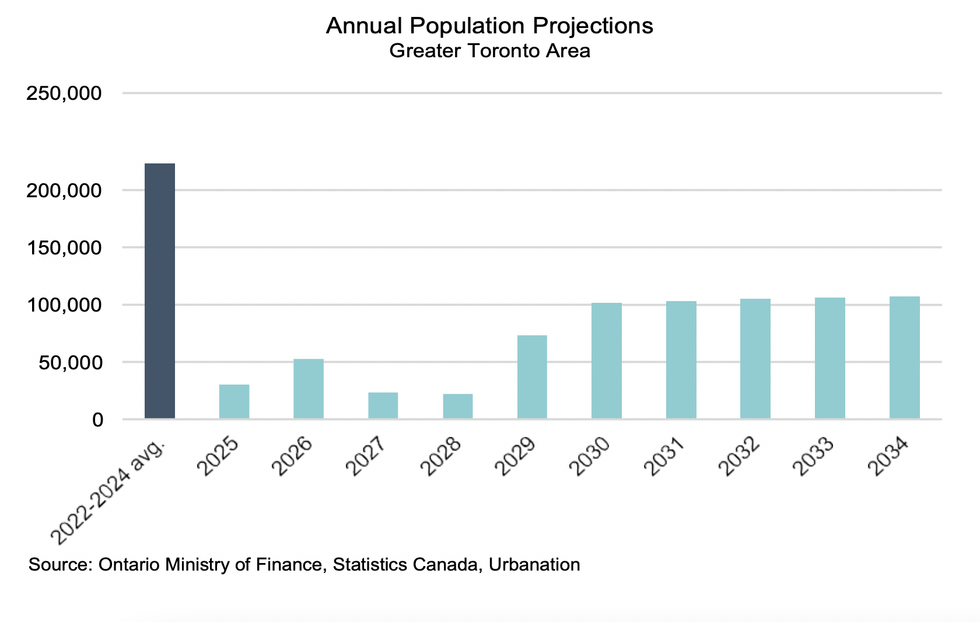
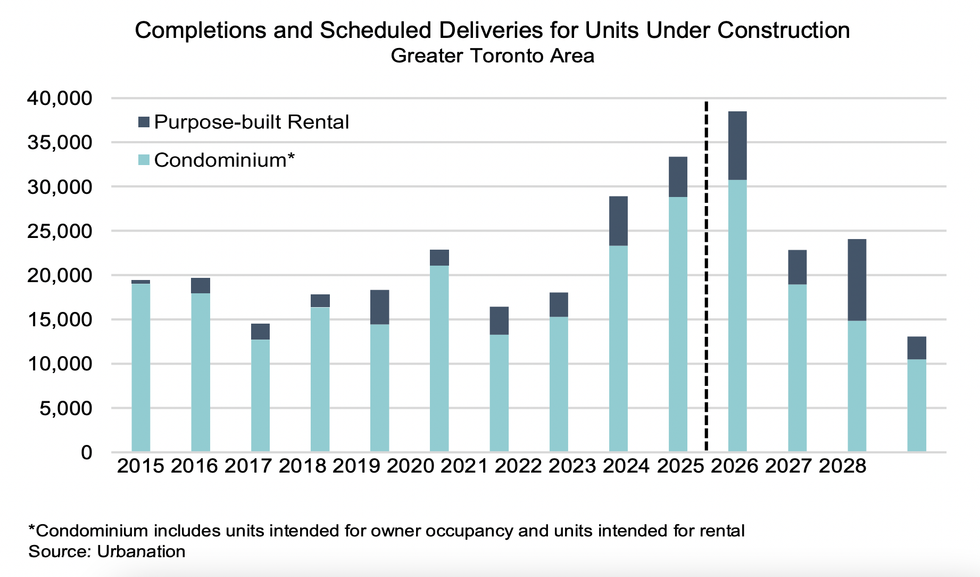
    A whitepaper prepared by Urbanation provides an updated view of the GTA’s PBR market as well as rental needs and the forces that are shaping those needs. The report highlights that the GTA saw a significant rise in rental demand over the past two years as the population surged by 550,000 people over 2023 and 2024. This historic demand was met by an historic wave of new purpose-built and condo rental completions that saw nearly 35,000 units added over the course of 2024 — more than double the 10-year average.

    Since the Feds lowered immigration targets in October 2024, the region has started to see the flow of permanent and temporary residents dwindle, bringing down rents as completions continue to arrive in record numbers. But while the GTA population is expected to grow by 726,884 residents over the next 10 years — 38% less than the previous 10 years (1,177,497 residents) — plummeting condo completions and slowing PBR growth will also “substantially” pull down supply.

    For context, the current downturn in condo presales has contributed to a 50% year-over-year drop in condo starts between 2023 and 2024, when it hit a 25-year low of 8,792 units. Meanwhile, despite rising 7% in 2024 to 6,637 units, PBR starts remain below the recent 2021 high of 7,061 units. Looking ahead, condo and PBR completions combined are expected to total 38,528 units in 2025, before moderating to 22,860 and 24,065 units in 2026 and 2027, respectively. Then by 2028, completions will fall to a 20-year low of 13,076 units.

    But with investors fleeing the condo market, the report says PBRs will be expected to fill the rental gap by delivering 16,000 to 19,000 rental units per year for the next ten years — something it is not currently on track to do, due in part to red tape at various levels of government. More on that later.

    “While the GTA could previously rely on condo investors to supply the market with the majority of new rental units, the downturn in new condo market activity underway suggests that won’t be the case going forward and there will be a greater need for PBR construction. However, relative to the other large markets in Canada, the GTA ranks lowest in terms of per capita for rental construction,” reads the report.

    On top of falling construction, declining homeownership rates are exacerbating the looming supply deficit as more would-be-homeowners turn instead to renting. According to Urbanation, the GTA’s homeownership rate fell from 68% in 2011 to 65% in 2021 and rates are expected to continue falling due to “ongoing, long-term ownership affordability challenges.”

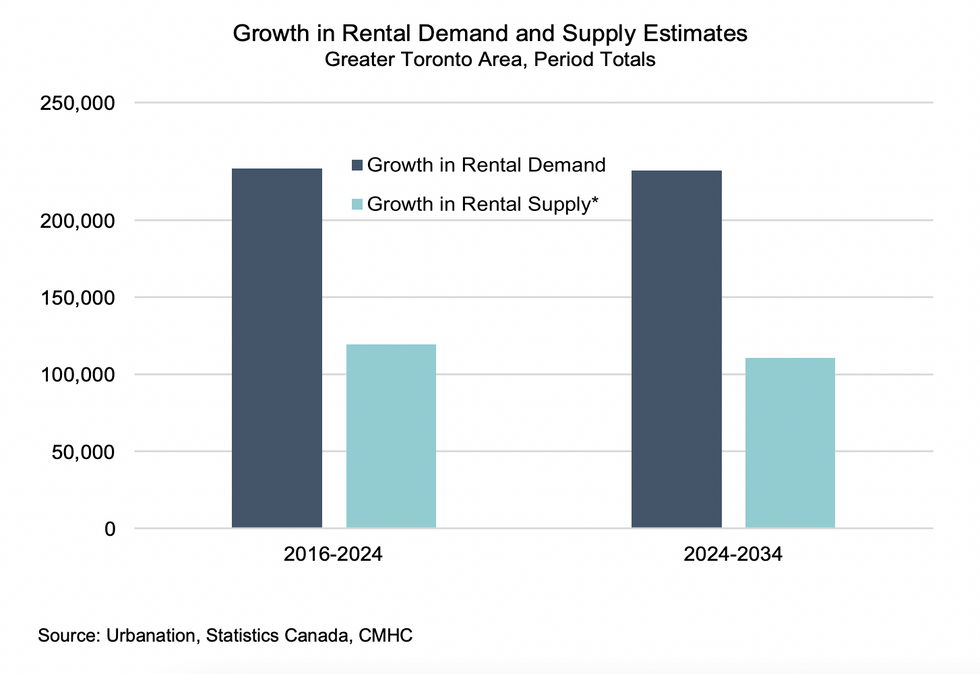
    Considering projected population growth, falling homeownership rates, and dwindling supply, Urbanation estimates the GTA will have a rental deficit of 235,000 units in ten years, made up of 121,000 units needed in the future and the 114,000-unit deficit that grew between 2016 and 2024.

    Feasibility Stronger Where DCs Are Lower

    Pro formas, pro formas, pro formas. While PBR demand may be headed fora major increase and while developers may be eager to build these rental types, Urbanation highlights that current conditions just aren’t conducive for development.

    “The deterioration in economic feasibility for new development and often lengthly application timelines has left a large supply of units waiting in the pipeline,” reads the report. “As of Q1 2025, the GTA had a total of 200,586 PBR units in the proposed stage that had not started construction. […] This is in addition to hundreds of thousands of units in the planning stages proposed as condominium or have an undetermined tenure.”

    To help explain how these conditions hold development back, the second portion of the report consists of two April 2025 pro forma analyses from Finnegan Marshall for condo and PBR projects proposed in both downtown Toronto and Mississauga. According to the analysis, both municipalities saw feasibility for PBRs improve over the last two years thanks to federal, provincial, and municipal changes, such as the feds waiving HST on new PBRs in fall 2023, the matching of that incentive by the province, and the two cities implementing various incentives to spur development.

    However, in Mississauga, where municipal incentives for development were more impactful, the analysis found that pro formas for both building types had improved by a greater amount than in Toronto. In January of this year, Mississauga voted to lower development charges (DCs) for residential projects by 50%, to eliminate the fees for three-bedroom PBR units, and to defer the collection of DCs until occupancy permits are issued for all residential developments.

    For Toronto’s part, the City has done things like freeze DCs at current rates and waive DCs for certain housing types like sixplexes, but the report says more needs to be done.

    “The lack of support from the City of Toronto remains a key impediment. While the city has adopted some measures, they are time-bound and have very restricted eligibility,” it reads. “The lack of broad-based relief in Toronto, where the need for more housing is notably the greatest, as evidenced by the pro formas in this document, means new PBR and condo remain non-viable.”

    According to the analysis, for a hypothetical 400-unit condo development in Mississauga, including year-one operating costs, the net revenue would now be $28,333,469. In Toronto, that same condo project would deliver just $11,478,175 in profits, making it unviable. For comparison, the profit on a 400-unit Toronto condo proposed in late-2022 would have been $39,772,225.

    If the same development was proposed as a PBR in Toronto, the project would now cost $251,850,000 and the net annual cash flow would be $974,246. In Mississauga, where average rent is around $383 lower than Toronto, the cost would be a more affordable $226,715, while annual income would be $820,460.

    Recommendations From BILD

    In the final portion of the report, BILD lays out a to-do list of policy changes for the municipal, provincial, and federal governments aimed at spurring rental development.

    At the municipal level, BILD recommends things like eliminating or lowering DCs for rental and mixed-use projects and lowering property tax rates for PBRs via Tax Increment Financing and the New Multi-Residential Subclass discount of 35% on property taxes. At the provincial level, they recommend unlocking existing DC reserves for ready-to-go projects, and federally, recommendations include expanding CMHC programs, lifting the foreign buyer ban, and establishing a housing task force that includes all three levels of government, among other suggestions.

    BILD’s SVP of Communications, Research & Stakeholder Relations, Justin Sherwood, emphasizes just how important it is that these recommendations be adopted in order to avoid a “tremendous economic hit,” ensure housing is delivered, and keep the industry on two feet.

    “The industry is facing massive amounts of layoffs. You’re looking at starts dropping tremendously — somewhere in the order of magnitude of 60% in the GTA — and you’re actually seeing the drying up of investment going into residential construction, whether it be for sale or for rent,” Sherwood tells STOREYS, adding that the number one goal is to ensure people are housed. “[…] We need to be able to put roofs over heads. Population is going to continue to grow. Whether it’s going to grow by 400,000 people a year in Canada or 500,000 people, it’s still growing, right? That need is not going away.”

    But spurring housing, Sherwood points out, not only benefits developers but all three levels of government as well. “There’s an economic benefit that the housing sector brings to the domestic economy,” he says. “It’s one of the largest sectors in the Canadian economy, it’s one of the largest employers in the Canadian economy, and it sources about 90% of its raw materials domestically. If all of a sudden that starts declining, there’s a tremendous negative impact to governments.”

  • "Self-Defeating": With DCs Out Of Control, Homeowners Are Paying The Price

    "Self-Defeating": With DCs Out Of Control, Homeowners Are Paying The Price

    British statesman Winston Churchill once said, “We contend that for a nation to try to tax itself into prosperity is like a man standing in a bucket and trying to lift himself up by the handle.”

    In many ways, that characterizes what we are doing with development charges (DCs) on new housing. Municipalities are unilaterally imposing the levies on new development to foot the bill for capital costs of infrastructure like roads, water, sewage and power services to support growth.

    In the end, it is self-defeating as new homeowners end up paying exorbitant fees that raise the cost of housing.

    Over the years, there’s been tremendous mission creep with these charges. The funds are being used to pay for everything from subways to animal shelters and, in one instance, a cricket pitch.

    In some municipal jurisdictions, such as in central Ontario, the GTA and Ottawa, DCs have become a runaway train. In Toronto, DCs on a two-bedroom condo increased to $88,000 from $8,000 over a 10-year period. Hikes like this put housing out of reach of most homebuyers.

    And make no mistake. It is homebuyers that are footing the bill. While developers are the ones who initially pay the DCs when they obtain building permits, they are passed on to the buyers of new homes as part of the purchase price.

    DCs are traditionally adjusted annually by municipalities to cover inflation and the increasing costs of infrastructure projects. However, these fees account for a large chunk of the tax burden on new housing.

    A report for RESCON done by the Canadian Centre for Economic Analysis found that taxes, fees and levies on new housing has jumped to almost 36% in Ontario, up from 31% three years ago.

    DCs are a main reason housing has become unaffordable. They are discretionary fees that municipalities can apply to developments to help pay for infrastructure to support new growth. However, there aren’t enough guardrails to stop municipalities from using DCs to fund items not related to housing.

    The original idea behind DCs was noble, but they’ve have ballooned out of control. Municipal governments are adding items to the wish list. The levies have become a way of raising money without increasing taxes.

    The result?

    Prices for new homes and for renters in new properties have risen. It’s a form of hidden taxation.

    As mentioned, a big problem has been that builders have had to pay for development charges upfront rather than on closing, which means they must finance the charges while projects are being built. Projects can take years, so it can be a hefty bill. The cost is then added to the price tag.

    The math is simple. The higher the development charges are, the harder it is for people to buy housing. This results in fewer projects being started, which restricts housing and pushes up prices.

    We’re now seeing that scenario play out in housing starts and sales figures. We are at the point where builders can’t build homes that people can afford to buy.

    The provincial government recently introduced legislation called Bill 17, or the Protect Ontario by Building Faster and Smarter Act, 2025, that enables developers and builders to defer the payment of DCs until the property has been transferred to the ultimate buyer. This will save developers money both on payments and financing charges as well as reduce red tape.

    It’s certainly a good start, but to really spur the market DCs ultimately need to be reduced. To fix the problem, the Province must get DCs under control and stop the abuse by municipal governments.

    A few municipalities have stepped up and done the right thing. DCs in the City of Vaughan, for example, were cut in half because Mayor Steven Del Duca took action as nothing was being sold. The City of Mississauga followed suit, substantially cutting its DCs in January of this year.

    Presently, Ontario’s municipalities are sitting on substantial DC reserve funds. Data shared by the provincial government indicates that the municipalities have $10 billion in the bank. Toronto has $2.8 billion of that figure, Durham Region has $1.1 billion and Ottawa has $800 million.

    The Ford government has recommended that the money be used quickly to reduce the cost of building homes. Meanwhile, we are waiting to see what the federal government will do on DCs.

    Prime Minister Mark Carney says Ottawa will be supporting municipalities that reduce DCs and we are hopeful significant measures will be introduced to support homebuilding in the budget this fall.

    To alleviate the housing crunch, we must get DCs under control. The Province got the ball rolling with Bill 17. The Feds must now answer the bell.

  • Unrealized Gains Tax Survives Supreme Court Scrutiny: What It Means

    Unrealized Gains Tax Survives Supreme Court Scrutiny: What It Means

    In a long-awaited ruling, the United States Supreme Court affirmed the constitutionality of a mandatory repatriation tax introduced by the Tax Cuts and Jobs Act (TCJA). 

    In upholding the tax, Justice Brett Kavanaugh wrote for the majority.